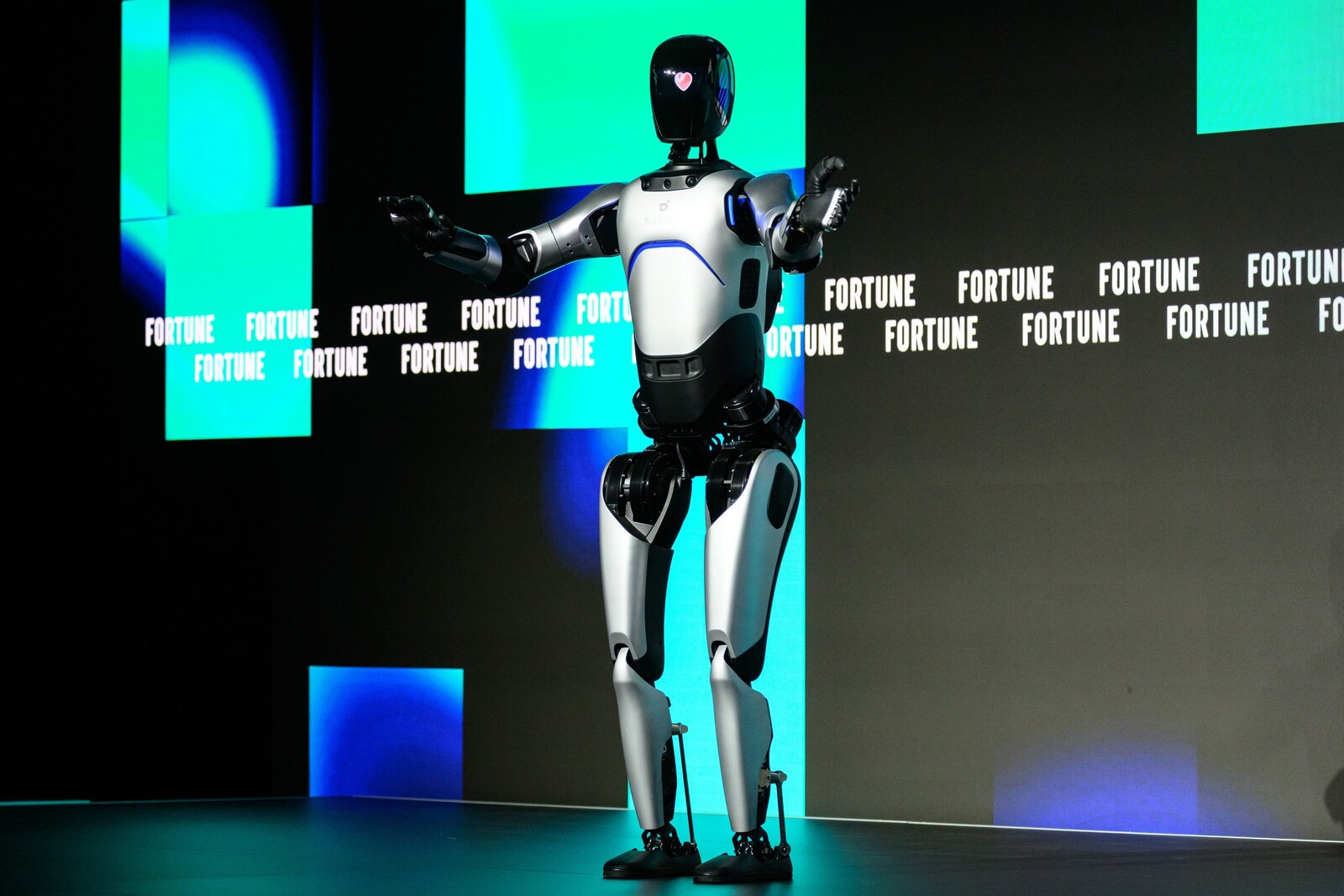
As of 2026-06-22T08:33:51Z UTC, AgiBot World 2026 is the clearest recent AI-China reminder that embodied AI is not won by a humanoid walking across a stage. The harder contest is whether a company can turn physical experience into reusable training infrastructure: robot trajectories, imperfect contacts, teleoperation, annotation, model-ready formats, and feedback from real deployments.
AGIBOT's June 3, 2026 release describes "Theme 2: Rich Interaction" as a 100% real-world dataset built to capture contact-rich interaction between robots and physical objects, including not only successful demonstrations but missed grasps, collisions, object drops, unstable contacts, and liquid splashes.[1] That phrasing matters. In language-model work, messy text data can often be filtered or regenerated. In robotics, the mess is the lesson. A robot that never sees the cup slip, the drawer jam, the cable snag, or the grip fail has not learned enough about the world it is supposed to enter.
The field signal is therefore not "China has another robot dataset." It is that a Chinese embodied-AI company is treating data collection as a production system. The public Hugging Face surface for AgiBot World 2026 labels the dataset for robotics, image, and text modalities, tags it around imitation learning, embodied AI, real-world scenes, and dual-arm work, and publishes it under a CC BY-NC-SA 4.0 license.[2] The project site and GitHub trail connect the 2026 dataset to a larger AgiBot World Colosseo platform, foundation models, benchmarks, and task catalogs rather than a one-off file dump.[3][5]
The useful data is not the cleanest data
The important move in Theme 2 is the explicit rejection of perfect-demonstration bias. Traditional robot-learning datasets often overrepresent successful task execution: pick up the object, open the drawer, place the item, repeat. That is useful for imitation, but it leaves out the physics that make deployment expensive. Real spaces contain flexible materials, reflective surfaces, wet objects, occluded handles, changing light, sloped floors, warped packaging, crowded tabletops, and human interruptions.
AGIBOT says Rich Interaction uses exploratory teleoperation so operators intentionally guide robots through varied objects, materials, geometries, mechanical structures, and functional properties.[1] The notable detail is not merely teleoperation. It is the decision to preserve contact events that conventional datasets might treat as noise. Missed grasps and drops can teach affordance boundaries. Collisions can teach geometry and force limits. Liquid splashes and unstable contacts can teach that some actions have delayed consequences. For world models and neural simulators, those negative and near-failure examples are not embarrassing residue; they are the part of the distribution that lets a policy stop pretending the world is a benchmark table.
That is why the phrase "robot data factory" is more accurate than "model release." The earlier AgiBot World Colosseo paper describes a large-scale manipulation platform spanning data, models, benchmarks, and ecosystem resources, with more than 1 million trajectories from 100 real robots and over 100 real-world scenarios in the broader beta corpus.[4] The current 2026 page is narrower in visible preview, but it points in the same direction: the asset is the collection loop, not only the downloadable rows.[2][5]
The China angle is vertical integration
Many AI-China posts focus on model families: Qwen, DeepSeek, Kimi, ERNIE, GLM, Hunyuan. AgiBot's signal is different because the model cannot be separated from the machine. A robot learning stack needs sensors, hands, arms, locomotion, teleoperation rigs, safety procedures, human demonstrators, task design, annotation, simulation, and deployment customers. The public release only exposes part of that stack, but it makes the dependency chain visible.
AGIBOT's own company description frames the firm as developing both an intelligence layer and the robotic embodiments needed to bring general intelligence into the physical world, with locomotion, interaction, and manipulation intelligence integrated into one embodied system.[1] The PRNewswire event release adds a commercial frame: the company talked about a data collection center, imitation learning, real-world reinforcement learning on production lines, world-model simulation, and targeted deployment scenarios such as exhibition guiding, manufacturing, logistics sorting, security inspection, commercial cleaning, data-collection training, and research education.[6]
Those claims are company claims and should be read as positioning, not audited market proof. Still, the structure is strategically important. If a company controls robot hardware, data collection, model training, and deployment sites, it can gather the kind of distributional feedback a lab-only project cannot. In embodied AI, every failed attempt in a warehouse, lobby, classroom, or factory can become training signal if the instrumentation is good enough and the privacy, safety, and annotation rules are clear.
This is one reason China is a serious arena for embodied AI even when individual robots remain awkward. The industrial base gives companies more chances to connect prototype hardware to real service or manufacturing settings. The open dataset gives outside researchers a window into that process. The moat, if one forms, will not be a single humanoid spec sheet. It will be a cycle: deploy robots, collect failures, label contact, retrain policies, test in new physical scenes, and repeat.
What builders should watch
The first watch item is data shape. A useful embodied-AI dataset needs more than video clips. It needs synchronized observations, action traces, robot state, task intent, object context, and metadata that make failures interpretable. The Hugging Face page's preview shows structured parquet records and hosted file paths, but the public viewer is limited, so teams should evaluate download structure, completeness, and reproducibility before treating the dataset as plug-and-play.[2]
The second watch item is benchmark honesty. AgiBot World Colosseo presents foundation models, benchmarks, and platform tooling together.[3][4] That is promising because robotics needs shared tasks and scoring. It is also a risk because platform owners can accidentally optimize for the tasks they collected best. The most useful external work will test whether policies trained on AgiBot-style data transfer to unfamiliar robots, different grippers, new object sets, and less curated rooms.
The third watch item is licensing and commercialization. The Hugging Face dataset page lists CC BY-NC-SA 4.0.[2] That is open enough for research, but it is not the same as unrestricted commercial reuse. For startups or industrial teams, the practical question is not just "can I download it?" It is "can I train on it, combine it with my private data, deploy a derivative model, and explain that chain to customers and lawyers?"
The fourth watch item is failure governance. Rich interaction data is valuable because it includes collisions, drops, unstable contacts, and other edge cases.[1] In production, those same categories are safety events. The best embodied-AI teams will not merely collect failure; they will classify severity, preserve sensor context, separate recoverable mistakes from unacceptable hazards, and enforce human confirmation where the downside is too high.
The counterweight: real-world data can still overfit
It is tempting to treat "100% real-world" as a cure-all. It is not. Real-world data can be narrow, biased, repetitive, or overfitted to a company's own robots and collection sites. A dataset captured with one hardware family may not transfer cleanly to another hand, wrist, camera placement, actuator delay, or control stack. A contact-rich task in a controlled data factory may still be simpler than a crowded restaurant kitchen, eldercare room, or live production line.
That is the falsifier for this field signal. If AgiBot World 2026 becomes mostly a branded dataset that downstream teams admire but cannot reproduce, extend, or use across hardware, then it will be a marketing asset with research value. If it becomes a baseline others can test against, criticize, fork into new tasks, and compare with their own robot logs, then it becomes infrastructure.
For now, the useful reading is disciplined optimism. AgiBot World 2026 does not prove that humanoids are ready for general-purpose work. It does prove that China's embodied-AI race is moving into the unglamorous layer where progress is more likely to compound: data collection procedures, failure capture, task catalogs, model formats, evaluation surfaces, and deployment feedback. The robot on stage gets attention. The dataset of how robots fail is where the next step is likely to be trained.
Sources
- AGIBOT, "AGIBOT Releases Open-Source Dataset AGIBOT WORLD 2026 Theme 2" (June 3, 2026; Rich Interaction release, real-world data framing, failure-event categories, and company context).
- agibot-world/AgiBotWorld2026 on Hugging Face (dataset card, modality tags, license, preview rows, and hosted dataset surface).
- OpenDriveLab,
AgiBot-WorldGitHub repository (Colosseo platform, GO-1 model, task catalog, dataset and benchmark ecosystem links). - Jiaqi Chen et al., "AgiBot World Colosseo: A Large-scale Manipulation Platform for Scalable and Intelligent Embodied Systems," arXiv:2503.06669v4 (platform paper, robot/data scale, model and benchmark framing).
- AGIBOT WORLD official project page (2026 dataset portal and project-level presentation for the embodied-intelligence dataset initiative).
- AGIBOT via PR Newswire, "AGIBOT Makes Debut at Fortune Event with Full-Size Humanoid Robot AGIBOT A2 as Special Guest" (December 2, 2025; source for the real photographic cover image and deployment/data-collection positioning).