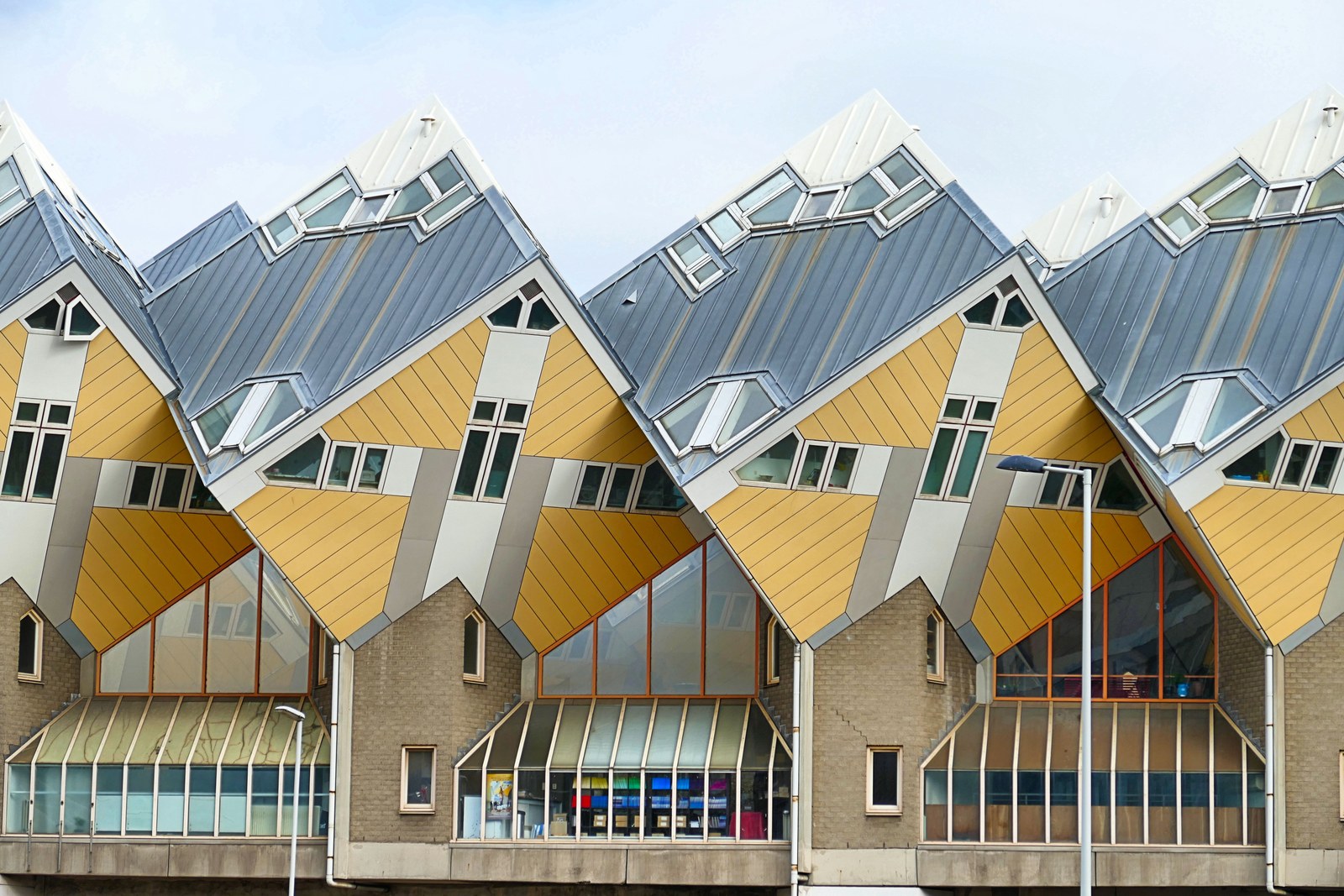
Coming out of Rotterdam Blaak station, you can see the yellow Cube Houses well enough to take the familiar photograph. What the picture tends to lose is the street. Head up to Overblaak and follow the pedestrian crossing toward the Oude Haven, the old harbour. Partway across, let someone headed for the harbour pass you. For that walker, the building you came to see is a shortcut. For someone upstairs, this stretch of bridge is the way to their front door. [1][2]
Piet Blom raised the houses on columns and tipped each cube onto a corner. From the side, you can follow one yellow face down to its point. From beneath, several houses run together overhead. Here the local name Blaakse Bos, the Blaak Forest, makes sense. Stand off the walking line between two columns and look up through the gap. Blom’s trees do something rather generous for a busy road crossing. The crowns belong to the households above, while anyone on foot can walk among the trunks. The crossing costs nothing. [1][3][4]
The door at number 70
Ed de Graaf had an unusually good reason to open his home to strangers. Before buying here, he visited Blom’s earlier cubes in Helmond. People with cameras were ringing residents’ bells to ask for a look inside. De Graaf told the Rotterdam paper De Havenloods that he took a proposal for a show house to the city. Both the city and the residents liked it. That history supplies the simplest piece of etiquette on Overblaak today. Save your curiosity for the door marked Kijk-Kubus, at number 70. The neighbouring doorbells still belong to people who live here. [2][4]
For a visit that takes in the crossing and the furnished house, aim for late morning, around 11:30. Allow half an hour of your own time for the interior. The standard adult ticket is €3.50, payable on site by cash or card. A visitor guide checked the price in November 2026. The museum also lists €2.50 for students and visitors aged 65 or older. If you are bringing a group or need a particular entry time, contact the house directly before setting out. Three floors and steep stairs make this a visit to plan around the least comfortable climber in your party. The walkway gives anyone skipping the interior a place to enjoy the buildings together first. [1][4]
Where would you put the fridge?
Inside the show house, start with an ordinary piece of furniture and follow its edge toward the wall. The floor gives a chair a level footing. The wall behind it slopes, so the space available at shoulder height can be quite different from the space at your feet. De Graaf’s museum uses furniture made to fit. A more revealing question than whether your sofa would go through the door is where, after you sat down, you could stand back up. [4]
Another household gave Dutch broadcaster BinnensteBuiten a particularly good answer to the kitchen problem. Darcy and Bart had one straight wall to work with in their kitchen. They stacked the refrigerator, freezer and dishwasher there. In the bedroom they kept things underneath a raised bed. These are details from their private home. Carry them back onto the bridge when you leave number 70. From below you can take in a whole row of yellow cubes at a glance, yet somewhere behind a slant like that one, a couple had to decide where the dishwasher would go. [6]
Sources
- Tourist in Rotterdam, visitor guide to the Overblaak walkway and Kijk-Kubus, checked November 2026.
- Jaap Deijbel, interview with show-house founder Ed de Graaf, De Havenloods.
- Heijmans, a project history of the Cube Houses and their local name.
- Kijk-Kubus Museumwoning, official visitor information, address and admission.
- Jan Geerling, photograph of the Rotterdam Cube Houses, Wikimedia Commons, CC BY-SA 4.0, resized.
- BinnensteBuiten, a visit with Darcy and Bart inside their Rotterdam cube house.