A radio receiver supplies a computer with audio; WSJT-X turns that audio into callsigns, locations and signal reports. This open-source program supports several ways of communicating through weak signals, including the widely used FT8 mode.[1] Its engineering becomes easier to understand when you follow one message outward: first restrict what it can say, then protect those bits, then give the receiver a recognizable pattern in time and frequency. Each stage makes the next one's job more manageable.
Make the message small by knowing its job
An ordinary radio contact needs surprisingly little information: who is calling whom, where a station is, whether its signal arrived, and whether the exchange is complete. FT8's message formats give those pieces dedicated places. The project's 77bit.txt describes a 77-bit payload with fields whose meanings depend on a message-type indicator. A standard format accommodates two callsigns, an acknowledgment flag, and a location or report.[3]
This is compression built around a shared vocabulary. The receiver already knows the field rules, so a sender need not spell out the surrounding explanation. A location field does not have to announce that it contains a location. Callsign encoding similarly takes advantage of the permitted structure of ordinary amateur callsigns.[3]
The boundary is visible in the same document: arbitrary free text is limited to 13 characters, while special formats handle such things as contest exchanges and nonstandard callsigns.[3] A successful contact is the intended product. A long conversation asks the format to do a different job.
Spend the saved space on surviving errors
Compression makes the payload compact; transmission then deliberately makes it longer. In encode174_91.f90, the encoder appends a 14-bit cyclic redundancy check, or CRC, to the 77 message bits. It then calculates 83 parity bits, producing a 174-bit codeword.[4]
Those additions have different purposes. The CRC provides an error-detection check. The low-density parity-check code, or LDPC, supplies relationships among bits that the receiver can use to recover a damaged message. In the implementation, each parity bit is calculated from a particular combination of message-and-CRC bits using a generator matrix. The transmitted result contains both the original information and these calculated checks.[4]
There is no contradiction between removing redundancy from the words and adding redundancy to the transmission. The first operation avoids spending bits on predictable language. The second spends bits on constraints useful to the decoder. Keeping those jobs separate also makes the source unusually readable: message packing decides what is meant; the error-control encoder decides how to protect its representation.
Give the receiver something recognizable to find
The small routine genft8.f90 joins these stages. It calls pack77, checks that the packed message can be unpacked, and invokes the error-control encoder. It then takes the resulting bits three at a time and maps them to eight possible tone indices.[5]
But the transmitted sequence also needs landmarks. The routine inserts the same seven-tone synchronization pattern at the beginning, middle and end. Between those patterns sit two groups of 29 data symbols. That arrangement yields 79 symbols in total, of which 21 help establish synchronization.[5]
The physical result is a transmission lasting about 12.6 seconds and occupying roughly 50 Hz, within a 15-second transmit/receive period.[1][6] The synchronization patterns help the receiver estimate timing and frequency offsets.[6] The user guide separately calls for the computer clock to stay within one second of UTC.[1] The clock puts the receiver in the right neighborhood; the signal's own landmarks help it align the message precisely.
Recover one signal, then listen again
A busy receiver can deliver several overlapping signals in the same audio recording. The protocol's designers describe a decoding process that finds candidate signals, estimates their timing and frequency, and attempts to recover their messages. A successful decode can then help with the rest of the recording.[6]
The software reconstructs the decoded signal, estimates how the radio channel altered it, and subtracts that reconstruction from the received audio. Another pass may reveal a weaker transmission previously obscured by the stronger one.[6] This is a particularly useful consequence of a tightly specified waveform: once the message is known, the program knows what signal to reconstruct. Success on one candidate can improve the evidence available for another. It does not guarantee that every overlap can be untangled.
Let context help without making it proof
WSJT-X also offers a priori decoding: information accumulated during a contact can constrain the next decode. If the operator is already exchanging messages with a particular station, the two callsigns become useful hypotheses. The decoder checks whether the remaining information and parity bits support them.[1]
That assistance slightly increases the false-decode rate. An annotation such as a2 or a3 identifies the prior information used; a question mark flags lower confidence.[1] The displayed text may have benefited from expectations about the exchange. A plausible callsign deserves attention, but plausibility alone does not establish that the message arrived correctly.
The practical appeal survives that qualification. In a firsthand Hackaday account, Dan Maloney described running WSJT-X on a Raspberry Pi 4 with an Icom transceiver and reaching Japan on the 30-meter band. He valued being able to complete brief contacts without a microphone conversation.[7] That report illustrates a use case, rather than promising a particular range for another station.
Read together, the code and that experience explain the attraction. FT8 makes a modest exchange worth pursuing across difficult radio conditions. Its small vocabulary, protective coding and recognizable waveform give the computer a precisely bounded task. The open implementation lets an interested operator trace how a few words earned their place on the screen.
Sources
- WSJT-X, User Guide, version 3.0.1 — introduction, system requirements and §15.1 on a priori decoding and confidence annotations.
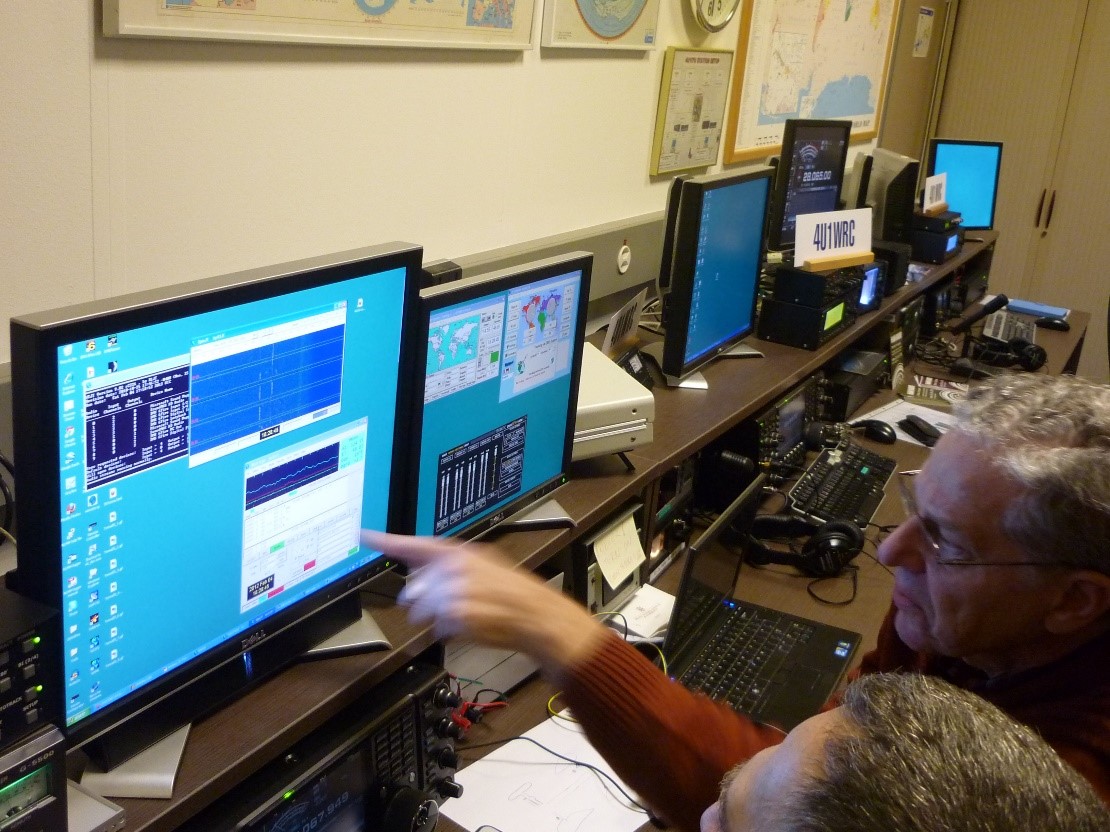
- ITU Pictures, photograph of Joe Taylor overseeing 4U1ITU's first Earth–Moon–Earth contact on 1,296 MHz, uploaded June 9, 2022 — archival photograph, CC BY-NC-SA 2.0.
- WSJT-X, “77bit.txt” — message layouts, callsign fields and free-text limits; source pinned to revision 967c85a61191.
- WSJT-X, “encode174_91.f90” — CRC generation and LDPC parity encoding; source pinned to revision 967c85a61191.
- WSJT-X, “genft8.f90” — message packing, tone mapping and synchronization-pattern placement; source pinned to revision 967c85a61191.
- Steve Franke, Bill Somerville and Joe Taylor, “The FT4 and FT8 Communication Protocols,” QEX, July/August 2020 — waveform timing, synchronization and successive signal subtraction.
- Dan Maloney, “The $50 Ham: Digital Modes With WSJT-X,” Hackaday, February 10, 2021 — independent firsthand account of station setup and operating experience.