Wasmtime gets praised so often as a fast, secure WebAssembly runtime that it is easy to miss what kind of software it actually is. The official introduction calls it a standalone runtime for WebAssembly, WASI, and the Component Model, usable either as a CLI or as a library embedded in a larger application.[1] That description is accurate, but still too flat. Wasmtime is more understandable if you read it as a set of deliberately separate control surfaces. Compilation policy lives in the Engine. live instance state and resource accounting live in the Store. import resolution lives in the Linker. component interfaces sit above raw modules. WASI sits outside all of that as a host-provided access layer rather than a free ambient environment.[1][2][3][4][7][8]
As of 2026-05-04T03:02:37Z UTC, the bytecodealliance/wasmtime repository reports 17,949 stars, 1,687 forks, 858 open issues, and a most recent push timestamp of 2026-05-02T14:43:52Z.[11] The latest stable release is v44.0.1, published on 2026-04-30.[10] Those numbers matter less as popularity markers than as maintenance signals. Wasmtime is still moving as a live runtime core while the surrounding WebAssembly ecosystem keeps widening.
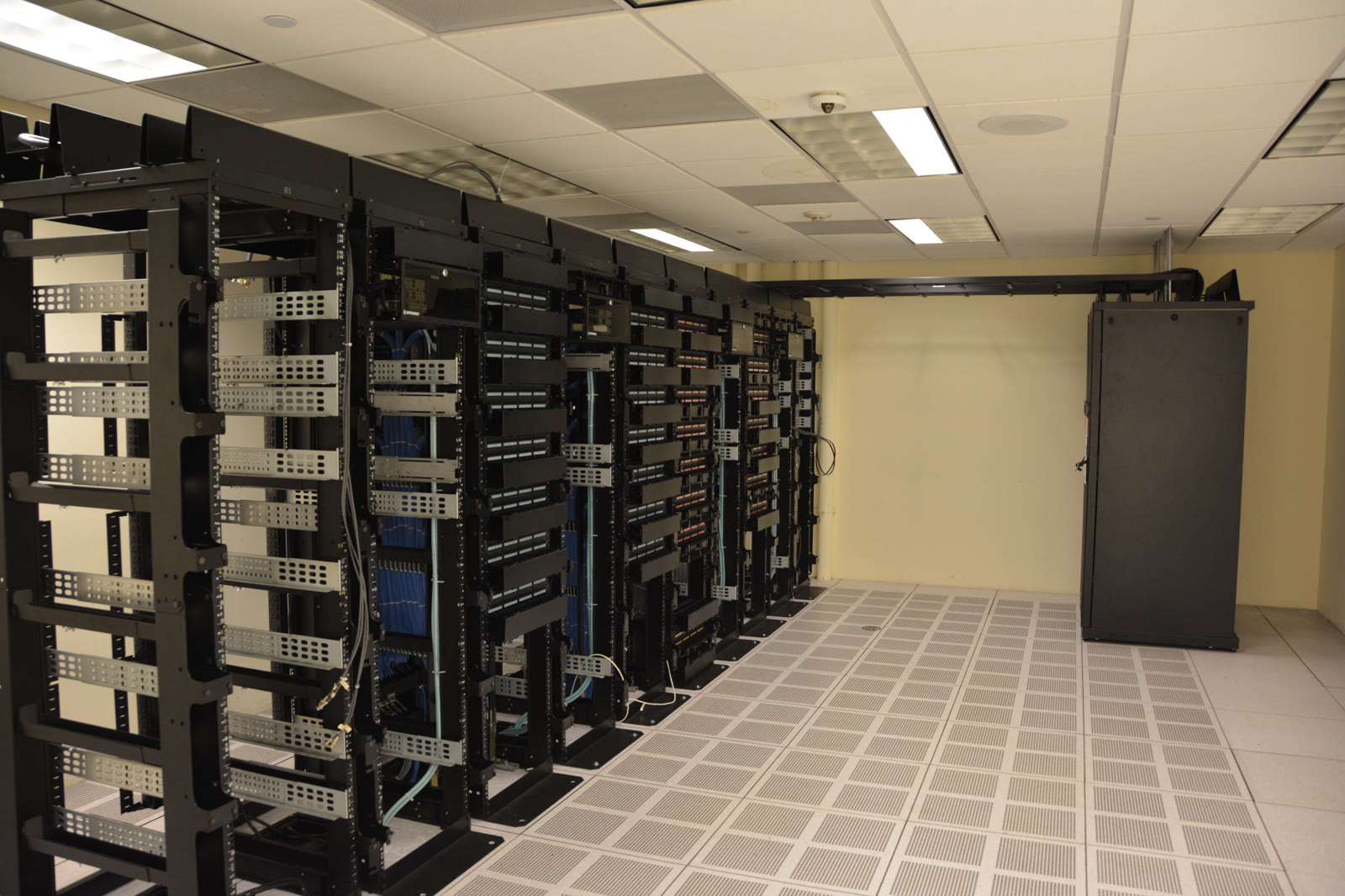
Image context: the cover uses a real datacenter photograph from Wikimedia Commons rather than a browser logo, bytecode diagram, or generated abstraction. That choice fits the article because Wasmtime's value appears where code crosses into host policy: on real machines where imports, filesystems, memory guards, and execution budgets have to be made explicit.[13]
The first boundary is Engine versus Store
Wasmtime's Engine is the long-lived global context. The API docs describe it as the place for compilation and management of wasm modules, with global configuration preferences such as compilation settings stored there; it is safe to share across threads and cheap to clone because the clone is just another handle to the same underlying engine.[2] That is a strong architectural signal. The runtime does not want every instance to reinvent compilation policy.
The Store is the opposite kind of object. Its docs define it as a collection of WebAssembly instances and host-defined state, then immediately warn that it is intended to be short-lived: instances created inside a Store are not deallocated until the Store itself is dropped, so it should correspond roughly to the lifetime of a "main instance" an embedding wants to execute.[3] That one sentence explains a lot about how Wasmtime expects hosts to think. An Engine is the reusable compile-and-policy surface. A Store is the execution-time ownership box.
That division becomes more important once host state enters the picture. The Store<T> type parameter is explicitly there to hold host-defined state, and that state is what imported functions access through Caller and the usual context traits.[3] In other words, Wasmtime does not treat host integration as a global singleton hanging off the runtime. It pushes host state down into per-execution context. If you are embedding untrusted code, that is exactly where you want the boundary to be.
The second boundary is Linker versus everything positional
The Linker is easy to mistake for a convenience wrapper, but its docs show a more important role. Wasmtime describes it as a structure used to link wasm modules and instances together through name-based resolution, avoiding the lower-level positional import dance of Instance::new.[4] It resolves two-level names, disallows duplicates by default unless shadowing is enabled, and can be reused across multiple Stores so long as you stick to compatible host-defined functions and stay inside the same Engine.[4]
That matters because it keeps capability wiring explicit. A module only gets what the host defines and links. The security guide says all interaction with the outside world happens through imports and exports, with no raw system-call access or ambient I/O outside what has been explicitly linked in.[6] Read together with the Linker docs, the point becomes clearer: Wasmtime's sandbox is not just an execution trick. It depends on the host naming the doors and deciding which ones exist.[4][6]
This is also why the Linker is not cross-Engine. The docs say mixing stores or items from a different Engine can panic at runtime.[4] That might look strict, but it preserves a clean rule: one compile/configuration universe, one linker universe. You avoid a whole class of invisible mismatches that way.
The third boundary is raw modules versus components
Wasmtime's component support is where the runtime starts looking less like "just run a .wasm file" and more like an interface-oriented platform core. The component module docs say the embedding API centers on three pieces: a compiled Component, a component-style Linker, and bindgen!, which maps a WIT world into generated Rust types and traits for the embedder.[7] The API docs for Component then make the compilation model explicit: validation and compilation happen synchronously during Component::new, artifacts can be serialized, and no compilation happens at runtime once that call returns.[7]
That is a major architectural choice. Wasmtime is not only validating raw modules. It is also lifting interface description into the runtime boundary. The component-model guide goes further and calls Wasmtime the reference implementation of the Component Model.[9] More practically, it shows that Wasmtime can run command components, serve HTTP-oriented components, and invoke exported component functions, all while still defaulting to deny access to system resources unless the host grants them.[9]
This is the point where many "Wasm platform" discussions get sloppy. The component layer is not a magical replacement for host policy. It is a better format for portable interface composition.[1][7][9] It lets the embedder define a world, wire it through a linker, and expose only the host functions and resources it chooses. That is stronger than raw module imports, but it is still a controlled boundary, not ambient access.
WASI is the resource contract, not proof that the sandbox is open
The wasmtime_wasi crate docs are unusually direct here. They describe the crate as Wasmtime's host implementation of different versions of WASI, built primarily with tokio and cap-std, with WasiCtx providing per-Store state and WasiCtxBuilder constructing that state.[8] That wording is important. WASI is not built into WebAssembly itself. It is a host implementation layer.
The component-model guide makes the same point from the CLI side: by default, Wasmtime denies a component access to all system resources, including the filesystem and environment variables, unless you grant that access explicitly.[9] That sentence is the cleanest antidote to the usual sandbox confusion. Wasmtime can be secure by default precisely because capability exposure is not implicit. The runtime executes inside a sandbox; WASI is how the host decides which parts of the outside world can be reached, and under what interface contract.[6][8][9]
This is where the architecture still needs host judgment. A careless WasiCtx and a generous linker can make a "sandboxed" guest much less boxed in than the marketing suggests. Wasmtime gives you the runtime structure to stay disciplined, but it cannot choose your least-privilege policy for you.
Performance policy is explicit because safety policy is explicit
Wasmtime's Config API is enormous, and that is not accidental. The docs describe it as the global configuration surface used to create an Engine and customize behavior, including compilation enablement, target ISA selection, fuel consumption, epoch interruption, memory reservation, copy-on-write memory initialization, and Component Model feature flags.[5] A runtime that wants to be embedded in many different environments cannot hide these choices forever.
The fast-execution guide shows what that explicitness buys. It says Wasmtime uses Cranelift as its optimizing compiler, recommends signals-based traps and large memory reservations to elide explicit bounds checks, and allows cross-compiling hosts to force-enable ISA extensions when precompiling for another machine.[12] That is not a generic "fast runtime" pitch. It is a disclosure that performance comes from concrete policy knobs attached to the Engine, not from a universal black box.[5][12]
The same is true for execution budgeting. Store exposes fuel and epoch-deadline controls, while the docs explain that fuel must be enabled through Config::consume_fuel, that most wasm instructions consume one unit, and that epoch-based interruption can be used for cooperative timeslicing under an async executor.[3] Those mechanisms matter because Wasmtime is designed for hosts that may need to meter or interrupt guest work without throwing away the rest of the embedding model.[3][5]
The sandbox is real, but it is still a host-managed system
Wasmtime's security guide is strong on first principles. WebAssembly's call stack is inaccessible to guests, linear-memory accesses stay in bounds, control transfers stay typed and structured, and interaction with the outside world must go through explicit imports and exports.[6] Wasmtime then adds defense-in-depth measures such as a default 2GB guard region before linear memories to mitigate certain sign-extension bugs.[6] That is a serious security posture.
But the same document also makes the architectural limit plain: different sandboxing strategies come with different tradeoffs in performance and feature support, and Wasmtime intends to offer users choices.[6] That means the runtime is not a one-click security product. It is a host-embedded execution core with a disciplined set of seams. If you keep those seams visible, Wasmtime is unusually legible. If you paper over them with "it runs wasm safely," you lose the main engineering value.
That is why Wasmtime matters as an oss architecture story in 2026. The project is not merely a fast runtime. It is a runtime that keeps its responsibilities separated in ways embedders can reason about: Engine for compile policy, Store for execution ownership and limits, Linker for import resolution, components for typed interface composition, and WASI for explicit host-resource exposure.[1][2][3][4][7][8][9] The sandbox is real. The host policy still decides what the sandbox can touch.
Sources
- Wasmtime documentation, "Introduction" - project definition as a standalone runtime for WebAssembly, WASI, and the Component Model, plus fast/secure/configurable/standards-compliant positioning.
- Wasmtime Rust API docs,
Engine- global compilation/management context, thread-safe sharing, cheap cloning, and precompilation surfaces. - Wasmtime Rust API docs,
Store- short-lived instance ownership, host-definedStore<T>state, resource limits, fuel accounting, and epoch-based interruption. - Wasmtime Rust API docs,
Linker- name-based import resolution, shadowing policy, multi-store reuse boundaries, and single-engine constraint. - Wasmtime Rust API docs,
Config- engine-wide configuration for compilation, target ISA, resource metering, memory behavior, and Component Model feature gates. - Wasmtime documentation, "Security" - sandbox model, import/export-only host interaction, memory isolation guarantees, and defense-in-depth memory guards.
- Wasmtime Rust API docs,
wasmtime::component- embedding API for the Component Model,bindgen!, WIT worlds, and typed component instantiation. - Wasmtime Rust API docs,
wasmtime_wasi- host implementation of WASI,WasiCtx,WasiCtxBuilder, and per-store resource state. - The WebAssembly Component Model guide, "Wasmtime" - Wasmtime as the reference implementation of the Component Model and the default-deny resource stance for running components.
- GitHub releases for
bytecodealliance/wasmtime- latest stable releasev44.0.1, published on 2026-04-30. - GitHub API snapshot for
bytecodealliance/wasmtime- repository stars, forks, open issues, and recent push activity at article creation time. - Wasmtime documentation, "Fast Execution" - Cranelift strategy, signals-based traps, memory reservation, memory guard sizing, and ISA tuning for precompiled artifacts.
- Wikimedia Commons, "File:Datacenter Server Racks (22370909788).jpg" - source page for the real datacenter photograph used as the article image.
- DevClass, "Wasmtime 1.0 released: WebAssembly outside the browser, but is it really production-ready?" - independent framing of Wasmtime's out-of-browser runtime role, portability claims, and early production positioning.