A paper pattern preserves a shape. Valentina can also preserve the reasoning that produced it: the measurements, allowances and construction rules that place its points and curves. This open-source clothing-pattern software becomes interesting when a useful design must be drawn again for another body. Change the inputs, and the geometry can rebuild according to the rules its maker supplied.[1]
The distinction has a place on an actual cutting table. In a January 2021 interview with Libre Arts, Luca Lavore described using Valentina in the family tailor shop where he worked with his father, Giuseppe, in Sicily's Palermo district. He had discovered it in late 2018 through a course. His attraction was practical: parametric drafting offered a way to bring computer-assisted pattern work into a small business whose existing methods still consumed considerable time.[2]
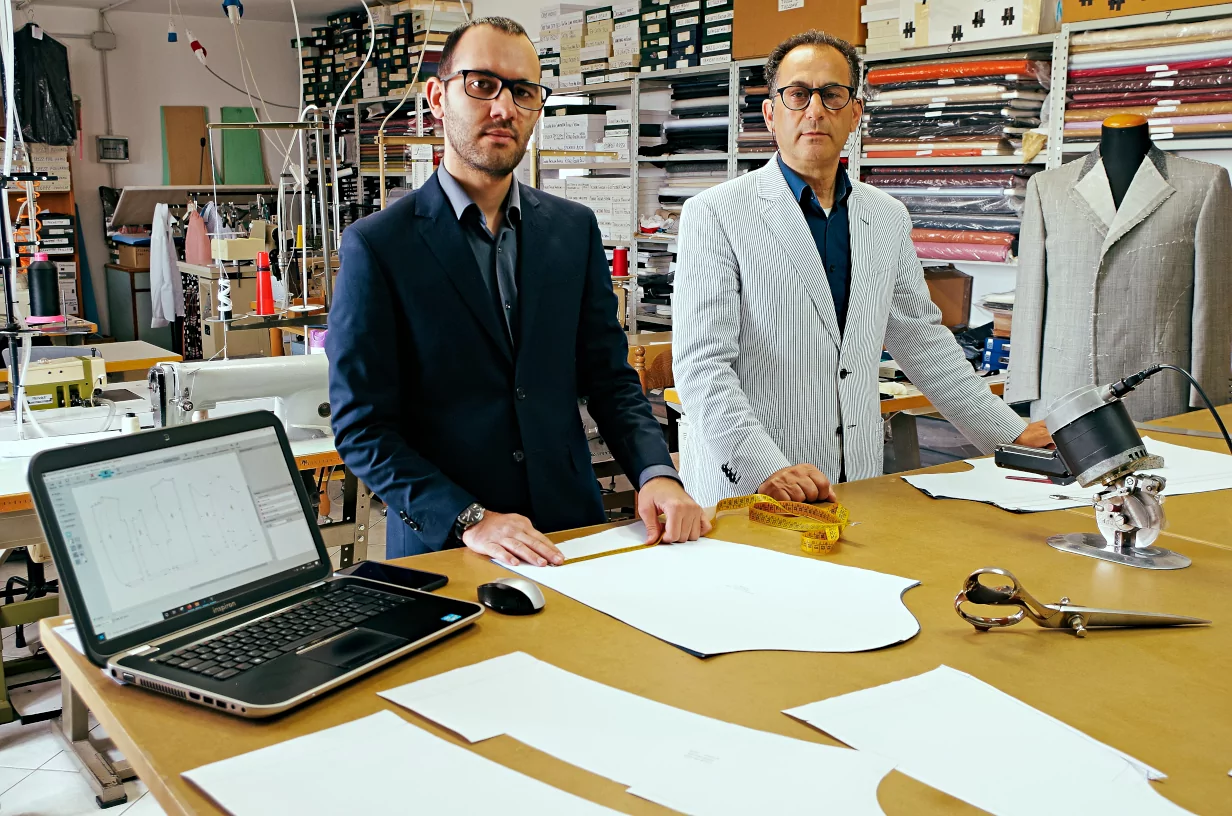
A line can remember why it is that long
Valentina runs on Windows, macOS and Linux. Its central idea is a parametric pattern: measurements and adjustable increments feed formulas that govern the construction. A change can therefore travel through related objects instead of requiring the maker to reposition every affected point separately.[1]
Consider a deliberately simplified example, not a garment-drafting prescription. Suppose one horizontal construction distance is defined as a quarter of a circumference plus a fixed 2-centimeter increment. With a circumference of 88 centimeters, that distance is 24 centimeters; at 96 centimeters, it becomes 26. The increment stays at 2 because that is what the rule says. Enlarging the whole original drawing proportionally would change it too.
That little calculation exposes the attraction and the responsibility. The pattern maker decides which dimensions follow the body, which stay fixed and which need a different relationship. Recalculation faithfully carries those decisions forward. It cannot establish whether they were good decisions for a particular wearer or fabric.
The project does not prescribe one drafting method; its FAQ explicitly allows users to bring their own.[5] That freedom makes existing craft knowledge useful inside the software. It also means a beginner needs something more than familiarity with drawing applications: a method to encode, and a way to judge the resulting garment.
Three applications, one route to the cutting table
The package divides the work among Tape, for measurements; Valentina, for pattern construction; and Puzzle, for manual layouts. The developer's introductory guide also separates the main application's workflow into drawing, details and layout. These are useful distinctions when first approaching a screen full of construction lines.[3]
A construction drawing is not yet a printable pattern piece. The guide has the user select a piece's main contour with the Workpiece tool before continuing in Details mode. Layout then arranges the resulting pieces for output. The area used to arrange them is distinct from the sheets used by a printer: a large layout can subsequently be divided into A4 tiles.[3]
For a first exercise, that suggests a manageable goal: take one familiar, simple piece through the complete route. Check the measurements, construct it, define its contour, arrange it and inspect the printed result. Keep a known physical dimension available to check print scale. A successful drawing is only one part of a successful handoff to paper.
The software has also become more explicit about the relationships behind the drawing. Version 1.1.0, released on June 27, 2026, introduced a Dependency Tree panel and renaming that updates formula references. It also consolidated measurement attachment under Load Measurements, with a choice between individual and multisize data.[4] These are worthwhile improvements for a project whose value depends on keeping construction logic understandable after the first draft.
An outline does not contain the whole recipe
Someone with years of patterns in another CAD application might reasonably expect to import a DXF and continue. Valentina's FAQ says it cannot import DXF patterns: the vector data lacks information required by its pattern format.[5]
The limitation follows from the distinction above. An outline can show where a curve ended up without explaining which measurement or formula should move it next. Recreating those relationships is substantive pattern work. My reading is that Valentina is most compelling when the reusable construction itself is valuable enough to justify that effort.
Lavore's account offers a useful check on inflated expectations. In 2021 he described exchanging patterns with a factory, but did not recommend wholesale replacement of established factory CAD/CAM systems. He also contributed Italian translation and regular feedback to Valentina's developer.[2] This is a picture of a craft tool finding a place in production, with experienced users helping shape it. It is not evidence that every export preserves every downstream requirement.
Version choice matters to that handoff as well. The 1.1.0 release notes warn that curve-name conversion can require manual corrections, and that files saved by 1.1.x cannot be opened by 1.0.x. They advise keeping originals and coordinating upgrades across a team.[4] A costume workshop sharing patterns across several laptops should settle that question before anyone saves the shared master in a newer format.
Getting a usable copy, then making a useful test
As checked on November 2, 2026, the official download page lists 1.0.5 as stable and 1.1.1 as edge. It identifies Valentina as GPLv3+ software, offers previous releases free of charge and places current official binary downloads within its subscription offering.[6]
The subscription page makes the distinction concrete. The free route includes source code, historical releases and community support; users can compile the code themselves. Basic adds current binaries, developer support and manual access.[7] For someone evaluating the project, access to the code and access to a convenient supported installation are separate practical considerations. The choice should reflect the version needed and the help available locally.
For an individual maker or a small teaching or costume team, I would start with a proven pattern and two measurement sets. Change one input at a time, explain the movement it causes, and follow each version through printing and a test garment. Someone should own the drafting rules; someone should check the output. In a one-person workshop those are two passes through the same work.
The useful result is a construction the maker can explain and repeat. Valentina can keep the measurements connected to the pattern while the tailor concentrates on what the cloth and the wearer reveal. The next fitting then has something precise to revise.
Sources
- Smart pattern, “About Valentina project” — project purpose, supported platforms and measurement-driven pattern construction.
- Aleksandr Prokudin, “Revolutionizing garment-making with Valentina,” Libre Arts, January 29, 2021 — workshop interview and photograph.
- Roman Telezhynskyi, “Valentina 0.7: Quick guide,” 2022 preview, “What is Valentina?” and chapters 2–4 — the three applications, creation of a workpiece and layout versus printing formats.
- Smart pattern, “Valentina 1.1.0 Is Here,” June 27, 2026 — Dependency Tree, formula-aware renaming, measurement loading and file-conversion limits.
- Smart pattern, “Frequently Asked Questions,” Valentina section — freedom to use different drafting methods and the absence of DXF pattern import.
- Smart pattern, “Download Valentina program,” checked November 2, 2026 — GPLv3+ designation, stable and edge versions, and access to current versus previous builds.
- Smart pattern, “Subscription,” checked November 2, 2026 — source access, historical releases, compilation and support included in the available plans.