A square is a modest beginning for a piece of embroidery. Ask a program to draw it again at a different angle, however, and a pattern starts to emerge. TurtleStitch makes that experiment accessible in a browser: connect programming blocks, watch a turtle trace their instructions, then export a design for an embroidery machine. Built on Snap!, it gives a maker a way to work with the rule that produces a pattern.[1]
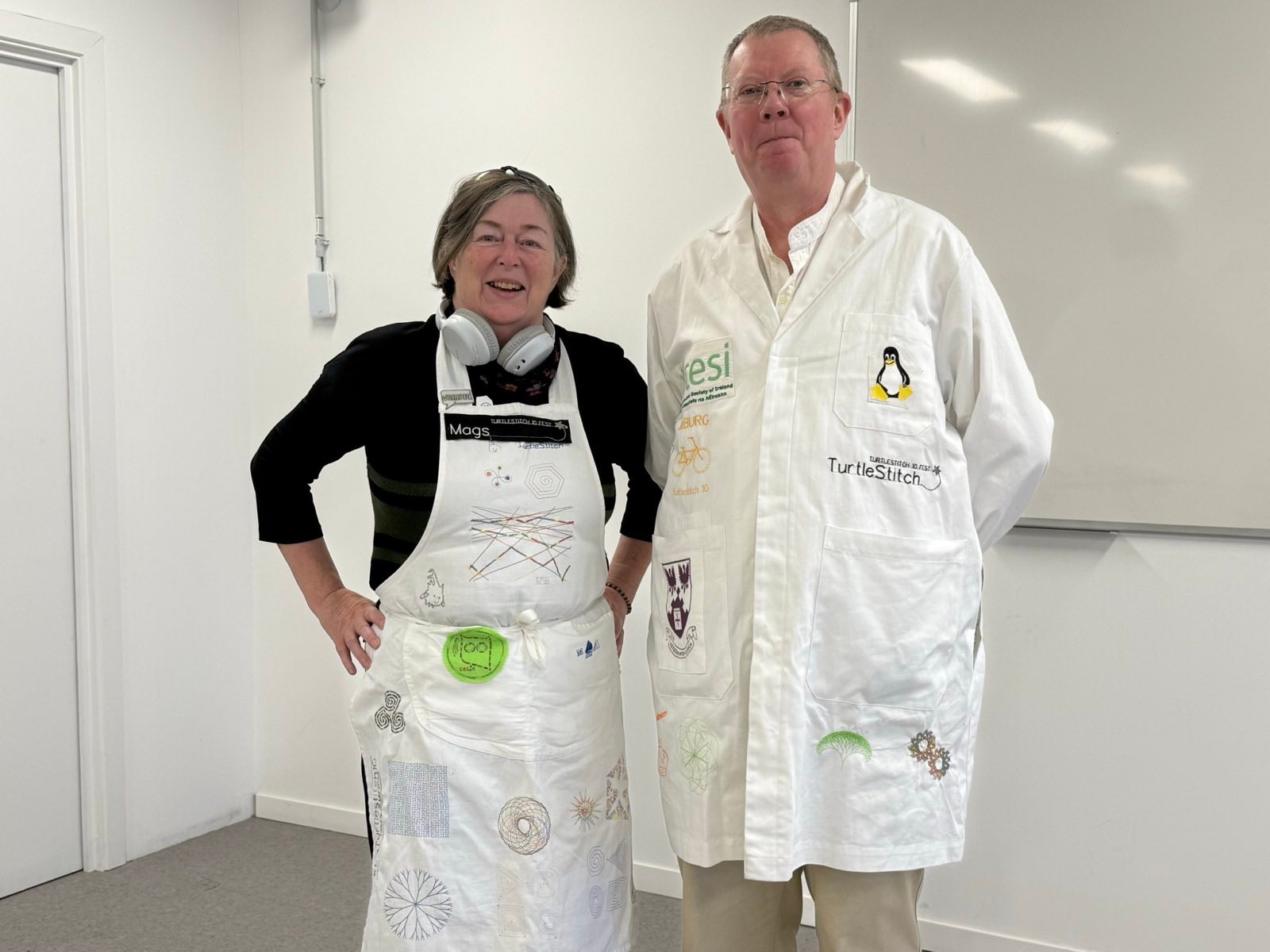
The clothes in TOG Hackerspace's workshop announcement show where that rule can end up. Mags Amond and John Hegarty wear an embroidered apron and lab coat; the designs have left the screen and joined someone's wardrobe. TOG's October 2026 announcement schedules a beginner workshop with CESI for November 21, combining coding with stitching on industrial and domestic machines.[2]
Give the square another instruction
The starting vocabulary is small: move, turn, repeat. Warwick Manufacturing Group's teaching resources build from basic movement to rotated shapes, custom blocks and variables. There is room to make something recognizable before learning much programming terminology.[3]
Consider a simple experiment. Repeat “move 50 steps, turn 90 degrees” four times. The turtle traces a square and returns to its starting position and heading. Now surround that sequence with another repetition: draw the square, turn 30 degrees, and do this twelve times. The result spreads around the shared starting corner. Changing the outer turn changes the relationship between the squares; changing their side length changes their reach.
Those are two different questions, and the program keeps them separate. You can ask what happens when the angle changes while leaving the side alone. A disappointing result is still informative if you know which instruction produced it.
The next useful step is to give the inner sequence a name. A custom block called square, with an input for its side length, turns four movements into a reusable idea. In their Bridges 2025 workshop paper, Joek van Montfort, Richard Millwood and Margaret Low explicitly teach this progression: create a procedure, introduce parameters, then explore recursion.[4] The beginner's square can become a building block for another design without being assembled from scratch each time.
The paper also describes explorations of Hilbert curves, Koch snowflakes and natural forms. These are examples of what participants can investigate, rather than prerequisites for getting started.[4] The invitation is to make a rule small enough to understand and see how far it can take you.
Thread notices where the turtle returns
That rotating-square experiment also exposes a physical question. Every square comes back to the same corner. On screen, repeated visits can look like a tidy meeting point. In cloth, they accumulate thread.
TurtleStitch's FAQ warns that overlapping lines and multiple layers can stress fabric. Its Density Warning and X-Ray View help reveal crowded areas. The same guide recommends a starting stitch length of 8–12 steps, with 10 steps corresponding to approximately 2 millimeters, and asks users to check the design against the embroidery frame.[5]
The practical lesson is to inspect the shared center before committing to a garment. Fewer repetitions or a different arrangement might preserve the visual idea with less congestion. That is a design judgment to test, not an automatic consequence of choosing a particular angle.
Even an empty gap can have a material trace. A jump between separated lines may leave a loose connecting thread that needs trimming or becomes part of the work. The FAQ also cautions that resizing a finished design affects stitch density.[5] Changing the picture's dimensions is therefore a sewing decision as well as a geometric one.
Keep the program available for the next experiment
TurtleStitch's repository identifies the software as AGPL-3.0-or-later and lists Melco EXP and Tajima DST among its exports. Those files are the handoff to compatible embroidery equipment.[6] Machine compatibility still needs checking; the project's FAQ notes that other machines may require format conversion.[5]
There is a separate handoff worth preserving: the editable project. The official offline instructions describe downloading and unpacking the application, opening index.html locally, and saving projects as XML files. Those projects can be loaded again; access to the online project store is unavailable in that local mode.[7]
For a workshop with unreliable internet, this makes a useful rehearsal possible. Put the application and a starter project on each computer beforehand, then check that participants can reopen their own saved work. Someone should also test the export on the actual embroidery machine. A room of successful screen drawings has not yet established that the shared sewing setup accepts their files.
The XML project is where the next question belongs. A participant returning to the rotating squares can change the side input or the outer repetition and run the experiment again, with its construction still visible.
A reason to learn in either direction
Writing in Make: in 2018, Caleb Kraft saw two audiences for TurtleStitch: people whose interest in embroidery might draw them into coding, and programmers whose curiosity might lead them toward textiles.[8] That observation remains a useful reading of the project. Neither group has to begin with the other group's expertise.
Warwick's Stitch in Time project supplies a concrete teaching context. Started during Coventry City of Culture 2021, it connects the city's textile history with modern technology. Its resources include mathematics activities, coding exercises and small objects such as coasters and finger puppets.[3] The object gives an abstract exercise a destination.
For an individual maker or a small class, I would begin with one shape and two deliberately different versions. Ask the maker to predict what will change, run both, and choose one for a sample. An experienced machine operator can help interpret what happens in the cloth. This keeps the first task manageable while giving programming and sewing something useful to say to each other.
The embroidered apron is a pleasing reward. So is being able to point to one small change in the program and explain why the next apron will look different.
Sources
- TurtleStitch, “About Turtlestitch” — browser-based coded embroidery, Snap! foundation and project purpose.
- TOG Hackerspace, “Learn Turtlestitch with our friends CESI,” October 13, 2026 — November workshop announcement and photograph of Mags and John.
- Warwick Manufacturing Group, “Turtlestitch” — basic skills, custom blocks, variables, Stitch in Time and classroom projects.
- Joek van Montfort, Richard Millwood and Margaret Low, “TurtleStitch: Exploring Shapes and Curves with Coded Embroidery,” Bridges 2025, pp. 633–638 — procedures, parameters, recursion and mathematical examples.
- TurtleStitch, “FAQ & Resources,” checked November 17, 2026 — stitch length, density, frame size, jump stitches and machine-format compatibility.
- TurtleStitch source repository, README and license — open-source terms and EXP/DST export support.
- TurtleStitch, “Using TurtleStitch Without an Internet Connection” — local application use, XML project saving and the offline cloud-access boundary.
- Caleb Kraft, “Turtle Stitch Goes From Code To Embroidery,” Make:, July 17, 2018 — independent perspective on the project's appeal to embroiderers and programmers.