TigerBeetle is easy to misread if you come to it through the generic database vocabulary of the last decade. The README calls it a financial-transactions database for mission-critical safety and performance, which is accurate, but the interesting part is not the speed claim alone.[1] The project makes more sense once you notice that it keeps refusing the usual “just use a general-purpose database and add ledger logic in application code” pattern. Its docs repeatedly separate TigerBeetle from an OLGP database such as PostgreSQL or MySQL and place it in the data plane, or hot path, while an ordinary database keeps the metadata, names, and slower-moving control-plane state.[2]
That split is the real hook. TigerBeetle is not trying to win by being a better all-purpose record store. It is narrowing the shape of the problem until consistency, retries, and throughput can all be engineered around one kind of workload: high-volume transactional events between accounts.[1][2][8] The cleanest architecture reading is therefore three coupled boundaries: ledger semantics in the data model, idempotent batching in the request protocol, and replica arithmetic in operations.[2][4][7]
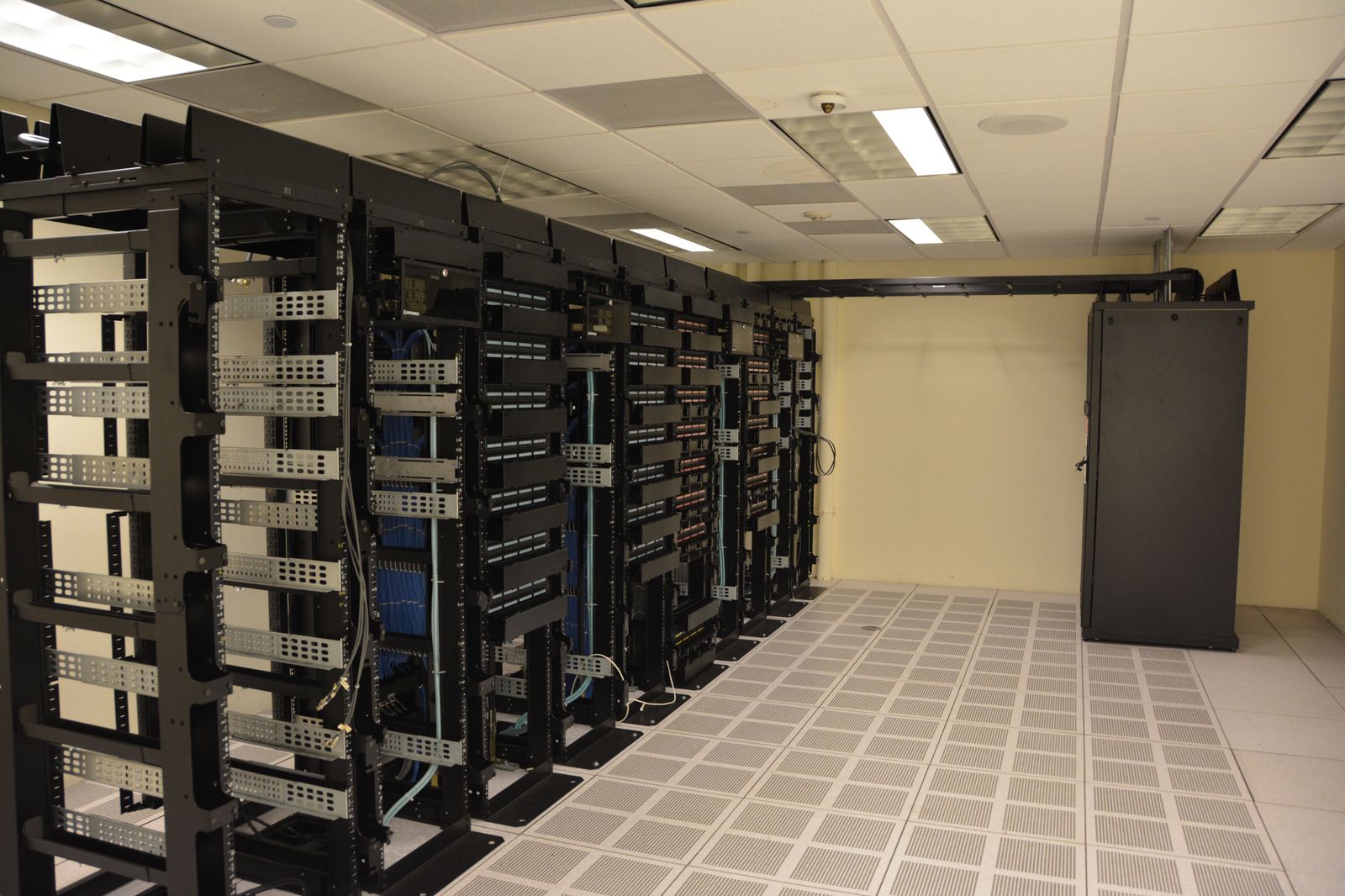
Image context: the cover uses a real data-center aisle rather than a dashboard screenshot or abstract architecture graphic because this piece is about where TigerBeetle's guarantees cash out in practice: replicas, failure domains, and operational discipline on real machines.[9]
The data model is narrow on purpose
The strongest signal in TigerBeetle is what it refuses to store. The system-architecture page says the OLGP side should keep string names, descriptions, and type mappings, while TigerBeetle keeps integer-coded ledgers, accounts, and transfers in the transactional path.[2] That sounds austere until you realize what the trade buys. The database can focus on recording transfers, tracking balances, enforcing balance limits, and preserving financial consistency through double-entry bookkeeping with strict serializability.[2]
The financial-accounting guide makes the wager even clearer. TigerBeetle does not treat debits and credits as decorative finance jargon pasted on top of a normal row store. It treats accounts as a type system: assets, liabilities, equity, income, and expenses carry directional meaning, and balances only make sense from the perspective the ledger has chosen.[3] That matters operationally because the application is no longer free to improvise balance math in five different services. Some of that discipline gets pushed down into the database schema itself.[2][3]
Two-phase transfers show how far the model goes. A pending transfer reserves value in debits_pending and credits_pending; a later event can post, void, or let that reservation expire.[6] In other words, authorization and settlement are not an afterthought layered on top of an undifferentiated transactions table. TigerBeetle gives those stages first-class mechanics. Once you see that, the project stops looking like “Postgres, but faster.” It looks like a database whose write surface has been deliberately compressed so that the financially dangerous parts become explicit.[3][6]
The request protocol turns retries into architecture
The second boundary sits in request handling. TigerBeetle’s requests page defines a request as one or more events of the same type sent in a single message; the cluster commits the whole request at once, applies events in series, and returns one result per event.[4] Later events in the same request can observe the effects of earlier ones, and event timestamps are totally ordered.[4] This is a compact API shape, but it carries a larger design consequence: throughput comes from batching and ordering discipline, not from pretending every transfer is an isolated one-row mutation.
The idempotency story is even more revealing. The docs say Account and Transfer IDs are idempotency keys, and the reliable-submission guide insists that the app or browser, not the API service, should generate and persist the transfer ID before submission.[4][5] That is a hard opinion about where correctness begins. Most teams talk about retries as middleware behavior. TigerBeetle treats retries as part of transaction design. If the request or the response vanishes on the network, the same client-generated ID can be retried; the result will be created once or exists thereafter.[4][5]
That choice simplifies some things and raises the bar on others. It simplifies the server side because the API service does not need to mint its own shadow deduplication scheme for every payment path.[5] It raises the bar because product and client engineers now have to treat durable ID generation as part of the user-facing flow, not as a backend cleanup detail. My read is that this is one of TigerBeetle’s most underrated architectural moves: it relocates exactly-once anxiety from “hope the queue semantics work out” into a narrow, testable contract at the edge.[4][5]
Strict serializability is also an operating model
The third boundary is the cluster itself. TigerBeetle’s operating docs define a cluster as a set of machines running one single-binary server, each on one local data file; that pairing of server plus file is the replica.[7] The cluster elects a primary replica to order and back up transactions across replicas, and the stated goal is strict serializability, high availability, and durability.[7] Those are familiar words in distributed systems. What matters here is that the project gives them very concrete arithmetic.
The recommendation for production is a 6-replica cluster.[7] The docs spell out the consequences: 4 of 6 replicas are needed to elect a new primary if the old primary fails; availability survives different failure patterns depending on whether the primary is still alive; and the system is designed to remain unavailable rather than continue unsafely after too much loss.[7] That last part matters. Plenty of software says “high availability” in a way that quietly hides the risk budget. TigerBeetle describes the budget directly and chooses safe unavailability over ambiguous correctness.[7]
The site guidance on geography sharpens the point further: for mission-critical availability, 3 sites with 2 replicas each are the optimal layout because one whole-site failure still leaves enough structure to continue operating safely.[7] Put differently, strict serializability is not just a consistency adjective attached to an API. It is a deployment commitment. If a team wants TigerBeetle’s semantics, it also has to accept replica count, placement, and failure handling as part of the product, not as infrastructure trivia.[7][8]
What kind of team should care
TigerBeetle is most compelling when transactions are numerous, write-heavy, and concentrated around hot accounts: payments, wallet movements, usage billing, marketplace settlement, treasury-style internal ledgers, or any system where “we will reconcile later” has already become a chronic operational tax.[1][2] In those settings, the project’s narrowness is a feature. The data model keeps the financial path disciplined, the request protocol makes retries explicit, and the cluster model states the cost of strong guarantees without euphemism.[2][4][7]
The boundary conditions are equally important. The docs are candid that TigerBeetle should sit beside, not replace, an OLGP database.[2] Metadata, human-readable labels, and wider application state still belong elsewhere.[2] The request model also works best when teams are willing to batch at the API layer and generate durable IDs in client software.[4][5] And the operational thesis really does assume that 6 replicas and site planning are reasonable costs for the business being served.[7]
That is why the strongest summary of TigerBeetle in 2026 is narrower than “a very fast database.” It is a ledger-shaped transaction engine whose architecture only fully clicks when three constraints are read together: the schema encodes accounting discipline, the submission protocol encodes retry discipline, and the cluster topology encodes correctness discipline.[2][3][4][5][7] Once those layers are visible, the project’s real product is not raw speed. It is a refusal to let critical transaction semantics leak into ad hoc glue code.
Sources
- TigerBeetle README - project overview, positioning as a financial-transactions database, and links to the design talk that frames its performance and safety goals.
- TigerBeetle docs, "System Architecture" - OLTP vs. OLGP split, data-plane placement, and the division of responsibilities between the app, API service, general-purpose database, and TigerBeetle.
- TigerBeetle docs, "Financial Accounting" - debits, credits, double-entry bookkeeping, and the account-type framing that shapes how balances are modeled.
- TigerBeetle docs, "Requests" - request composition, event ordering, batching, and create-event idempotency semantics.
- TigerBeetle docs, "Reliable Transaction Submission" - client-generated IDs, local persistence before submission, and safe retry behavior under network failure.
- TigerBeetle docs, "Two-Phase Transfers" - pending reservations plus post, void, and expiry resolution paths for staged fund movement.
- TigerBeetle docs, "Cluster Recommendations" - replica definition, primary election, 6-replica production guidance, and 3-site placement logic.
- InfoQ, "Redesigning OLTP for a New Order of Magnitude" - independent conference coverage of TigerBeetle's local storage-engine and consensus-design argument.
- Wikimedia Commons, "Datacenter Server Racks (22370909788).jpg" - source image used for the article cover.