Thunderbird's most consequential maintenance signal is not a release number. It is that a free desktop mail client now converts hundreds of thousands of small gifts into full-time protocol, release, mobile, infrastructure, and support work—and does so through a written division of power rather than a single corporate product chain.
That arrangement has real engineering consequences. An elected Thunderbird Council stewards the project and its roadmap; MZLA Technologies, a wholly owned Mozilla Foundation subsidiary, employs the staff and carries the legal and fiscal responsibilities. Neither body can simply treat the other as an advisory mailing list. Their term sheet specifies approvals, review intervals, spending-change thresholds, and even a separation path.[2][3] Thunderbird has made funding an operational interface.
The signal is strong, but it is not the comforting claim that community money makes governance friction disappear. The donor base reduces dependence on one commercial sponsor. MZLA supplies payroll and execution. The Council supplies community legitimacy and strategic oversight. Those strengths meet at an awkward boundary: the same donations that rescued the core client also helped Thunderbird expand into mobile and hosted services. The next test is whether money, staff attention, and decision rights remain legible as that product surface grows.
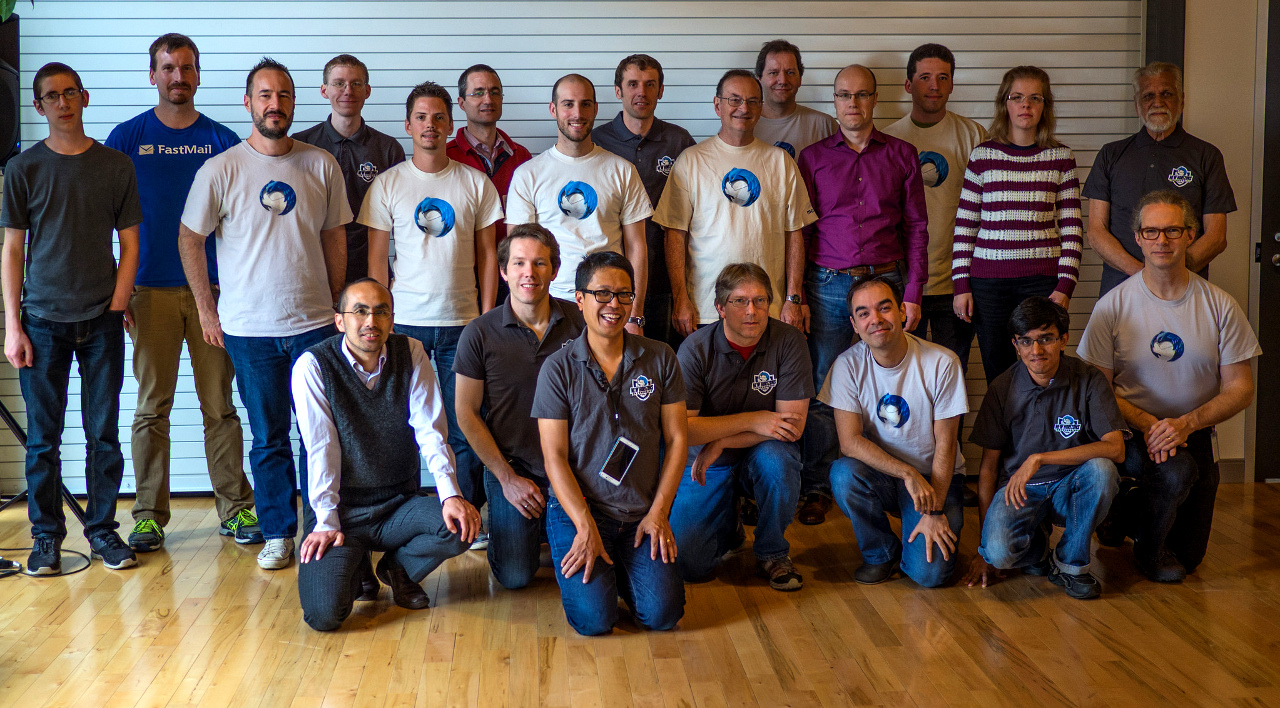
Image context: the cover photograph shows the 22 contributors who gathered at Mozilla's Toronto office in October 2014. They were not celebrating a launch. They were resolving who could make decisions after paid Mozilla attention had dwindled to roughly one full-time-equivalent and formal leadership had become ineffective.[1]
A council arrived before the payroll
The 2014 photograph looks almost aggressively ordinary: a long table, office chairs, laptops, winter layers, fluorescent light. Its significance lies in what the group could no longer postpone. Mozilla had sharply reduced paid work on Thunderbird in 2012. By the Toronto summit, the remaining staff commitment had declined further while authority still formally sat with staff. The project's own account says that nobody was effectively in charge and important decisions were difficult to make.[1]
The contributors elected a seven-member Council, identified immediate release work, and agreed to seek donations for full-time staff. The sequence matters. Thunderbird did not first hire a management layer and then bolt on community consultation. It established a body capable of setting direction, then built a funding engine that could execute that direction.
Independent reporting on Thunderbird's later recovery shows why volunteer energy alone was not enough. When Ryan Sipes joined in 2017, changes in Firefox's upstream tree could leave Thunderbird unbuildable for weeks or months. Thunderbird's comm-central codebase depended on moving parts from Firefox, while difficult mail-protocol work offered little of the novelty that attracts casual contributions. In a 2024 GUADEC talk covered by LWN, Sipes used IMAP maintenance as the blunt example: hundreds of pages of protocol specifications do not routinely become somebody's evening hobby.[4]
That is the problem the funding model solves. Donations do not replace maintainers; they buy sustained attention for the parts of maintenance that a large, old client cannot leave to chance. They turn upstream breakage, release engineering, accessibility, account setup, security, support, and protocol correctness from hopeful backlog items into jobs somebody is expected to keep doing.
The donor base behaves like distributed infrastructure
Thunderbird's latest complete public financial snapshot makes the concentration story unusually concrete. In 2024 it received $10.3 million through more than 539,000 transactions from more than 335,000 people. The median contribution was $16.66; 94% of gifts were $35 or less; only 17 were at least $1,000. One quarter of transactions were recurring monthly contributions.[5]
That shape matters more than the headline total. A project funded by one cloud vendor, one acquisition-minded company, or a few large grants inherits a short list of renewal decisions. Thunderbird instead inherits a very broad behavioral dependency: it must keep enough users willing to respond to donation appeals. No individual donor gets a product veto, but the project has to explain progress and make the connection between gifts and maintenance credible.
The base is broad without being perfectly diversified. The 2024 report says contributions arrived from more than 200 countries, while the top ten accounted for 83% of revenue.[5] Currency, payment processing, regional economic stress, or fatigue in a few mature user markets could still matter. A large donor count lowers sponsor capture; it does not create an annuity.
The spending side is visible in staff capacity. Thunderbird ended 2024 with 43 full-time staff after adding 14 during the year, and reported that 80% of staff worked in technical roles. The same report estimates more than 20,000 people contributed code, localization, support, or other work, with translation coverage growing from 58 to 70 locales.[5] This is not a story in which paid labor displaced community labor. It is a two-layer system: staff carry work that needs scheduled ownership, while a much larger contributor population expands reach and feedback.
There is a practical boundary for other projects tempted to copy the model. Thunderbird had a widely installed product, a direct communication surface inside that product, and a problem ordinary users could understand: maintain the private mail client they already depend on. A library buried six layers down a dependency graph cannot assume that twice-yearly appeals will produce the same result. Thunderbird's lesson is not “add a donation button.” It is to connect a recognizable public good, an accountable governing body, and a repeated explanation of what maintenance costs.
The term sheet is a control plane, not ceremony
Thunderbird describes the Council and MZLA as joint stewards, but their powers are deliberately asymmetric. The Council is responsible for project strategy, technology, features, donation stewardship, yearly goals, and first approval of the project budget. MZLA handles legal and fiscal matters, employment, daily management, spending within the approved budget, and the trademark on Mozilla's behalf.[2][3]
Roadmap authority and fiscal authority meet through mutual gates. The Council is the final decision-maker for the yearly product roadmap. Staff leadership reports progress within 45 days after each quarter. MZLA's board is the final fiscal decision-maker on the annual budget, but that budget must arrive signed off by the Council. Once approved, a change greater than 30% of a budget category or 10% of the entire budget—whichever threshold is smaller—requires majority approval from both bodies.[3]
Those rules resemble a system designed for failure containment. The Council cannot hire, pay invoices, or satisfy corporate law by resolution alone. MZLA cannot legitimately redirect Thunderbird's product or donation-funded work as if it owned an ordinary proprietary business unit. The duplicated approvals add latency, but they also make capture harder: community authority and operating authority must agree at the points where strategy becomes spending.
The separation clause makes that constraint more than rhetoric. If a dispute remains unresolved after notice, counterproposal, possible independent resolution, and six months, either side may invoke a process to separate Thunderbird from MZLA; the Council would remain the software project's governing body under Mozilla's module-ownership system.[3] Separation would plainly be expensive and disruptive. Its value is as an architectural escape hatch: the legal employer and the open-source project's governing identity are related, not fused.
Current governance work shows that the interface still needs maintenance. Council working groups have been clarifying roadmap review, decision procedures, and the Council's strategic role as MZLA has grown. Their stated concern is coordination: preserve community confidence and early intervention without turning the Council into the day-to-day engineering manager.[6] That is healthy evidence only if it produces usable review paths. A public charter cannot compensate for late information, unclear escalation, or exhausted councilors.
Pro services make the accounting boundary the product boundary
The sharpest new test comes from Thunderbird Pro: hosted mail, scheduling, file sharing, and related services that a client-only application cannot provide. The 2024 report says donation growth helped fund the work that led toward Thundermail and the Pro services, alongside mobile development and core-team expansion.[5] Thunderbird's current donor guidance draws the intended steady-state boundary differently: nearly all operating revenue still comes from user donations; the desktop and mobile applications remain free; optional Pro services require subscriptions because servers, storage, and operations create continuing costs.[7]
Those statements can both be true. Donations can supply risk capital for an open service while subscriptions later carry its variable infrastructure. The governance question is whether readers can verify the transition. “Open source” answers whether service code can be inspected or reused. It does not answer which account pays an engineer who works across desktop, Android, Thundermail, and shared identity infrastructure.
This is where future reports should become more detailed, not less. The useful signals are separate service revenue and cost, explicit treatment of shared staff and infrastructure, Council approval for donation-funded investment, and roadmaps that reveal what the free clients gain or defer. If subscriptions eventually subsidize core maintenance, that can strengthen Thunderbird. If core donations quietly absorb persistent hosted-service costs, the project will have changed the donor bargain even if every repository remains public.
The same boundary protects engineering focus. Desktop Thunderbird still carries the comm-central and Gecko coupling that made “red-tree days” so costly. Android has its own lineage through K-9 Mail. Hosted services introduce uptime, abuse handling, data residency, storage, and incident-response obligations. That 43-person year-end team could do much more than the Toronto group—but each new operational surface creates on-call work that does not automatically improve IMAP correctness or desktop stability.
What would prove the model is durable
For users and downstream distributors, the positive reading is already substantial: funding comes from a wide population rather than a dominant sponsor; the project has paid technical capacity; community contributors remain numerous; and decision rights are documented down to review cadence and material budget changes.[3][5] That is a stronger maintenance signal than stars, download counts, or a lively release announcement.
The falsifier is opacity. If annual reports stop connecting revenue to staffing and output, if Council review follows rather than shapes major commitments, or if Pro's shared costs cannot be distinguished from free-client maintenance, the written checks will have become ceremonial. Donor concentration should also be tracked by retention and region, not only transaction count. A broad base that must be reacquired from scratch every year is less resilient than the same total suggests.
Engineering teams adopting Thunderbird do not need to audit every Council motion. A small organization using it as a desktop client should care about release support, security response, profile migration, add-on compatibility, and whether its needed mail and calendar protocols remain owned. A distributor or enterprise packaging Thunderbird at scale has a stronger reason to watch upstream build health, roadmap decisions, and the allocation between client and service work. Neither group should mistake donor funding for a support contract.
The 2014 summit solved a leadership vacuum by deciding who could decide. The decade after it solved a maintenance vacuum by asking users to pay for unglamorous work. Thunderbird's unusual achievement is not merely that the appeal succeeded. It is that the money flows through a visible set of community and corporate checks. As the project grows beyond the desktop, keeping that interface inspectable is now maintenance work in its own right.
Sources
- Kent James, “Thunderbird Reorganizes at 2014 Toronto Summit,” The Thunderbird Blog (November 25, 2014) — summit account, governance transition, staffing context, and source of the archival group photograph used in this article.
- Thunderbird Council, “Thunderbird Council” — current description of the elected body, its joint stewardship with MZLA, budget and roadmap duties, election roll, and project goals.
- Thunderbird Council, “Thunderbird Operational Rules Term Sheet” — formal division of roadmap, budget, staff, trademark, review, material-change, conflict, and separation authority.
- Joe Brockmeier, “Lessons from the death and rebirth of Thunderbird,” LWN.net (July 24, 2024) — independent reporting from Ryan Sipes's GUADEC keynote on upstream breakage, fundraising, protocol maintenance, governance, and project recovery.
- Ryan Sipes, “State Of The Bird 2024/25,” The Thunderbird Blog (October 8, 2025) — 2024 contribution distribution, geography, staffing, community participation, expenses, mobile work, and services context.
- Thunderbird Council, “Working Groups” — current roadmap, term-sheet, and bylaws work intended to clarify strategic oversight as MZLA and the product surface grow.
- Thunderbird Donor Support, “Thunderbird and MZLA Technologies” (updated June 26, 2026) — current operating-revenue statement and the stated funding boundary between free desktop/mobile clients and optional subscription services.