The strongest R governance signal in 2026 is not a newly elected technical council or a transfer of commit rights. It is a funded attempt to make more people capable of doing the work that must happen before a commit: reproducing a bug, preparing a focused patch, testing it across platforms, reviewing somebody else's change, and carrying the discussion far enough that an R Core developer can make a sound decision.
The UK's Research Software Maintenance Fund awarded £499,981.21 to a 24-month project called Enabling the Next Generation of Contributors to R. Its plan includes mentoring a cohort of expert contributors, modernizing development infrastructure, widening participation, improving communication, developing a project-wide code of conduct, and proposing changes to R Foundation organization and elections.[1][2]
Those goals belong in one program because R's continuity problem is not simply “find another maintainer.” Authority and labor are spread across overlapping groups. R Core controls the official base-R source. The R Foundation supplies a legal, financial, and public-facing home. The CRAN team curates the package repository most users experience as the R ecosystem. Many people serve in more than one of those places, but the places do different jobs. A succession program that blurred them would make R harder to understand. This one is more interesting because it aims to widen the contributor path while the existing authority boundaries remain visible.
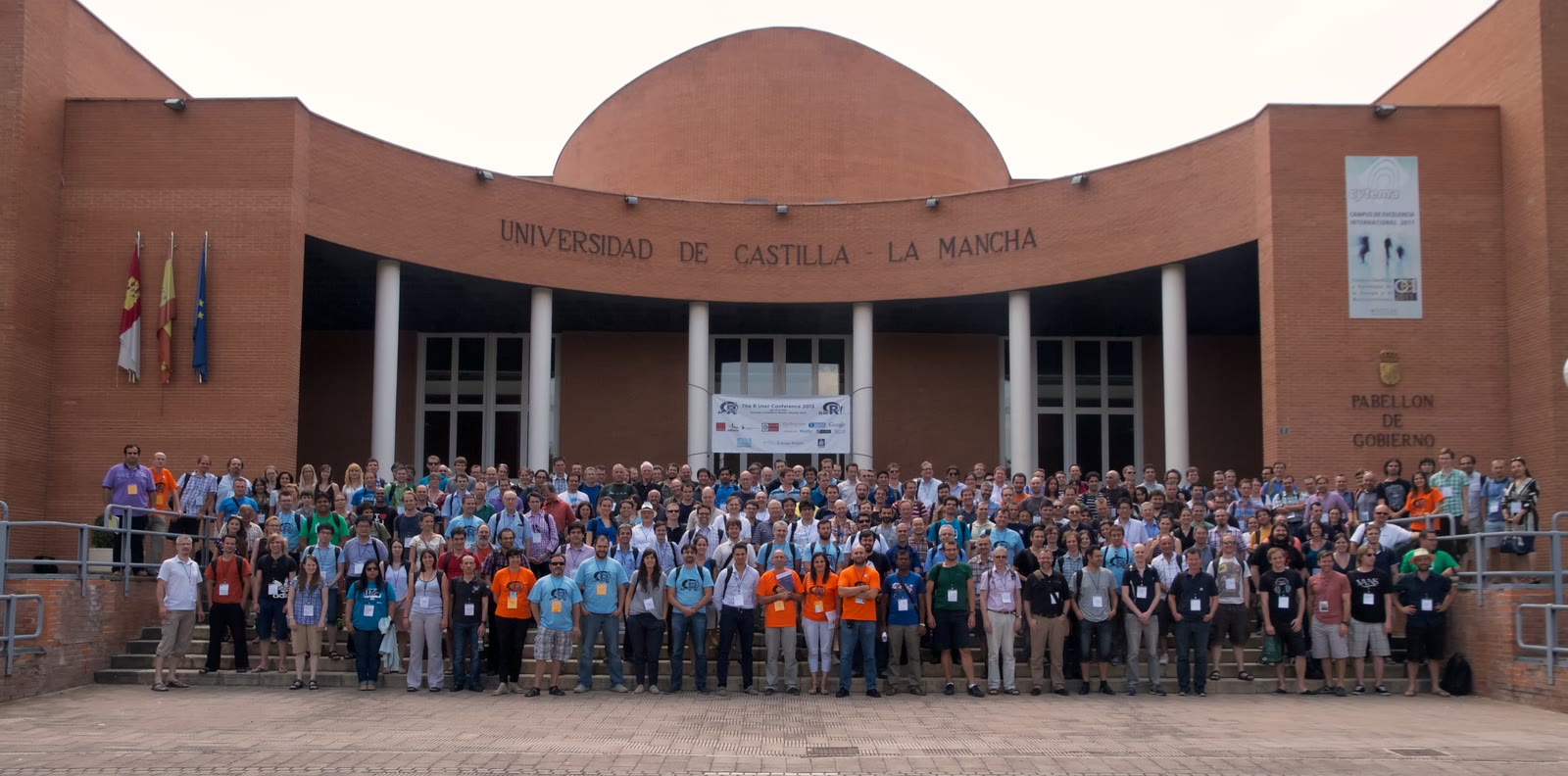
Image context: the cover shows the useR! 2013 group outside the University of Castilla-La Mancha. It is documentary evidence of the human scale around R, rather than a logo standing in for community. The governance question is how some of that broad user-and-package-developer population can gain the experience needed to review and maintain the much smaller base system.[8]
Write access is the last step, not the first
Base R still has a deliberately narrow write boundary. R's March 2026 software-development-life-cycle document says the official Subversion repository is access-controlled so that only R Core members can write to it. It separates the release branch, which accepts bug fixes and only minor feature enhancements, from the development branch where major features enter. A designated release manager approves a release after testing, and the document's scope is base R plus the recommended packages distributed with it—not every add-on hosted by CRAN.[4]
The public contribution path is wider, but it does not pretend that a GitHub pull request merges itself. The R Development Guide tells an external contributor to work from the current development source, run make check-devel, create a focused svn diff, and submit the patch through Bugzilla. A GitHub mirror can run checks on a proposed change across configurations and operating systems; the resulting diff still returns to the patch workflow for review and, ultimately, acceptance or rejection by a core developer.[3]
That design has a sensible safety property. Someone can contribute evidence before receiving production authority. Reproducing a failure, adding a regression test, checking portability, or reviewing a patch all reduce uncertainty for the person who can merge. The dangerous simplification would be to measure succession only by the number of new committers. A project can enlarge its committer list and still have too few people willing or able to review changes at the interpreter, memory-management, platform, numerical, or compatibility boundaries.
R's own guide names the immediate constraint plainly: lack of code review is a bottleneck, numerous issues already have proposed fixes, and nobody is employed merely to review them. It encourages contributors to test patches and comment even when they cannot provide a perfect review, because that lets experienced developers reserve their scarce attention for the subtleties only they can judge.[3]
Three institutions create one user experience
“R governance” is easy to misread because users normally encounter one download command and one package name. Underneath, at least three systems of responsibility meet.
R Core governs base-R integration and release. Its members hold write access, maintain the release and development lines, and decide whether an external patch enters the source. This is the technical trust boundary that the new contributor cohort can support but does not automatically inherit.[3][4]
The R Foundation governs an association. Its statutes give the Foundation responsibility for supporting R's continued development, operating communication and distribution infrastructure, holding and administering copyright, organizing events, and acting as an official public voice. Ordinary members—not paying supporting members—form the Foundation's highest authority, elect its board, approve accounts, set fees, and amend the statutes.[5] That makes the Foundation a real governance body, but its general assembly should not be casually described as the merge authority for base R.
CRAN governs repository admission and ongoing distribution. Its policy describes a volunteer-operated repository backed by R Foundation and employer resources. It requires publication-quality packages, portable code, a reachable named maintainer, checks against current R, and attention to reverse dependencies. The team may archive packages that fail after a new R release or remain unmaintained, and CRAN itself builds the Windows and macOS binaries it distributes.[6] A package author's relationship with this gate is not the same as a contributor's relationship with the base-R source tree.
The groups overlap socially, and that overlap carries context between them. It also creates a bus-factor risk: one person may be doing core development, platform work, CRAN checks, and Foundation work under several labels. Counting organizations without counting task ownership can therefore exaggerate resilience.
The old model solved routine work better than renewal
There is a useful historical warning here. In a 2009 study based on interviews with most of the then-current R Core team, sociologist John Fox described a flat formal organization with a largely organic division of labor. Routine releases, incremental improvements, and bug fixes could proceed through expertise and modified consensus; controversial new directions were harder, and sometimes no action followed when consensus did not form.[7]
That article is a historical source, not a current organization chart. Yet its mechanism still explains why contributor succession is governance work. Tacit ownership is efficient while the owner is available. It becomes hard to transfer because the role was never fully specified: the knowledge may include a platform toolchain, a web of package dependencies, the judgment to distinguish a numerical regression from an intentional change, and the relationships needed to coordinate a release.
Documentation lowers the entry cost but does not transfer judgment by itself. Events create contact but do not guarantee sustained review. Money can buy focused time but does not confer legitimacy. The new program's design connects those pieces: experienced core developers will mentor an expert cohort; the cohort will work on maintenance and bug triage; contributor events and guides will continue; and infrastructure experiments will try to shorten the distance from an interested outsider to a reviewable change.[2]
That is a better succession unit than “one person learns one subsystem.” A cohort can review one another, make hidden procedures explicit, and leave multiple people able to diagnose the same class of failure. It creates redundancy before a vacancy forces a rushed transfer.
The reform is a proposal, not an accomplished transfer
The program also plans to test broader changes: alternative development platforms, a process for discussing enhancement proposals, stronger communication between R Core and the wider community, and a new organizational structure and modernized election procedures for the R Foundation.[2] The tense matters. These are intended experiments and proposals. The award itself is evidence that the project recognizes a continuity problem; it is not evidence that a new constitution, election process, or technical decision system has already taken effect.
Nor should the funding be read as an automatic democratization of base-R merge authority. An easier on-ramp can produce more patches. An enhancement-proposal process can make the reasons for a large change inspectable. A wider reviewer pool can improve throughput and spread expertise. None of those changes requires every participant to have write access, and none should quietly move CRAN repository decisions into the Foundation or Foundation elections into R Core.
The limited grant term is another boundary. The R project post announcing the work explicitly says the award is short-term and that long-term sustainability still requires diversified income.[2] Two years can establish a cohort and test processes; it cannot prove that review labor, community coordination, and Foundation administration will remain funded after the project closes.
What would count as a durable signal
The meaningful outcomes will be visible in handoffs rather than announcements.
First, external contributors should be able to move from reproducible reports to tested patches and substantive reviews without depending on private instructions. The useful metric is not raw issue traffic but changes that survive the full compatibility and review path.
Second, review should become a recognized contribution with enough funded or institutionally supported time behind it. If the cohort produces patches faster than experienced reviewers can assess them, the program will have moved the queue rather than relieved it.
Third, proposed governance processes should state where a decision ends. An enhancement process needs an explicit route to technical acceptance. Foundation election reform needs to identify which Foundation powers it changes. A code of conduct needs a reporting and enforcement body. Clear interfaces matter more than a tidier diagram.
Finally, the work needs a post-grant maintenance home. Documentation, CI, contributor events, and mentoring all decay when their owners return to unfunded spare time. A durable result would pair each new process with named stewardship, a budget source, and a way to replace its current operators.
For an engineering team that depends on R, the practical reading is reassuring but bounded. Base R retains a conservative integration and release path; CRAN continues to impose repository-wide portability and reverse-dependency discipline; the Foundation can fund and house shared work. The fresh signal is that R is now investing directly in the human layer between its enormous user community and its narrow source-write boundary.
That layer is where succession actually begins. A new maintainer is safest when they arrive after months of reproducing, testing, reviewing, documenting, and earning context—not when an empty chair suddenly requires a new name. R's 24-month program will deserve to be called governance reform if it makes those preparatory roles easier to enter, possible to sustain, and strong enough to outlive the grant.
Sources
- Software Sustainability Institute, “RSMF Round 1 Projects” — award amount, 24-month duration, team, planned contributor pipeline, governance work, and infrastructure modernization.
- Heather Turner, “RSMF: Enabling the Next Generation of Contributors to R,” The R Blog, December 17, 2025 — program design, mentoring cohort, contribution infrastructure, communication, Foundation proposals, and short-term-funding boundary.
- R Contribution Working Group, “Lifecycle of a Patch,” R Development Guide — external patch workflow, testing, review bottleneck, Git mirror checks, Bugzilla submission, and core-developer acceptance.
- R Foundation, R: Software Development Life Cycle, March 12, 2026 — source-write access, branch roles, release management, testing, infrastructure, and document scope.
- R Foundation, Statutes of The R Foundation for Statistical Computing, November 17, 2025 — objectives, membership, general-assembly authority, board duties, copyright, infrastructure, and public representation.
- CRAN Repository Maintainers, “CRAN Repository Policy” — volunteer basis, submission requirements, portability, checks, reverse dependencies, archiving, and binary distribution.
- John Fox, “Aspects of the Social Organization and Trajectory of the R Project,” The R Journal, December 2009 — independent interview-based analysis of R Core's flat structure, division of labor, consensus, and renewal risks.
- useR! 2013 organizers, “The R User Conference 2013” — official conference record and provenance page for Benno Pütz's group photograph used as the article image.