Polars is easy to undersell as "pandas, but faster." That comparison helps people find the category, then quickly becomes the wrong mental model. The strongest way to read Polars is as a query engine with a DataFrame front end: Python gives users a compact expression language, Rust owns much of the execution path, and the lazy API turns a chain of familiar operations into a plan that can be optimized before data moves.[1][2]
That matters because the expensive part of analytical code is rarely the one line that looks slow in a notebook. It is the accidental contract created by the whole chain: read too many columns, materialize too early, filter after a join, duplicate an expression, or force everything into memory before discovering that the output only needed a narrow slice. Polars' architectural bet is that a DataFrame workflow should be readable like ordinary code but executable like a planned query.[1][3]
As of 2026-06-13T05:01:00Z UTC, the pola-rs/polars repository showed 38,745 stars, 2,879 forks, 2,791 open issues, an MIT license label, and a most recent push timestamp of 2026-06-12T17:03:54Z through the GitHub API.[5] The latest GitHub release was Python Polars 1.41.2, published on 2026-05-29T17:39:42Z.[6] Those numbers do not prove that Polars fits a workload. They do show that this is active infrastructure, not a frozen benchmark project.
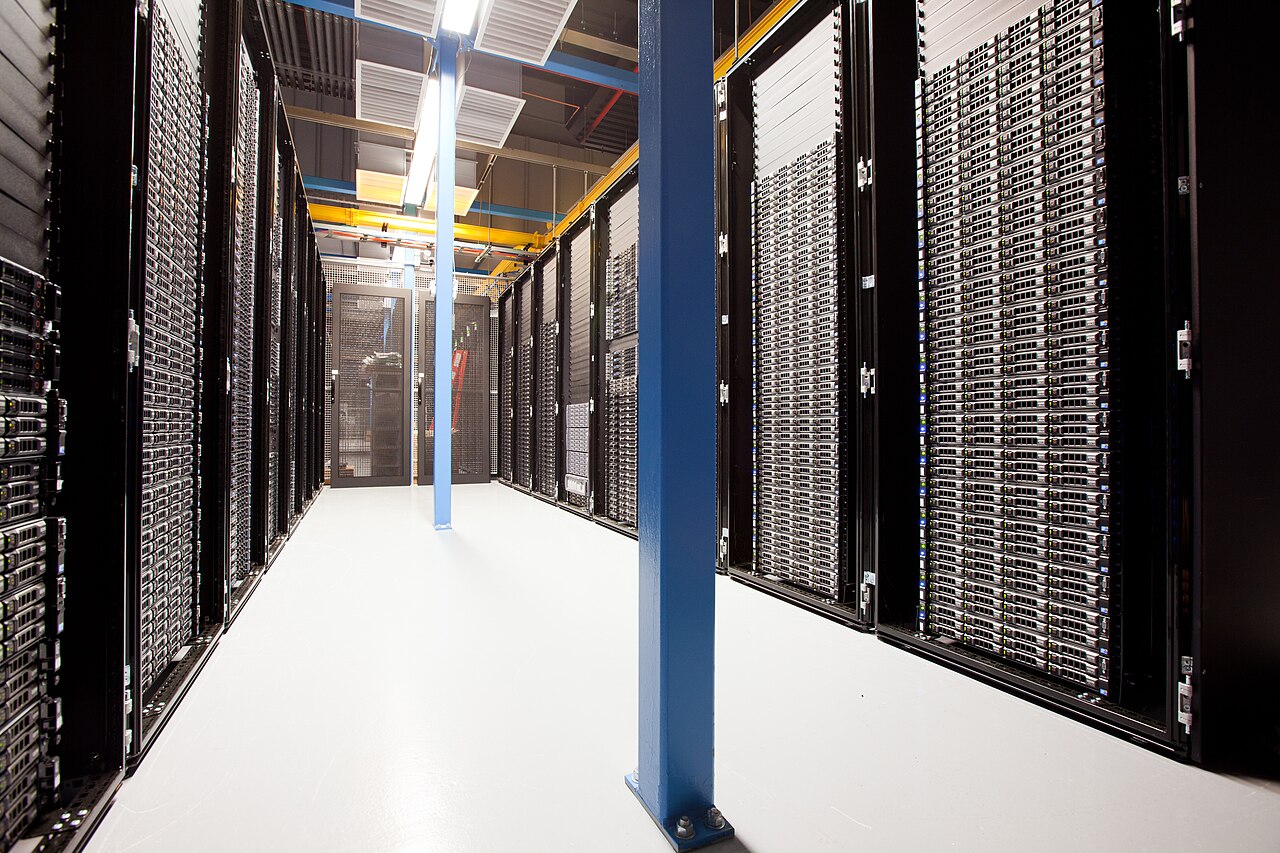
Image context: the cover is a real 2012 Wikimedia server-room photograph from Wikimedia Commons.[8] It is not a Polars-specific image, but it fits the argument because the article is about execution discipline: query plans, streaming batches, parallel work, and memory boundaries that are easier to reason about when the data path is visible.
LazyFrames change the unit of work
Polars supports eager and lazy operation, but the user guide is direct about preference: the lazy API is usually the better path because it lets Polars process the full query end to end instead of executing line by line.[1] A LazyFrame does not simply hold rows waiting for a later call. The reference documentation describes it as a representation of a lazy computation graph or query against a DataFrame, enabling whole-query optimization and parallelism.[2]
That is the first real boundary. In eager mode, every method call has already happened by the time the next line runs. In lazy mode, the chain remains negotiable until collect() asks for materialization. Independent walkthroughs of LazyFrames make the same practical distinction: a scan builds instructions first, and .collect() is the point where the result becomes a materialized DataFrame.[10] That gives the engine room to ask practical questions: which columns are actually needed, which predicates can move earlier, which expressions can be simplified, which branches can share work, and which source scan can avoid unnecessary I/O.[1][3]
The adoption lesson is simple: if a team evaluates Polars only by porting eager pandas-shaped snippets, it may miss the architecture. The interesting question is not whether group_by is faster in isolation. The interesting question is whether the workload can be expressed as a plan before execution. CSV, Parquet, and IPC scans become more valuable when they feed a lazy graph, because the engine can reason about projection and predicate pushdown before loading data that later disappears.[1][3]
This is why Polars often feels most coherent in ETL, feature generation, local lakehouse work, notebook-to-job promotion, and analytical command-line tools. These workloads are not just tables. They are pipelines with scans, filters, joins, groupings, derived columns, and output steps. A DataFrame API is pleasant at the surface; the query plan is what keeps the surface from becoming accidental work.
Expressions are the contract language
Polars' expression system is the second architectural boundary. The concepts guide frames expressions as the core way users describe transformations inside contexts such as select, with_columns, and filter.[7] This matters because expressions are not arbitrary Python callbacks hidden from the engine. They are structured operations the engine can inspect and combine.
That distinction is easy to miss. In a small script, a Python function can feel more flexible than an expression tree. At scale, that flexibility can become opacity. If the engine cannot see the transformation, it cannot reorder it, push it down, combine it with related work, or reason about its type behavior before execution. Polars' expression model asks users to trade some free-form Python convenience for operations the engine can optimize.
The payoff appears in ordinary code. A derived column can be defined once and reused. A filter can remain attached to the plan instead of becoming an already-materialized boolean mask. A select can tell the scanner that the workload needs three columns rather than the whole file. A group aggregation can be planned as part of the same graph rather than as an isolated Python-side loop.[1][3][7]
The failure mode is also clear. If a team keeps reaching for row-wise Python functions, treats every intermediate as something to inspect eagerly, or breaks the graph to accommodate habits from another library, Polars loses part of its reason to exist. The tool can still be fast, but it stops being architectural. The strongest Polars code keeps as much intent as possible inside expressions until the output boundary is real.
Optimizer passes are not invisible magic
The query-plan guide is useful because it encourages users to inspect plans instead of trusting vague performance folklore. Polars exposes methods such as explain() so users can see the logical plan and understand how the engine has reorganized work.[3] The optimization documentation names several of the passes that make lazy execution valuable, including projection pushdown, predicate pushdown, slice pushdown, common subplan elimination, common subexpression elimination, and expression simplification.[4]
Those are not decorative compiler terms. Projection pushdown is the difference between reading a wide dataset and reading only the columns the result uses. Predicate pushdown is the difference between filtering after expensive work and letting filters move close to the source when possible. Common subexpression elimination is the difference between repeating the same derived calculation and letting the engine reuse it. Slice pushdown is the difference between limiting after full materialization and asking earlier stages to do less work.[4]
This is where Polars fits differently from a pure convenience library. It gives data teams an inspection surface for performance. If a query is surprisingly slow, the question can become "what plan did the engine build?" rather than "which line feels suspicious?" That does not eliminate tuning. It makes tuning less mystical.
It also sets a boundary around expectations. Optimizers are powerful, but they are not proof that every query shape is good. Bad join keys, high-cardinality groupings, expensive string work, huge skew, and careless materialization can still dominate. The healthier posture is to write Polars code that gives the optimizer a good graph, inspect the plan when stakes are high, then measure with representative data.
Streaming is the memory boundary
The streaming guide gives Polars another important lane: lazy queries can execute in batches so results do not require the entire dataset to sit in memory at once.[9] The docs describe passing engine="streaming" to collect() for this mode and frame it as a way to handle datasets that do not fit comfortably in memory.[9]
That does not mean streaming turns a laptop into a warehouse. It means the execution boundary changes. A workload that can be streamed can keep memory pressure lower by moving batches through supported operators. A workload that requires global state, unsupported operations, or output-wide materialization may still need memory, a different query shape, or a database engine. The point is not that Polars erases memory limits. The point is that lazy planning gives the engine an execution mode in which memory can become a managed constraint instead of a surprise crash.[7]
For production use, this is often the most practical test. If Polars is running daily jobs on files, the team should know which queries stream, which do not, and what fallback looks like. It should know whether the source format supports efficient scanning, whether intermediate materialization is intentional, and whether a final collect() is happening at the right boundary. "Works on the sample" is not enough when the sample hides memory shape.
Where Polars fits
Polars is strongest when a team wants local or embedded analytical execution with a clean expression language and a query-plan spine. It fits Python-heavy data work where the bottleneck is not only raw CPU but also needless materialization, over-reading, repeated transforms, and brittle notebook logic. It fits engineers who are willing to treat LazyFrame pipelines as reviewable artifacts, inspect plans, and keep transformations inside expressions where the engine can see them.[1][2][3][7]
It is weaker when the organization really needs a shared transactional database, multi-user governance layer, long-lived serving system, or distributed warehouse. Polars can read from and write to serious storage formats, but it is not a catalog, scheduler, access-control plane, or semantic layer. If a team needs those things, Polars should sit inside a larger architecture rather than pretend to be the architecture.
The best pilot is not a blanket "replace pandas." Pick one job with a visible data path: scan, filter, derive, join, aggregate, write. Build it lazily. Inspect the plan. Test it against representative row counts and file layouts. Try streaming only where the query shape supports it. Keep one comparison run against the incumbent implementation, not to win a benchmark trophy, but to confirm that the new code is clearer about where work happens.
Polars' real promise is not that every DataFrame becomes fast by association. It is that DataFrame work can stop being a sequence of immediate side effects and become an explicit plan. Once that shift happens, performance becomes easier to explain, memory pressure becomes easier to locate, and analytical code becomes something a reviewer can reason about before the job runs.
Sources
- Polars user guide, "Using the lazy API" - lazy execution, automatic query optimization, streaming, and schema checking.
- Polars Python API reference, "LazyFrame" - lazy computation graph, whole-query optimization, and parallelism.
- Polars user guide, "Query plan" - plan inspection and
explain()workflow. - Polars user guide, "Optimizations" - optimizer passes such as projection, predicate, slice, common-subplan, and common-expression optimization.
- GitHub API,
pola-rs/polarsrepository metadata sampled on 2026-06-13 - stars, forks, open issues, license label, and push timestamp. - GitHub,
pola-rs/polarsPython Polars 1.41.2 release - latest release tag and publication timestamp used for the freshness check. - Polars user guide, "Expressions and contexts" - expression model and the contexts where expressions define transformations.
- Wikimedia Commons, "File:Wikimedia Servers-0051 19.jpg" - real 2012 Wikimedia server-room photograph used as the article image source.
- Polars user guide, "Streaming" - batch execution through
engine="streaming"and the larger-than-memory execution boundary. - Real Python, "How to Work With Polars LazyFrames" - independent practical explanation of LazyFrames, scans, and materialization with
.collect().