OpenBSD is easy to caricature as an operating system for purists, security people, or people who still enjoy reading manual pages before breakfast. That misses the more useful signal. In 2026, OpenBSD's strongest governance feature is not nostalgia and not even a single famous security slogan. It is the fact that the project makes its operating assumptions unusually inspectable: source is visible, releases arrive on a public rhythm, development events are described in concrete terms, and security ideas are turned into small interfaces that can be reviewed instead of brand campaigns.[1][2][4]
As of 2026-06-01T22:02:02Z UTC, the current release is OpenBSD 7.9, published on May 19, 2026 as the project's 60th release.[1] The project goals still say the quiet part plainly: OpenBSD wants full source access, acceptable licenses, prompt security fixes, machine independence where feasible, technical merit over politics, developer-oriented work, and an approximate six-month release cadence.[2] Those are not trendy goals. They are governance constraints. They define what the project is willing to optimize for and, just as important, what it is willing to leave out.
The cadence is a contract, not a calendar habit
The six-month release promise matters because it gives outside users a way to test project health without guessing from social media. OpenBSD 7.9 is not a thin anniversary tag. Its release notes cover platform work across arm64, amd64, riscv64, graphics, virtualization, wireless networking, userland, ports, and security fixes.[3] The point is not that every downstream should run OpenBSD on every laptop, firewall, or server. The point is that a volunteer operating-system project with a deliberately small culture is still shipping whole-system releases on a visible clock.
That clock is a governance mechanism. It limits the project's ability to hide unfinished work indefinitely. It also forces integration decisions into the open: a release page has to say what landed, where the hardware boundary moved, and which fixes or errata users should track.[3] For teams evaluating open-source dependencies, this is more informative than raw repository activity. A fast issue tracker can still conceal weak integration discipline. A release train that repeatedly publishes whole-system state is harder to fake.
The official site reinforces the same signal from the funding side. OpenBSD is developed entirely by volunteers, with development environment and developer events funded through contributions collected by the OpenBSD Foundation.[1] The Foundation describes itself as a Canadian not-for-profit that supports OpenBSD and related projects such as OpenSSH, OpenBGPD, OpenNTPD, OpenSMTPD, LibreSSL, mandoc, and rpki-client; it says funds go toward infrastructure costs, developer events, and initiatives.[8] That does not make the project institutionally risk-free. It does make the support model legible. Users can see the connection between donations, hackathons, infrastructure, and release output instead of inferring it from a vendor roadmap.
Hackathons are the maintainer surface
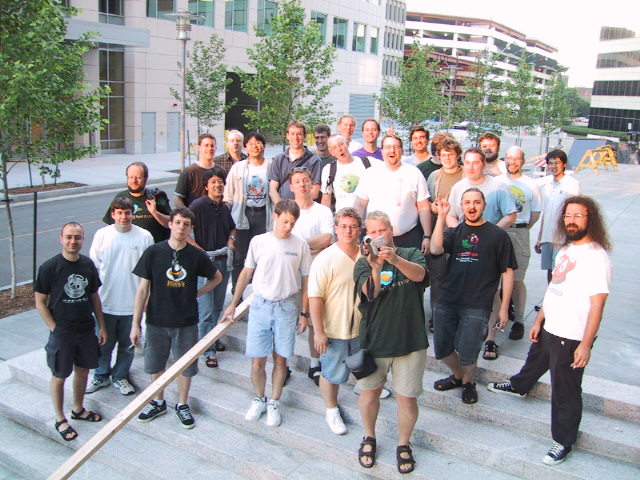
OpenBSD's hackathon page is unusually revealing because it describes a development process rather than a conference brand. The page says the early 1999 event brought developers together in Calgary and quickly integrated IPv6 and IPsec work, and it emphasizes that OpenBSD hackathons are about writing code, not talks or a fixed schedule.[7] More recent entries keep the same concrete texture: a 2026 Isla Mujeres hackathon had 12 developers; 2025 events included Coimbra, Ottery St. Mary, Leipzig, and Nara; the entries name places, dates, rough developer counts, and funding sources.[7]
This is a different governance shape from the foundation plus annual summit model common in larger ecosystems. OpenBSD's important maintainer surface is not a giant public program. It is concentrated room-time among people who are already close enough to the tree to move changes. That has obvious tradeoffs. It is not a beginner-friendly onboarding machine, and the page says plainly that attendance is by invitation and that these are not developer training events.[7] But the model is coherent: if the project values integrated system work, small review loops, and fast tree changes, then the event structure matches the technical philosophy.
The risk is equally clear. A project that depends on concentrated expert work must keep renewing the group of people who can do that work. OpenBSD does not solve that risk by pretending every user is a maintainer. It exposes the process, funds the infrastructure around it, and keeps publishing releases. For an outside adopter, that is the real signal to watch: not whether the culture feels broad, but whether concentrated development still converts into maintained code, portable releases, and security improvements.[1][3][7][8]
Security ideas become small interfaces
OpenBSD's security reputation is often reduced to posture, but the better reading is interface discipline. The innovations page is a long record of ideas that moved from policy into implementation: privilege separation in OpenSSH, systemwide stack protector, W^X, ASLR, position-independent executables, randomized library order, kernel relinking, RETGUARD, and other mitigations.[4] The pattern is not "security as a department." It is security as repeated small changes to default behavior and program boundaries.
pledge(2) is a good example. Its manual page describes a process declaring the subsystems it will need through a space-separated set of promises; operations outside those promises become unavailable, and later calls can reduce the available set but cannot re-enable revoked permissions.[5] That design turns least privilege into an application-local contract. It is not a policy dashboard. It is a small kernel interface that asks a program to state its future shape.
unveil(2) completes the other half of that story. Its manual page says the first call removes visibility of the filesystem except for specified paths and permissions; subsequent calls can add allowed paths, and the view should be locked after configuration.[6] LWN's outside explanation of unveil() captured why this matters: ordinary file permissions do not mean every process run by a user should see every file that user can read.[10] That is the OpenBSD style at its best. It does not try to model the entire world first. It finds a boundary that many programs can understand and makes that boundary cheap enough to use.
The governance relevance is that these primitives are reviewable. An adopter can read the manual pages, inspect calls in the tree, and reason about failure modes. A maintainer can add constraints incrementally. A user can understand the direction of travel without accepting a new platform theory. OpenBSD's security model is therefore not only a technical asset; it is a maintainability signal. The project repeatedly chooses interfaces that are small enough for a volunteer systems culture to carry.
The signal and the boundary
None of this makes OpenBSD the default answer for every team. The same discipline that creates trust also narrows the adoption lane. Hardware support, package expectations, desktop polish, cloud images, and organizational familiarity can all matter more than elegance in a production decision. The governance signal should not be confused with universal fit.
The sharper lesson is that OpenBSD shows what mature open-source governance can look like when it is expressed through constraints instead of scale. The project has an approximate six-month release clock, a public goals page, a long record of whole-system security work, visible developer events, and a foundation that funds the unglamorous costs around infrastructure and concentrated development.[1][2][4][7][8] Its best evidence is not a slogan. It is the repeated match between stated goals, process shape, and shipped code.
For downstream teams, the watch items are concrete. Does the six-month cadence continue to produce full releases rather than ceremonial tags? Do hackathons still convert into integrated work? Do security primitives remain small enough to audit and broad enough to matter? Does Foundation support keep infrastructure and developer events funded? If those answers stay positive, OpenBSD remains an unusually clean governance signal: a project whose trust surface is built from release discipline, readable interfaces, and maintainers who still make the tree move.[1][3][5][6][7][8]
Sources
- OpenBSD, project home page - current release 7.9, May 19, 2026 release date, volunteer development, Foundation-funded development environment, and associated projects.
- OpenBSD, "Project Goals" - source access, licensing preferences, security focus, technical-merit framing, developer-oriented work, and approximate six-month release cadence.
- OpenBSD 7.9 release page - release date, 60th-release note, errata links, platform work, kernel changes, hardware updates, and userland/security changes.
- OpenBSD, "Innovations" - chronology of OpenBSD-developed or OpenBSD-maintained concepts including privilege separation, W^X, ASLR, PIE, RETGUARD, and related hardening work.
- OpenBSD manual page,
pledge(2)- process promise model, one-way permission reduction, and examples of subsystem restrictions. - OpenBSD manual page,
unveil(2)- filesystem visibility restriction, path/permission rules, and the recommendation to lock the view after configuration. - OpenBSD, "Hackathons" - development-event model, invitation boundary, funding notes, recent 2024-2026 events, and historical c2k/c2k1 context.
- The OpenBSD Foundation - not-for-profit support role, related projects, infrastructure costs, developer events, and funding purpose.
- Wikimedia Commons, "OpenBSD hackers at c2k++ at MIT.jpg" - archival photograph by Dug Song, with EXIF date and public-domain status.
- Jonathan Corbet, "OpenBSD's unveil()," LWN.net, September 28, 2018 - independent explanation of
unveil()and the filesystem-access problem it addresses.