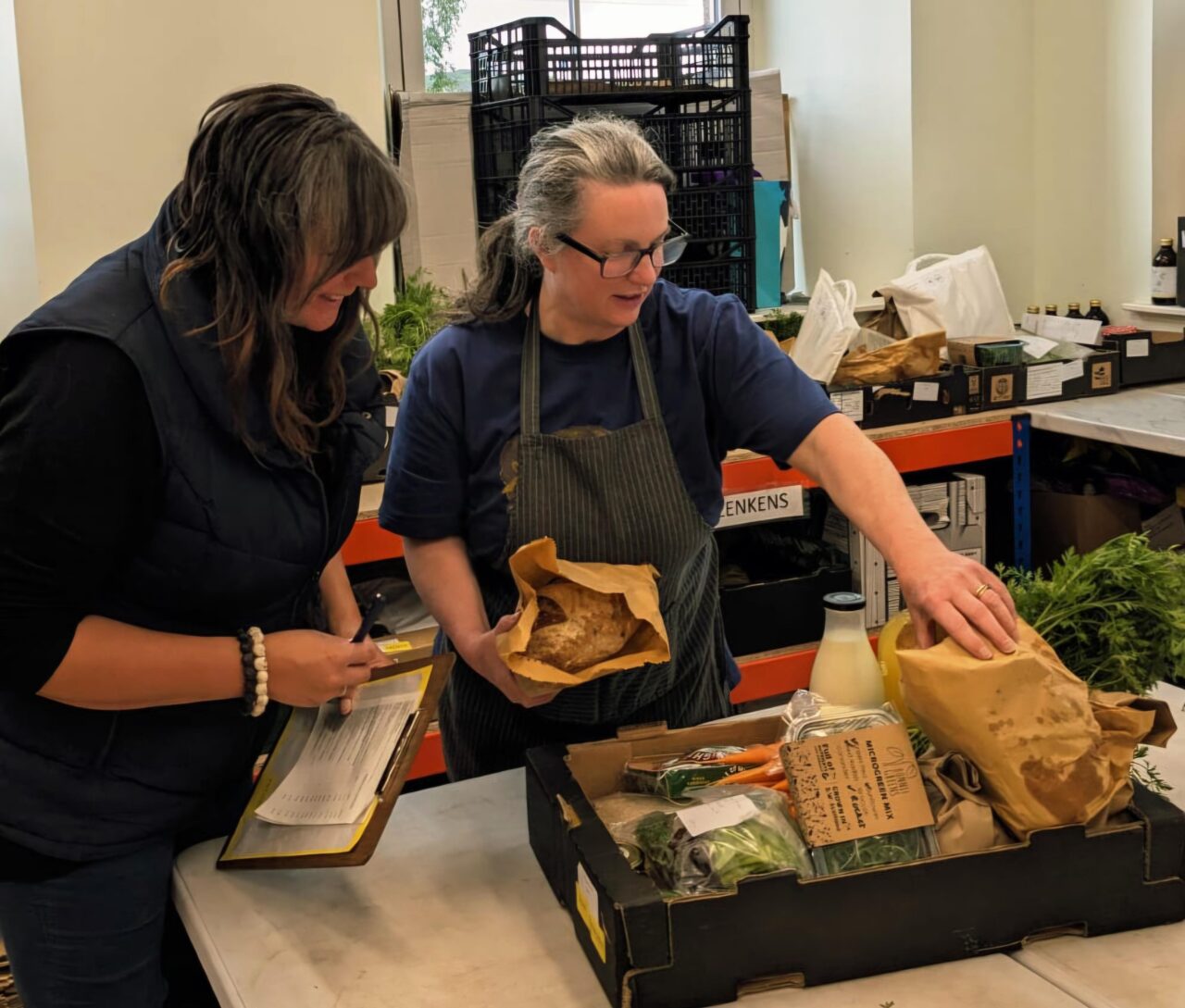
A food hub has to make several small businesses behave like one shop for a few hours. Customers want a single basket; the grower, baker, and packing team each need a different account of what is in it. Open Food Network is an open-source marketplace built for that arrangement, connecting independent producers, hubs, and buyers.[1] Its most revealing feature is the order cycle: a shared timetable attached to a specific selection of food.[3]
Consider the routine described in Open Food Network UK's Galloway Food Hub case study. Orders open on Friday at lunchtime and close on Tuesday at lunchtime. Tuesday afternoon is for administration, giving producers time to prepare; food arrives by Friday morning for collection or delivery later that day. The hub operates from a community centre in Dalry, Dumfries and Galloway.[2] Closing the online shop gives the people behind it time to fulfil its promises.
A catalogue needs an appointment
Creating a hub order cycle means choosing a coordinator, opening and closing times, incoming products, and the hubs that will distribute them. A single hub can coordinate and distribute. At least one payment method and one shipping method must be configured before a cycle can go live.[3]
Imagine a small buying group taking orders for bread and vegetables, then arranging one Saturday collection. Its first task is to agree that schedule with its suppliers. The software gives those decisions a place to live: which goods belong in this round, when ordering stops, and when customers should collect them.
The distinction between a catalogue and a sale matters. A product with zero stock will not appear in the shopfront even if it has been selected for the cycle.[3] A missing loaf can therefore be a stock-setting problem, rather than a broken checkout.
Cooperation has permissions
OFN calls the participating businesses enterprises. A producer grants a hub permission to add its products to an order cycle. That permission is separate from allowing the hub to manage the producer's products or edit its profile.[4]
This is a consequential distinction for a shared catalogue. The guide's example describes a farmer supplying two hubs: if one hub has permission to manage the farmer's products, changing a product price can affect the other hub's shopfront under standard settings. Delegating sales access and delegating catalogue maintenance carry different consequences.[4]
For the imagined buying group, the practical question is who should correct a price or remove an unavailable product. A small team should settle that responsibility before inviting customers. Giving every collaborator every permission makes setup easy, but leaves a much wider scope for an ordinary edit to surprise another seller.
There is also a documentation trap here. As checked on September 17, 2026, the guide marks the Inventory tool as retired and available only to legacy users. Its older instructions describe hub-specific overrides of prices and stock; a new operator should confirm available controls with local support before designing a workflow around them.[7]
Packing and transport have a price
The hub's work can be represented through Enterprise Fees, which allocate costs for administration, packing, transport, sales, or fundraising. Creating a fee does not activate it: it must also be added to an order cycle.[5]
The calculation method matters as much as the label. The documented weight-based calculator applies to products priced per kilogram; it does not attach a weight charge to an item sold as a bunch. A fee per item, in turn, does not apply to goods sold by weight or volume.[5]
That makes a mixed basket a useful rehearsal. Put a weighed product and an item-priced product through checkout and inspect the resulting charges. A label such as “packing” expresses the intention; the selected calculator determines which purchases contribute. This check is particularly valuable for a volunteer team whose person configuring the shop may be different from the person balancing its accounts.
One basket becomes several working lists
OFN's reports rearrange the same orders for different jobs. Order Cycle Supplier Totals helps producers see what has been ordered, including while a cycle is still open. Order Cycle Customer Totals provides the customer, line items, payment status, and shipping information needed to assemble individual orders.[6]
The supplier report also preserves a subtle accounting distinction. Its total cost sums costs at the time each item was purchased. Multiplying the displayed current unit cost by the total quantity can therefore give a different result if prices changed during the selected period.[6] A reconciliation should explain that difference before anyone assumes the export is wrong.
Galloway's packing routine shows where configuration ends and additional work begins. Its team wanted separate meat packing lists because meat was packed in another room, along with a particular sort order and shipping-method column. OFN built an add-on automation for those requirements.[2] The room layout helped determine the report layout.
For a first trial, follow a handful of orders all the way through supplier totals, payment checks, packing, and collection. A successful payment establishes only one part of that chain. Someone still has to notice the absent product and decide what the customer will receive.
Shared code still needs local organisation
The repository releases OFN under AGPL-3.0 and points server operators to a separate set of Ansible provisioning playbooks.[1] Running a server is therefore a distinct responsibility from running a shop. A buying group with little operational capacity should start by discussing an account and support with its local OFN organisation; self-hosting requires someone accountable for the service beyond collection day.
An independent 2023 study by Vangelis Papadimitropoulos and Haris Malamidis places OFN within “open cooperativism”: shared digital resources supporting locally organised enterprises. Drawing on interviews, observation, and documentary material, it also identifies tensions between volunteer participation and professional commitments.[8] The study offers a useful reading of the project, without establishing that software alone makes any particular hub sustainable.
The engineering lesson I take from this is modest and practical. Open Food Network gives people explicit places to record their agreements about products, authority, charges, and time. Its value becomes tangible when the baker knows what to bake and the packing team knows which box it belongs in.
Sources
- Open Food Foundation, Open Food Network repository — project scope, AGPL-3.0 licence, and links to server provisioning tools.
- Open Food Network UK, “Galloway Food Hub Case Study” — reported operating schedule, packing-list integration, and packing-day photograph.
- OFN User Guide, “Order Cycles (for Hubs)” — coordinators, product selection, stock visibility, distribution, and checkout prerequisites.
- OFN User Guide, “Enterprise Permissions” — separate rights for selling, catalogue management, and profile editing.
- OFN User Guide, “Enterprise Fees” — cost categories, calculator behaviour, and activation within an order cycle.
- OFN User Guide, “Order Reports” — supplier and customer totals, fulfilment fields, and historical purchase costs.
- OFN User Guide, “Inventory tool” — retirement notice and legacy override functionality; checked September 17, 2026.
- Vangelis Papadimitropoulos and Haris Malamidis, “Prefiguring the counter-hegemony of open cooperativism: The case of Open Food Network,” Journal of Rural Studies 101 (2023), 103067 — independent analysis, particularly sections 3 and 4.2; full-text PDF.