KDE's interesting signal in 2026 is not that Plasma has another round of features. It is that the project has made a large, user-facing desktop stack look increasingly like an operating discipline: public goals every two years, a timed Plasma 6 train, a nonprofit funding body, and enough contributor process to keep hundreds of visible edge cases from turning into random polish debt.
That matters because desktop environments are unusually unforgiving open-source systems. A database can hide complexity behind a client API. A compiler can speak mostly to people who expect sharp edges. A desktop shell is touched through mice, trackpads, tablets, displays, shortcuts, translations, accessibility surfaces, file dialogs, power settings, theme engines, application frameworks, and distribution packaging. When it fails, the failure feels personal. KDE's governance story is therefore less about charisma than about whether the project can keep taste, hardware support, release timing, and contributor energy moving in the same direction.
The Goal System Is A Constraint, Not A Slogan
KDE's current 2024-2026 goals are unusually revealing: streamline the application development experience, improve input handling, and formalize contributor recruitment.[1] Read together, they describe a project trying to reduce friction at three different layers. Application developers need better paths into the stack. Users need keyboards, mice, drawing tablets, gamepads, touchscreens, and input methods to feel less like platform exceptions. The community needs a more explicit way to convert interested users into active maintainers.
That is a governance signal because none of those goals is a single headline feature. "We care about your Input" is not a menu item. It is a cross-cutting quality program that touches KWin, device settings, tablet support, accessibility, games, language input, and bug triage. "Streamlined Application Development Experience" similarly points at the developer surface around KDE apps, including how newcomers build and ship applications without already knowing the project's internal geography.[1]
The practical test is whether goals survive contact with release work. Open-source projects often publish aspiration documents that sit above engineering reality. KDE's stronger signal is that these goals are framed as community-wide focus areas set at Akademy on even-numbered years, not as a vendor roadmap handed down to a product team.[1] That makes them slower and messier, but also better aligned with how volunteer-heavy software actually changes: through maintainers deciding which irritations are worth repeated attention.
Plasma 6 Turned The Release Calendar Into A Product Surface
Plasma 6's public schedule is one of KDE's most important artifacts. The schedule page lists the 6.6 cycle with a February 17, 2026 public release, follow-on bugfix releases through May 12, and a planned 6.6.6 update on July 7.[2] It also shows the dependency ladder that matters to downstream packagers: Plasma 6.6 sits on Qt 6.10 and KDE Frameworks 6.22, while earlier 6.x feature releases align to earlier Qt and Frameworks versions.[2]
That kind of table looks boring until you have to ship a desktop distribution. It gives Fedora, openSUSE, Arch, Neon, Kubuntu, and smaller derivatives something to plan around: tarball dates, beta windows, bugfix cadence, and dependency expectations. The release train turns "KDE feels polished" from a vague impression into an operational promise. If a feature misses the train, it can land later. If a regression appears, it has a bugfix stop. If a distribution needs to decide whether to chase a feature release, the calendar makes the risk legible.
The Plasma 6 megarelease in February 2024 was the reset point: Plasma 6, Frameworks 6, and Gear 24.02 arrived together as a large Qt 6-era transition.[3] Two years later, the important thing is not simply that the transition happened; it is that KDE kept publishing after it. A one-time rewrite can create momentum. A predictable post-rewrite train creates trust.
The counterweight is also obvious. A desktop stack with this many components can accumulate integration failures that no release page can fully expose. Wayland display behavior, fractional scaling, multi-monitor state, tablets, screen sharing, power management, and distribution-specific defaults all sit at the boundary between KDE and the rest of the Linux graphics stack. LWN's Plasma 6 coverage captured that mix well: the release brought real Wayland-era improvements such as HDR and per-display scaling support, but those benefits still depended on hardware, applications, and surrounding platform maturity.[5]
The e.V. Funding Loop Changes The Maintainer Math
KDE e.V. is easy to underestimate if one only looks at code repositories. The 2024 report says the organization had an exceptionally strong financial year, and describes a post-pandemic expansion of activity that included resumed travel, event organization, and increasing use of contracted development work on KDE software.[4] That is not the same as turning KDE into a company. It is closer to adding selective load-bearing beams under a contributor commons.
This matters because desktop work has a long tail of unglamorous tasks. Someone has to run infrastructure, support Akademy, fund travel, coordinate sprints, handle legal and administrative work, and sometimes pay for development that is important but not naturally funded by a single employer. A volunteer project can survive without that machinery for a while. A desktop platform with global users, distribution deadlines, and hardware churn eventually needs institutional support.
The hard part is balance. Too little funding and the project relies on burnout, employer accidents, or heroic maintainers. Too much centralized funding and the project risks confusing nonprofit capacity with product command. KDE's public posture still looks like the first model with reinforcements: the e.V. supports the community, while technical direction remains distributed across maintainers, teams, goals, and release processes.[4]
Adoption Guidance: Treat KDE As A Platform, Not A Theme
For engineering teams choosing a Linux desktop base, KDE should not be evaluated as a pile of preferences about panels, widgets, or visual style. The real question is whether the organization can consume KDE as a moving platform. That means tracking the Plasma release branch, the Qt and Frameworks dependency floor, the distribution's packaging lag, and the hardware classes that matter to the fleet.
The good-fit case is a team that wants a feature-rich desktop with serious Wayland momentum, strong customization, and a community that is explicitly investing in input devices and developer on-ramps. The weaker-fit case is an environment that needs a very slow LTS-style desktop surface with minimal behavior change and little tolerance for display-stack edge cases. KDE's train is a strength, but a train still moves.
The boundary condition is testing. If a fleet depends on docks, external monitors, graphics tablets, remote desktop, mixed-DPI displays, or unusual keyboard/input-method workflows, a KDE rollout should include hardware acceptance tests before the default image changes. Plasma's governance can improve the odds that issues are found and fixed; it cannot make every downstream hardware combination boring by decree.
What To Watch
The first watch item is whether the 2024-2026 goals keep producing visible work rather than remaining community labels. Input-device polish is especially measurable because users notice failed gestures, broken tablet mapping, gamepad weirdness, and language-input regressions quickly.[1]
The second is whether the Plasma 6 schedule continues to keep feature releases and bugfix releases legible for distributions. The July 2026 bugfix stop for 6.6 is a small example of the larger promise: KDE is telling downstreams when to expect stabilization points, not merely announcing finished releases after the fact.[2]
The third is whether KDE e.V. can keep funding activity, travel, events, and selective contracted work without flattening the project's distributed governance.[4] The healthiest version of KDE is not a loose hobby group or a disguised vendor product. It is a large commons with enough process to make polish repeatable.
That is why KDE's governance signal is stronger than any single Plasma 6 feature. The project is trying to make a desktop environment behave like a maintained public platform: goal-led enough to focus, scheduled enough to package, funded enough to endure, and open enough that new contributors can still change the direction from inside.
Sources
- KDE Community Wiki, "Goals" - KDE's 2024-2026 goals and explanation of the community goal-setting process.
- KDE Community Wiki, "Schedules/Plasma 6" - Plasma 6 dependency table, release history, and upcoming 6.6 bugfix schedule.
- KDE, "KDE MegaRelease 6" - official announcement for the February 28, 2024 Plasma 6, Frameworks 6, and Gear 24.02 release.
- KDE e.V., "2024 KDE e.V. Report" - annual report covering financial performance, travel, events, and contracted development activity.
- LWN.net, "The KDE desktop gets an overhaul with Plasma 6" - independent coverage of Plasma 6's Wayland-era changes and practical platform boundaries.
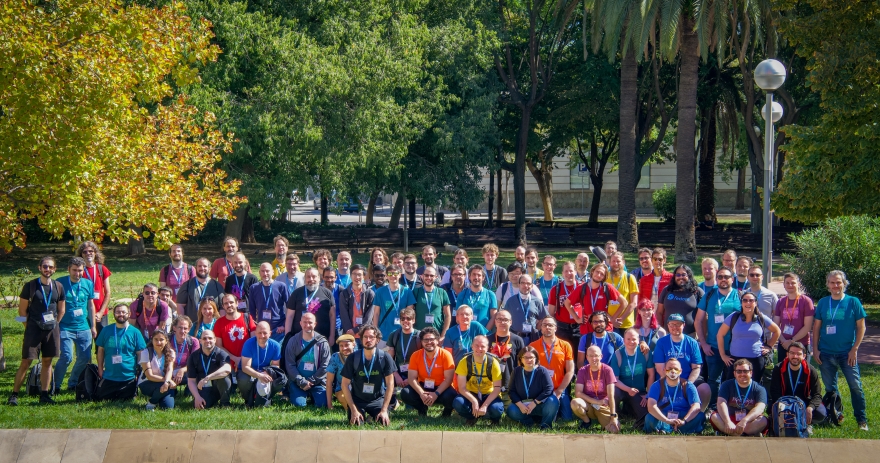
- KDE Akademy, "Akademy 2024" - official event page using KDE's Akademy group photography, the source context for the cover image.