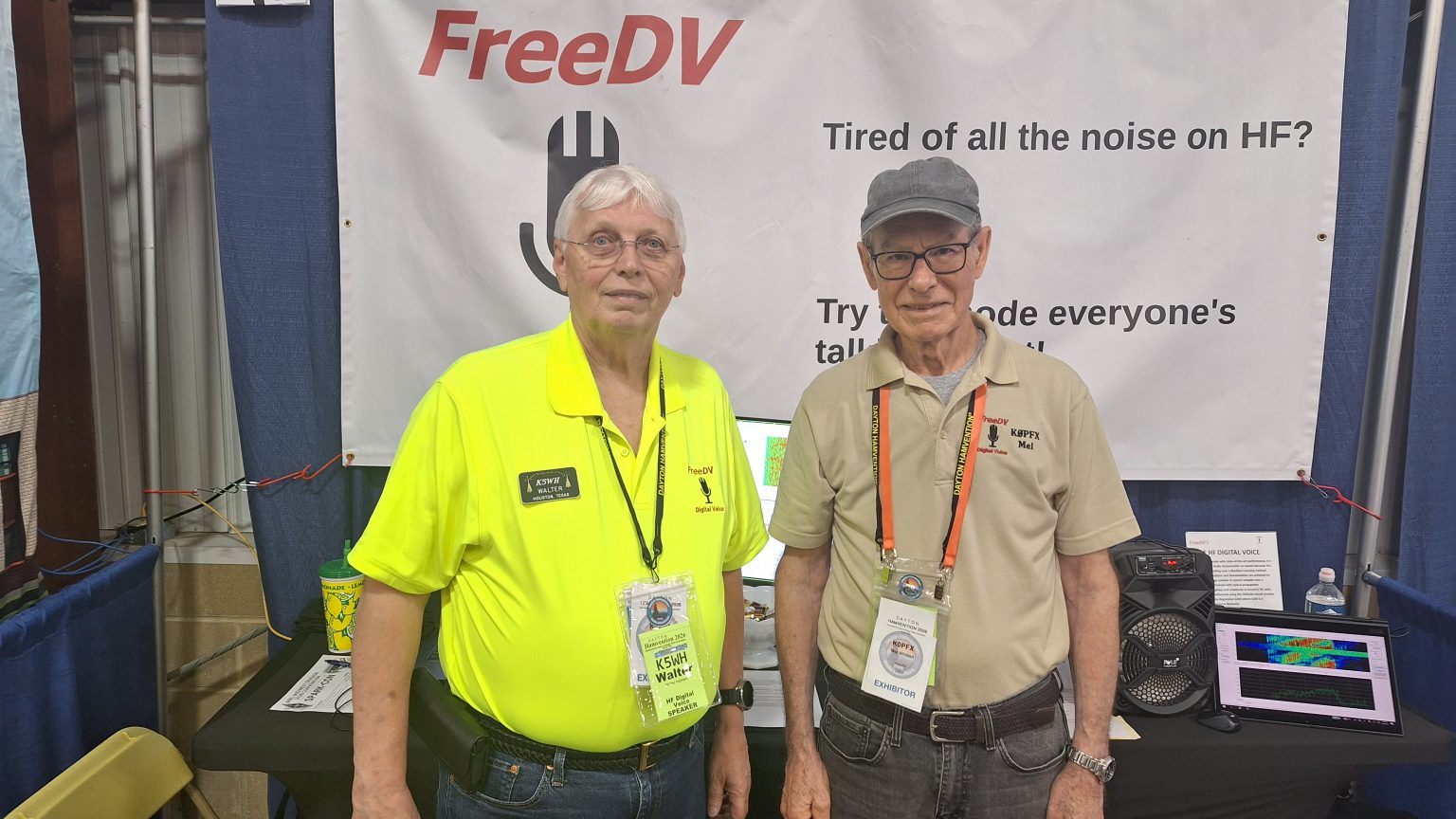
At the FreeDV booth at Hamvention in May 2026, the demonstration was a conversation coming through a radio. Mel Whitten and Walter Holmes used remote connections to their stations to show visitors RADE, the project's newer voice mode.[2] The appeal was immediately practical: could a voice arriving over a noisy high-frequency radio path become easier to listen to?
FreeDV is an open-source application and family of voice modes for HF, the shortwave bands used by radio amateurs for long-distance contacts. Its desktop application runs on Windows, macOS and Linux, connecting speech software to an existing single-sideband, or SSB, radio.[1] For an operator with a suitable station, that makes trying a different way of carrying speech possible without replacing the transceiver.
A voice reconstructed at the other end
RADE stands for Radio Autoencoder. The figures here concern RADE V1; the project currently describes V2 as being in beta testing. V1 carries speech with an audio bandwidth of 8 kHz using roughly 1.5 kHz of radio-frequency bandwidth.[3] Those numbers describe different things: the range of sound reconstructed for the listener and the slice of spectrum occupied by the transmitted signal.
The unusual part is what passes between them. In David Rowe and Jean-Marc Valin's research paper, the encoder takes features describing speech, including pitch and spectral shape, and turns them into continuously valued modulation symbols. There is no intermediate payload bitstream of the conventional kind. At the receiving end, recovered features feed a vocoder that synthesizes speech.[4]
This is more specific than adding an AI noise filter to a receiver. Both ends participate in a method for representing and transporting the voice. The model is trained with channel impairments in the loop, while established signal-processing techniques still handle tasks such as synchronization.[4]
The distinction also matters when reading older FreeDV instructions. RADE uses the FARGAN vocoder, rather than the Codec 2 speech codec associated with earlier FreeDV modes. It needs the resources of a modern computer or a Raspberry Pi 4-class machine; the project's SM1000 and ezDV adapters cannot run it.[3] A familiar project name does not make every generation of its hardware interchangeable.
The cables still have a vote
On the desktop, FreeDV needs audio from the radio, somewhere to send decoded speech, and a microphone for transmitting. A radio with its own USB sound interface can provide the radio connection; a USB headset can provide the separate listening and microphone connection. The Tools → Easy Setup dialog separates sound devices, radio control and reporting. For receive-only use, its transmit audio device can be set to None.[5]
That separation is useful when something goes wrong. Hearing ordinary radio audio in a speaker does not establish that the application is receiving it. Equally, seeing microphone activity does not establish that the radio is transmitting. Treating those as separate observations makes a silent first attempt easier to diagnose.
The setup guide asks for an unprocessed radio audio path: disable receive noise reduction and transmit speech compression. It also warns against excessive transmit drive, which distorts the waveform and worsens reception. Its From Radio, From Mic and To Speaker displays help locate clipping or missing audio.[5] Controls that make analog speech sound more forceful can therefore work against this experiment.
Better sound is a result to examine
The research offers a reason to listen carefully. Its evaluation passed 500 speech samples through simulated radio channels and used automatic speech recognition to measure word errors. RADE performed better than the comparison systems under those conditions; the paper also reports transmissions over real HF paths.[4] This supports a defined experimental result. It does not establish that every antenna, accent, interference source or listening task will behave identically.
There is encouraging operating experience, too. In an August 2026 report, funder ARDC quoted Peter Marks describing an Australian FreeDV net whose participants found RADE easier to listen to amid urban radio noise.[8] That is testimony from users, reported by an organization supporting the project. It complements the experiments without supplying an independent, controlled comparison.
For a first trial, I would arrange a contact with another operator and alternate familiar speech between modes. Compare missed words and listening effort, and write down the equipment and conditions. A pleasant sample is worth hearing; a repeatable improvement at your own station is more useful when deciding how regularly to use it.
From an application to a radio mode
There is a timely reason to look at FreeDV again. The August 25, 2026 release of version 2.4.0 included updated desktop software and integrations for FlexRadio equipment. Its Docker package can be uploaded through SmartSDR on the 8000 and Aurora series; separate packages support running the integration on a computer or Raspberry Pi.[6] That is a specific hardware path, not a promise of installation inside every SSB transceiver.
Independent commentator Steve Stroh singled out the in-radio integration in his Hamvention report. He treated the ability to select FreeDV alongside an established mode as a significant development.[7] His observation captures the practical stakes: an experimental technique becomes easier to revisit when starting it requires fewer separate pieces of software.
FreeDV remains useful as a desktop experiment, too. The project publishes its implementation, including the speech technology, and offers FreeDV Reporter to help operators find one another.[1] For an individual amateur, the entry point can be a receive-only setup. For a small club sharing a station, I would first document a working audio configuration and assign someone to maintain it before inviting members to change settings.
The booth demonstration poses a good question for either audience. Once the connections work, can you follow the other person with less effort? Open source gives the experiment room to continue beyond that first answer: operators can inspect how the voice is carried, compare implementations and contribute the awkward real-world cases that a clean demonstration leaves out.
Sources
- FreeDV, project introduction, source-code links and community resources — application platforms, open implementation and FreeDV Reporter.
- FreeDV / Mooneer Salem, “Our experience at Hamvention 2026” (May 22, 2026) — booth demonstration account and source of the photograph.
- FreeDV, “RADE – Radio Autoencoder” — V1 bandwidth, FARGAN, computing requirements, adapter limitations and V2 development status; accessed November 5, 2026.
- David Rowe and Jean-Marc Valin, “RADE: A Neural Codec for Transmitting Speech over HF Radio Channels,” revision 2 (July 26, 2025) — signal representation, training and evaluation.
- FreeDV, “Getting Started” — audio connections, Easy Setup, radio control, signal levels and processing settings; accessed November 5, 2026.
- FreeDV / Mooneer Salem, “FreeDV 2.4.0 released” (August 25, 2026) — desktop release and supported integration packages.
- Steve Stroh, “Zero Retries 0251” (May 2026), “FreeDV RADE in FlexRadio” — independent commentary on the significance of in-radio integration.
- Rebecca Key, ARDC, “FreeDV RADE: A New Approach to Digital Voice over HF, Now Integrated into Popular Radios” (August 27, 2026) — funder report including Peter Marks's account of operating experience.