FreeCAD has crossed the line where the adoption question is no longer "is there a free parametric CAD program?" The better question is whether a team can move real modeling work into FreeCAD without carrying old failure habits with it. Version 1.0, released in November 2024, brought the long-running topological-naming mitigation into the mainline release and added a built-in Assembly workbench; version 1.1 followed in March 2026 with another broad layer of usability, Assembly, FEM, and CAM work; 1.1.1 then shipped in April as a patch release with many fixes across workbenches and platform surfaces.[1][2][3]
That sequence matters because CAD adoption is not like swapping a formatter or a terminal prompt. A parametric model is a history of design decisions. When a team changes CAD systems, it is also changing how designers name references, build sketches, mate parts, produce drawings, prepare toolpaths, and trust older files. FreeCAD 1.x is strongest when the migration is treated as a modeling-stability project first and a license-cost project second.
Start with the brittle-model problem
The phrase that follows FreeCAD everywhere is the "topological naming problem." The official documentation describes the issue as geometry changing internal names after modeling operations, which can break downstream references in later features.[4] In practical terms, a face that a pocket, fillet, drawing view, or assembly constraint depended on may stop being the same face after an earlier feature changes. This problem is not only a FreeCAD problem, but FreeCAD's older releases made users unusually aware of it.
FreeCAD 1.0 changed the adoption posture by shipping a mitigation algorithm for this problem. The project announcement framed the change as a major reason 1.0 could finally carry a "real work" milestone, while also making clear that the fix was not the end of all model breakage.[1] Libre Arts' independent 1.0 analysis makes the same useful distinction: many topological naming failures are mostly gone, but it is still possible to build fragile models in any parametric CAD system.[6]
That is the first migration rule. Do not pilot FreeCAD with a demo cube and call the test successful. Pick the models that usually expose your team's bad habits: brackets with repeated edge references, parts that change thickness late, sketches copied across revisions, drawings that depend on fragile generated geometry, and assemblies where constraints were made directly to volatile faces. Rebuild those in 1.1.1, change upstream features, recompute, and record what breaks. If the test does not include deliberate edits, it is testing drawing ability rather than model resilience.
Treat Assembly as a workflow choice
The built-in Assembly workbench is the second reason FreeCAD 1.x feels different. The 1.0 release highlighted a new included Assembly workbench using the Ondsel solver, and the current Assembly documentation centers the workflow around inserting parts, grounding components, and connecting them with joints.[1][5] Libre Arts describes the 1.0 Assembly path as a bottom-up workflow: create an assembly, insert parts as links, ground one part, connect parts with joints, set offsets and limits, and test motion.[6]
That gives teams a cleaner standard path than the older FreeCAD world of multiple external assembly workbenches and local preference. It does not remove the need for a policy. A small team should decide early whether assemblies reference body features, datum geometry, local coordinate systems, or named stable construction objects. It should decide how joints are named, where offsets live, when a part becomes a separate file, and whether bills of materials or exploded views are generated from the same assembly source. Without that policy, a built-in Assembly workbench merely makes inconsistency easier to share.
The conservative migration pattern is to create one pilot assembly that represents a real job but not the largest job. Include moving joints, purchased components, a drawing page, at least one part revision after mating, and one bill of materials pass. Then change a base dimension and watch the failure surface. If the model survives, the team has evidence. If it breaks, the breakage teaches the reference policy before the team has hundreds of files in the new pattern.
Use 1.1 as a polish signal, not a magic threshold
FreeCAD 1.1 is useful because it is not just a victory lap after 1.0. The release announcement names transparent Part Design previews, interactive draggers for tools such as Fillet and Chamfer, three-point lighting, a Clarify Selection tool, Assembly and FEM improvements and animations, and a new CAM tool-library system.[2] Those are the kinds of changes that reduce daily friction: selection ambiguity, preview confidence, manufacturing setup, analysis workflow, and motion inspection.
The patch stream is equally important. GitHub's 1.1.1 release notes show backported fixes across Spreadsheet, Core, measurement, GUI, Draft, BIM, PartDesign, TechDraw, CAM, Mesh, Assembly, and platform-specific code.[3] That breadth should shape rollout. FreeCAD is moving fast enough that teams should not freeze on a first impression from 1.0 or a weekly build. They should pin a stable release for production files, test patch releases quickly, and keep weekly builds separate for evaluating regressions or upcoming fixes.
This is especially important for shared workstations and training labs. FreeCAD's June 2026 versioning announcement says the project is switching to a YY.N calendar-versioning scheme, aiming for three major releases per year, with a quality-focused January branch and later releases balancing fixes and features. The first release under the new scheme is planned as 26.3, with a branch on September 30, 2026 and expected shipping 4-6 weeks after branching.[7] That cadence is good for a project that needs faster stabilization loops, but it also means organizations need a version policy instead of letting every designer install whatever is newest.
Where it fits now
FreeCAD 1.x is a strong candidate when the team values inspectable files, scriptability, cross-platform access, Python extension points, and no per-seat licensing constraint. It is especially interesting for education, small mechanical design teams, makerspaces, research hardware groups, fixtures, jigs, repair parts, machine-shop preparation, and organizations that want CAD work to remain close to open tooling. The 1.0 cycle also made the surrounding workbenches harder to ignore: BIM absorbed Arch and NativeIFC work, Path became CAM, FEM terminology and tools were improved, Sketcher was heavily revised, and a new material system and App::VarSet gave parametric design more explicit handles.[1][6]
The weak-fit cases are just as clear. If the workflow depends on a mature enterprise PDM system, certified vendor support, deeply standardized drawing release controls, complex class-A surfacing, large supplier ecosystems, or regulated traceability built around an existing commercial stack, FreeCAD should be piloted as a secondary lane before it touches release authority. The question is not whether FreeCAD can produce serious work. It can. The question is whether the surrounding organization can support the same seriousness in version control, review, templates, training, and recovery.
A sane migration plan
Start with a fresh install of the latest stable release, not a random weekly build. Capture the exact version in the project README or design-control document. Build three representative models: one single part with late feature edits, one assembly with joints and a drawing, and one manufacturing or analysis workflow if CAM or FEM matters. For each model, perform upstream edits after the model looks finished. The result you want is not "no problem ever." The result you want is predictable failure and repair: named sketches, stable references, documented recompute steps, and file history that a second person can understand.
Next, define team conventions. Use datum or construction geometry where volatile faces would create brittle references. Name sketches, bodies, parts, and joints as if someone else will debug them six months later. Decide which workbenches are allowed in production files and which add-ons remain experimental. Keep template files under version control. Save exported STEP, PDF, DXF, or toolpath artifacts alongside the source file only when they represent an approved release, not every local experiment.
Finally, choose a fallback boundary. For the first several jobs, keep the old CAD system available for release-critical deadlines and use FreeCAD on bounded scopes where learning does not endanger shipment. The falsifier is concrete: if routine upstream edits still break pilot models in ways the team cannot diagnose or repair, the migration is not ready. If those edits become understandable and the team can document the repair pattern, FreeCAD has passed the test that matters.
FreeCAD 1.x should not be sold internally as "commercial CAD, but free." That undersells what changed and overpromises what did not. The stronger claim is narrower: FreeCAD has become a credible open CAD platform when the team treats model stability, assembly references, release cadence, and file governance as part of the adoption plan. The license removes a procurement barrier. The migration succeeds only if the modeling practice gets better.
Sources
- FreeCAD News, "FreeCAD Version 1.0 Released," November 19, 2024 - official 1.0 announcement covering topological-naming mitigation, built-in Assembly, BIM/CAM/FEM/Sketcher changes, materials, and project milestone framing.
- FreeCAD News, "FreeCAD Version 1.1 Released," March 25, 2026 - official 1.1 announcement covering Part Design previews, interactive draggers, selection, Assembly, FEM, and CAM tool-library improvements.
- FreeCAD/FreeCAD, "FreeCAD 1.1.1" GitHub release, April 2026 - patch-release change list and latest stable release context used for rollout guidance.
- FreeCAD Documentation, "Topological naming problem" - official explanation of the geometry-reference problem that affects parametric model stability.
- FreeCAD Documentation, "Assembly Workbench" - official Assembly workbench documentation for parts, grounding, joints, preferences, and examples.
- Aleksandr Prokudin, "FreeCAD 1.0: new features and the larger picture," Libre Arts, November 19, 2024 - independent release analysis covering toponaming, Assembly, Sketcher, Part Design, FEM, BIM/CAM, VarSets, and governance context.
- FreeCAD News, "New FreeCAD versioning scheme and development cycle," June 26, 2026 - official CalVer and three-release-per-year cadence announcement.
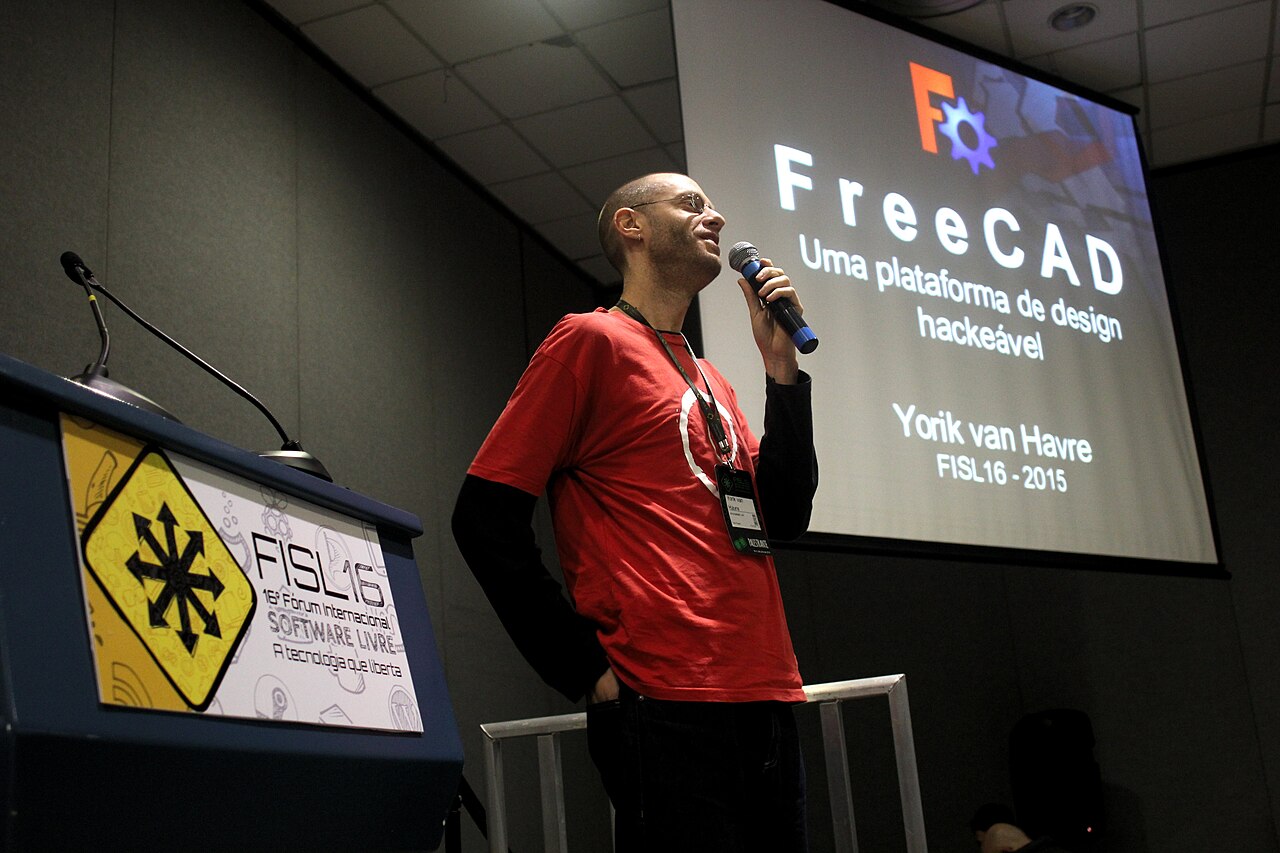
- Wikimedia Commons, "FreeCAD - uma plataforma de design hackeavel, com Yorik van Havre - Foto Guilherme Almeida (19605970385).jpg" - real photograph used as the article image source.