
The easiest way to flatten Falco is to describe it as a runtime-security daemon that watches syscalls and emits alerts.[1][2][3] That sentence is still directionally true. It is also too small for what the project is trying to become. The strongest part of "In Falco's Nest: The Evolution of Cloud Native Runtime Security" is not the generic promise of detection. It is the way the maintainers keep shifting attention from the sensor to the operating model around it: event sources, rule layering, operator reconciliation, and the failure mechanics that show up once a busy cluster starts dropping visibility.[1]
That makes the talk worth embedding now. Falco's own documentation still begins in the right place: a monitoring and detection agent that observes Linux kernel events and other data sources through plugins, then evaluates rules and sends alerts in real time.[2] But the 2026 maintainer framing adds a more useful engineering claim. Falco is no longer most legible as a single binary with a rules file attached. It is better understood as a stateful detection engine whose value depends on how event sources are extended, how rule artifacts reach every node, and how the system recovers when load outruns a naive single-threaded path.[1][3][4][6]
The article's thesis follows directly from that shift: Falco matters less as a marketing category called "runtime security" than as a design problem about where visibility begins, where policy lives, and how much operational machinery is required to keep both in sync across Kubernetes.[1][2][5][6]
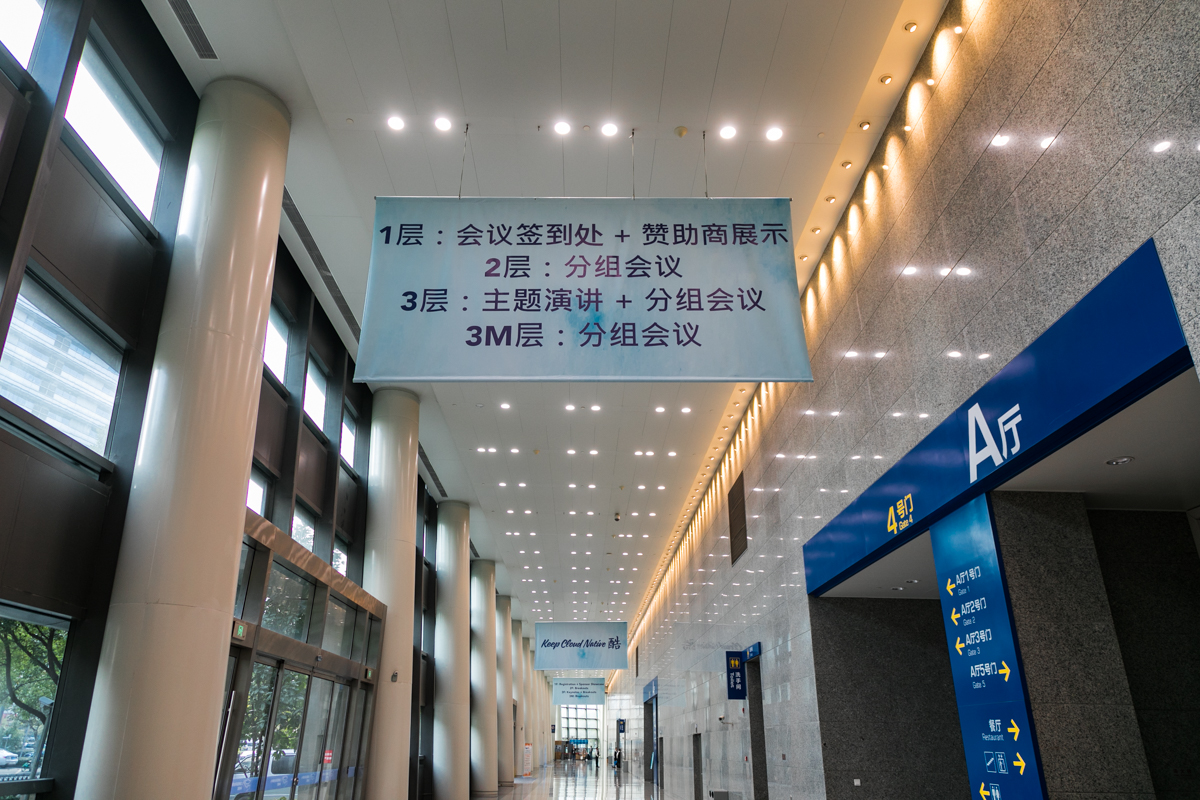
Image context: the cover uses a real KubeCon + CloudNativeCon venue photograph with on-site wayfinding signage rather than a logo, chart, or architecture slide. That choice keeps the visual language immersive and topic-grounded: this article is about operational reality around Falco's runtime model, not abstract diagram aesthetics.[7]
Around 1:45 to 4:00, the talk clarifies that Falco is a rule engine wrapped around multiple event lanes
The opening explanation is deceptively basic. One maintainer uses the familiar "security camera" analogy, then immediately grounds it in implementation: Falco gets kernel-level visibility through eBPF instrumentation or a kernel module on legacy systems, sends those events to a user-space detection engine, and evaluates YAML-defined rules against them.[1][3] If the talk stopped there, it would be a standard project overview.
It does not stop there. Within the same early stretch, the speakers push past the syscall-only image and emphasize two extensions that matter more in practice: you can alter the predefined ruleset, and you can extend Falco with plugins that either produce new event streams or enrich existing ones with metadata from container runtimes and Kubernetes.[1][4] That is the first important boundary correction. Falco is not just "watch the kernel, then alert." It is "normalize multiple event sources into one detection grammar, then decide where policy should attach."
Falco's docs support exactly that reading. The project overview describes Falco as a detection agent that can observe Linux kernel events and "other data sources through plugins."[2] The kernel-events page explains the low-level capture lane, while the plugin-events page makes explicit that supported plugins can bring in Kubernetes Audit, AWS CloudTrail, and Okta event sources alongside the traditional syscall stream.[3][4] Held together, those sources make the early minutes of the video more important than they first appear. The project's center of gravity is no longer the syscall itself. The center of gravity is the rule engine's ability to keep heterogeneous event sources legible enough for one policy surface.
That matters because many teams still evaluate Falco as if it were a narrow host probe. The talk's early architecture framing says otherwise. Falco begins with kernel truth, but it becomes operationally useful only when that truth can be enriched, correlated, and filtered without forcing every environment into the same single-source security model.[1][2][4]
Around 7:40 to 15:15, the real 2026 shift appears: Falco becomes a Kubernetes reconciliation problem
The middle section is where the talk stops being a product update and starts becoming an architecture talk. Aldo Lacuku draws a blunt line between Helm and the new operator: Helm is fine for getting started, but once the chart is deployed it steps back, which means it does not watch rules files, plugin drift, or accidental deletion of ConfigMaps that Falco relies on.[1] That sentence is the clearest explanation of why the operator matters. The problem is not installation. The problem is ongoing convergence.
From there the talk gets more specific than most "operator" pitches do. Because Falco runs as a DaemonSet on every node, a centralized controller alone is not enough; rules, plugin configuration, and related artifacts still need to land inside each pod that is actually performing detection.[1] The answer shown on stage is a two-part design: a user-facing operator plus an artifact sidecar that watches artifact APIs, shares filesystem paths with Falco, and places plugins, config, and rules where the Falco container can reload them.[1][5] That is a meaningful architectural claim, not just a packaging tweak. It moves Falco closer to a managed control plane for runtime policy distribution.
The layering model matters just as much. In the talk, Lacuku explains that rules can now coexist across OCI artifacts, ConfigMaps, and inline overrides, so teams can pull base rules, layer custom rules on top, and then surgically override behavior without collapsing everything into one giant file.[1] The engineering consequence is larger than the demo language. Once rules become layered artifacts instead of one static payload, Falco starts behaving like a continuously reconciled policy system rather than a one-shot detector binary.[1][5]
That is the section most worth watching if you operate Kubernetes at any scale. The value proposition is not "operators are modern." The value proposition is that runtime detection fails quietly when rule distribution, plugin lifecycle, and per-node state drift apart. Falco's 2026 operator story is really an attempt to close that drift budget before alerts become untrustworthy.[1][5]
Around 16:50 to 21:05, the performance story reveals the project's hardest boundary: lost events mean lost state
The final section that matters most is the performance segment, because it names the failure mode directly instead of hiding it inside benchmarks. The maintainers explain that Falco has historically recovered system information by scanning /proc during initialization and during state recovery after dropped events, but that approach is expensive: it opens and reads huge numbers of small files and generates more work for the engine in the process.[1] This is not a cosmetic optimization problem. It is a visibility problem.
Their answer comes in two parts. First, they describe using BPF iterators, available from Linux kernel 5.8 onward, to traverse kernel structures more efficiently for tasks like thread-state recovery.[1][3] Second, they explain why a single-thread event loop that once felt "blazingly fast" becomes a liability on modern highly parallel machines, where saturation can cause dropped events and reduced visibility.[1][6] The proposed multithreading approach, partitioning events by thread-group ID to keep local consistency while exploiting parallelism, is presented as an architectural necessity rather than a nice-to-have.[1]
This is the point where the whole article folds together. Falco is a stateful engine. The minute it drops too many events, it stops being merely delayed and starts becoming partially blind.[1][6] That is why the operator section and the kernel/probe section belong in the same article. Runtime security here is not one thing. It is a chain: event capture, enrichment, rule delivery, and state recovery. If any link goes soft, the alerts may continue while the model underneath them gets less trustworthy.
That is also why this talk is more useful than a generic "what is Falco?" overview. It gives the project a harder shape. Falco in 2026 still begins with kernel probes and plugin-fed event sources, but the decisive engineering work is happening around distribution and failure containment: how rules arrive, how plugin state stays converged, and how the engine preserves enough thread-level truth to remain believable under load.[1][2][3][4][5][6]
Sources
- CNCF, "In Falco's Nest: The Evolution of Cloud Native Runtime Security - Iacopo Rozzo & Aldo Lacuku," YouTube video, published April 9, 2026.
- Falco, "The Falco Project" - official overview of Falco as a monitoring and detection agent for kernel and plugin-fed events.
- Falco, "Kernel Events" - official documentation on syscall event capture through eBPF instrumentation or a kernel module.
- Falco, "Plugin Events" - official documentation on plugin-provided event sources such as Kubernetes Audit, CloudTrail, and Okta.
- Falcosecurity, "falco-operator v0.2.0" - GitHub release page for the operator release the speakers describe as production-ready.
- Falco, "Falco Is Dropping Syscalls Events" - troubleshooting guide explaining why dropped events reduce visibility and how Falco reports them.
- Wikimedia Commons, "File: KubeCon CloudNativeCon China 181114 daily01-01 (44961094325).jpg" - source page for the cover venue photograph used in this article.