
Most API clients describe themselves in terms of protocol coverage, test runners, or interface polish. Those things matter, but they often distract from the more durable question: where does the state of API work actually live? In a surprising number of tools, the answer is some mixture of workspace database, team cloud account, exported bundle, and sync layer. You can still collaborate, but the collaboration surface is partly outside the repository and partly outside ordinary review habits.
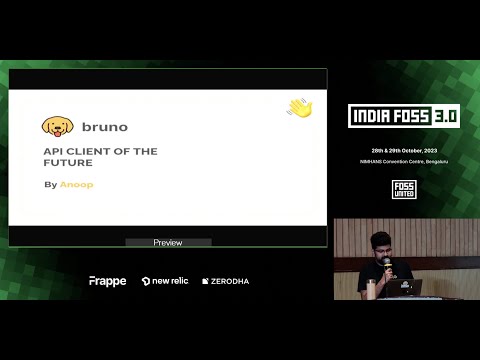
Anoop M D's IndiaFOSS talk on Bruno is useful because he keeps returning to a narrower and more consequential claim. Early in the talk he says Bruno stores collections as files, uses Git for collaboration, and stays fully offline with no server component and no plan for cloud sync.[1] The official docs and README make the same promise in calmer product language: Git-friendly collaboration, offline-first use, plain-text collections, no required account, and a workflow that can sit directly alongside source code.[2][3][7] Read together, the video and docs suggest that Bruno is less a prettier request sender than an attempt to move API work back into the same artifact model developers already trust for code.
That is the lens worth carrying into the rest of the talk. My inference from the video plus the docs is that Bruno's real design bet is repository-native API state. The product's value is not mainly that it can send a REST or GraphQL request. Plenty of clients can do that. The value is that collections, scripts, environments, and collaboration history can be treated as ordinary files with ordinary diffs, ordinary pull requests, and ordinary local ownership.[1][2][3][4][5][6][7]
Image context: the cover uses Anoop M D's real GitHub profile portrait. That choice fits because this article is built around a founder-maintainer explanation of a workflow model, not around decorative product UI. The point is the design stance behind Bruno, not a generic screenshot of an API panel.[8]
Around 1:53, collections become repository artifacts before they become app state
The strongest part of the talk arrives surprisingly early. Around 1:53, Anoop says Bruno stores collections as files, uses Git for collaboration, and remains fully offline; a few seconds later he adds that there is no server component in Bruno and no plan for cloud sync.[1] That sequence matters because it defines the product by storage and collaboration semantics before it defines the product by interface.
The documentation reinforces the same order of importance. The getting-started guide introduces Bruno as a Git-friendly, offline-first API client for fast local workflows and plain-text collections.[2] The README is even more explicit: collections live directly in a folder on your filesystem, the Bru markup language stores request information as text, and there are no plans to add cloud sync.[7] None of that is just branding. It is a decision about where truth should live.
This is the first reason Bruno feels materially different from a workspace-centric client. If the canonical representation of a request collection is already a set of local files, then backup, review, branching, and historical audit all inherit the same machinery that developers already use for source code.[2][3][7] You do not need a second mental model for "API stuff" and a first mental model for "repository stuff." The collection can sit next to the service it describes.
That does not automatically make collaboration better. Files can still be badly structured, secrets can still be mishandled, and teams can still create noisy diffs. But the boundary is cleaner. A Bruno collection starts life as an artifact you can inspect without opening the application, and that alone changes the operational posture.
Around 5:08, the folder tree is the product boundary
Around 5:08, the talk gets even more concrete. Anoop says the thing that separates Bruno from clients like Postman and Insomnia is that Bruno saves collections, folders, and requests as folders and files.[1] That line is stronger than it first sounds. It means the app is not merely exporting an internal object graph into files as a convenience feature. The file tree is the primary surface.
The collaboration documentation makes the payoff plain. Bruno's "superpower," in the docs' own phrasing, is native collaboration through version-control systems and code-hosting platforms, including the co-location benefit of storing collections directly alongside source code.[3] That phrase, co-location, is the right one. When request definitions live near the service, schema, or SDK they belong to, the review loop tightens. API examples stop drifting into a separate admin tool that only some teammates open regularly.
The repo README points the same way with simpler words: use Git or any version control system of your choice to collaborate over API collections.[7] What looks like a UX preference is really a choice about failure modes. Hidden-workspace tools fail by creating invisible drift between what a team thinks it is testing and what the shared workspace currently contains. A file-native tool still has drift risk, but it drifts in a place where existing review machinery can catch it.
That is why I would not summarize Bruno as "local Postman." The useful summary is narrower: it treats API client state as reviewable repository material. Once that is the goal, the file tree stops being an implementation detail and becomes the product boundary itself.
Around 9:00, scripting turns Bruno from request sender into workflow runner
The back half of the talk shifts from philosophy to mechanics. Around 9:00, Anoop says he wants to get into the architecture bits of Bruno, and by 10:00 he is talking about state management from a file-system perspective.[1] Earlier, when he walks through request details, he also notes that headers, authentication, and scripts reside in the same file-centric structure.[1] This is where Bruno stops looking like a simple request tab manager.
The scripting docs show why. Bruno exposes a sizable JavaScript API for request mutation, headers, environment variables, response inspection, and chained workflow state.[4] The separate script-flow guide then defines two execution models, Sandwich and Sequential, which determine how collection-, folder-, and request-level scripts run relative to one another.[5] That is not garnish. It means the product is trying to make automation structure explicit rather than bury it in one opaque pre-request/post-response bucket.
There is a practical distinction here. A lightweight API client lets you poke endpoints. Bruno, at least by design, wants collections to carry executable behavior with them: tests, setup logic, environment state, and repeatable flow ordering.[2][4][5] Once those behaviors live in files that can be committed and reviewed, the collection stops being a disposable scratchpad and starts behaving more like a small, inspectable workflow package.
This is also where the repository-native model becomes more demanding. File-based automation is only valuable if teams keep scripts legible and execution order understandable. Bruno provides the primitives, but those primitives can still produce a mess if every collection turns into a miniature test framework. The docs are useful precisely because they articulate the boundaries: a request API, a flow model, and scoped environment access rather than a magical automation blob.[4][5]
Around 11:47, format portability matters because the artifact should outlive the app
Late in the talk, around 11:47, Anoop says Bruno will support saving things in JSON, YAML, or TOML.[1] The current documentation shows how that direction matured. The Bru language overview says .bru files remain fully supported, while OpenCollection YAML is now the recommended format for new collections because it is an open specification based on standard YAML and integrates more easily with existing tooling.[6] That is a revealing evolution.
If the real goal were only to make one desktop client pleasant to use, the internal format would matter mostly to Bruno itself. But if the goal is to make API collections durable repository artifacts, format choices matter a lot. They affect review readability, interoperability, migration cost, and the ability of other tools to participate without reverse-engineering a private schema.[6][7] In that light, format openness is not a side quest. It is part of the same design discipline as offline-first storage and Git-native collaboration.
The docs quietly round out the picture by showing Git collaboration, scripts, tests, collection running, and CLI execution as parts of one workflow rather than separate premium surfaces.[2][4][5][6] That matters because a durable artifact has to travel. It should be comfortable in the desktop app, comfortable in a repository, and still usable from automation lanes. Bruno's docs do not solve every migration or team-process problem, but they do keep aiming at the same answer: make the collection readable, local, and portable enough that it can survive outside the application that authored it.
That is the main lesson I take from this video. Bruno is worth watching not because it promises every feature under the API-client sun, but because it is unusually clear about what it refuses to center: server-side workspace state, account-gated sync, and collaboration that lives somewhere other than the repository.[1][2][3][7] Its stronger promise is smaller and more credible. Let API work behave like reviewable engineering artifacts, then build scripting and automation on top of that foundation.
Sources
- Anoop, "Bruno Talk - IndiaFoss 3.0 Conference," YouTube video, published October 29, 2023.
- Bruno Docs, "Getting Started" - Git-friendly, offline-first positioning, plain-text collections, local workflows, scripting, Git collaboration, and CLI usage.
- Bruno Docs, "Collaboration in Bruno" - native version-control collaboration, GUI/CLI Git paths, and co-location with source code.
- Bruno Docs, "JavaScript API Reference" - request, response, environment, and runner scripting primitives.
- Bruno Docs, "Script Flow in Bruno" - Sandwich and Sequential execution models for collection-, folder-, and request-level scripts.
- Bruno Docs, "Bru Markup Language" - continued
.brusupport and the recommendation to use OpenCollection YAML for new collections. - Bruno GitHub README - file-based collections,
Brutext format, Git collaboration, offline-only stance, and link back to the IndiaFOSS talk. - GitHub API profile for
helloanoop- source page for the portrait image used in this article.