Backstage is easy to misread if you look only at the homepage demo. The catalog cards, docs panes, and plugin tiles can make it feel like a polished internal portal product that simply accumulates integrations over time. In 2026, the stronger reason to take the project seriously is not the interface. It is the governance underneath it. Backstage has grown large enough that the core risk is no longer "will this idea catch on?" The real risk is whether an internal developer platform can stay extensible without becoming an unreviewable junk drawer. The project looks healthier than many OSS platforms in that position because its maintainers have turned extension pressure into process rather than leaving it to habit.[1][2][3][4]
That is the governance signal worth reading. Backstage now ships on a visible monthly stable cadence, runs a weekly next-release line, keeps older versions on security updates for a bounded window, splits code ownership into project areas, and moves a long tail of plugins into a separate community-maintained repository with its own workflows.[1][2][3] Those choices do not make Backstage simple. They make it legible.
As of 2026-04-12T23:04:34Z UTC, the GitHub API reports 33,074 stars, 7,262 forks, 493 open issues, and a most recent push at 2026-04-12T22:54:00Z for backstage/backstage.[5] The release feed shows a stable v1.49.4 published on 2026-04-07T13:19:23Z and a prerelease v1.50.0-next.2 published on 2026-04-07T17:49:30Z.[6] Those figures matter less as popularity theater than as evidence that the project is still shipping in two lanes at once: one for operators who need predictability, one for contributors who need forward motion.
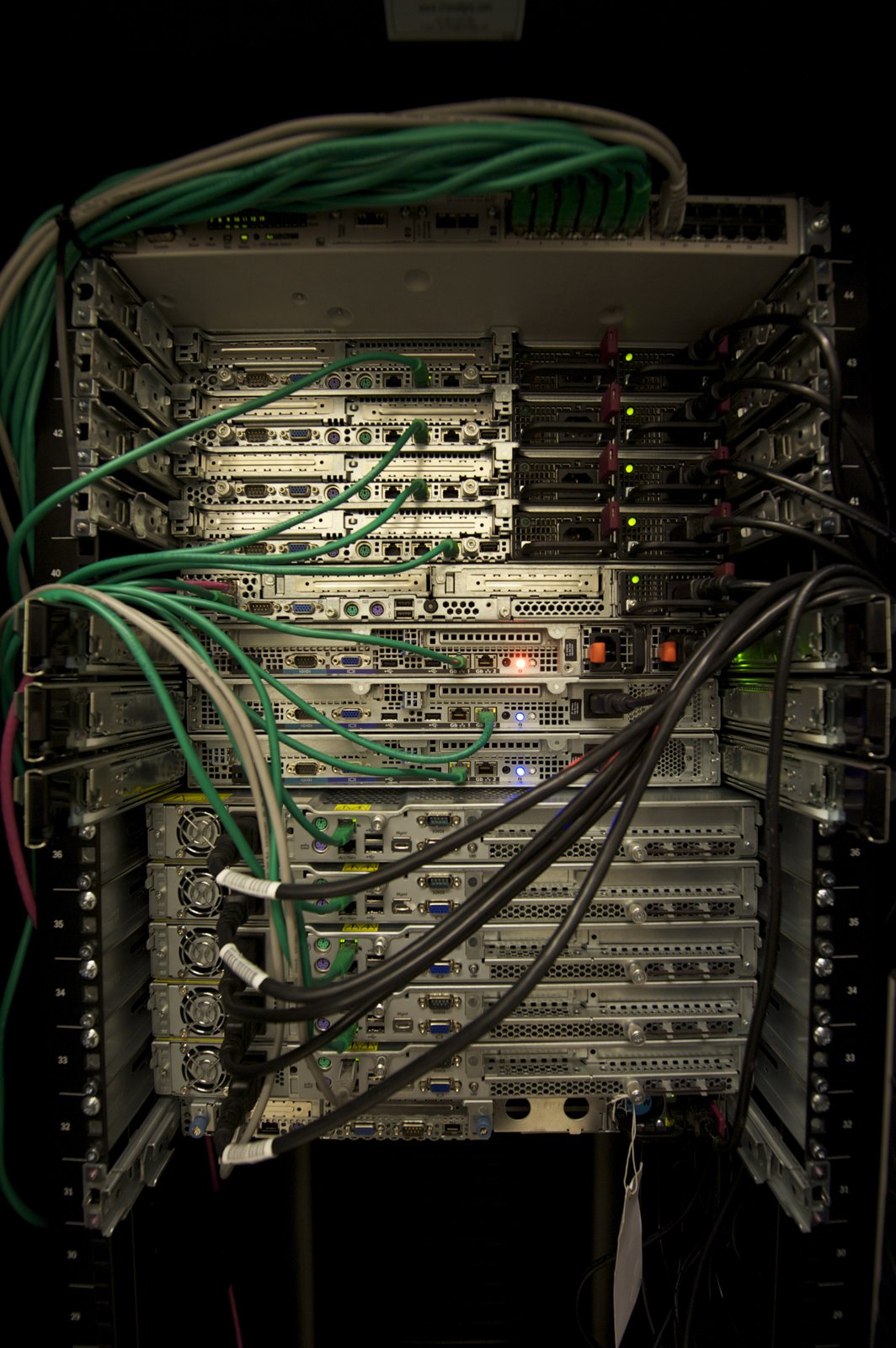
Image context: the cover uses a real datacenter infrastructure photograph rather than a portal screenshot. That choice fits because this article is about maintainership, operational boundaries, and internal-platform discipline under real production constraints, not decorative UI chrome.[9]
1. Release policy is part of the product
Backstage's versioning policy is unusually explicit about time. The stable line releases monthly, specifically on the Tuesday before the third Wednesday of each month, while the next line releases weekly for users who want earlier access to upcoming changes.[2] That is already a useful signal. Many large OSS platforms drift into a vague release story where maintainers promise "frequent" shipping and operators absorb the uncertainty. Backstage instead gives teams two recognizable contracts.
The important part is that the project pairs cadence with support boundaries. The same policy says older Backstage versions receive security updates for the last six months if feasible.[2] Inference from that policy plus the live release feed: the maintainers are treating upgrade rhythm as part of the operating model, not as accidental housekeeping.[2][6] Stable users are told when to expect movement; adventurous users are given a weekly lane without pretending it carries the same compatibility guarantees.
That separation matters because Backstage is not a small library anymore. It is a broad internal platform with frontend packages, backend plugins, scaffolding actions, and catalog behavior that can all shift underneath adopters. A project of that size needs temporal discipline before it needs another feature. The monthly stable plus weekly next split is how Backstage avoids forcing every adopter into the same risk appetite.[2][6]
2. Ownership is decomposed instead of romanticized
The governance document is strong because it does not hide scaling problems behind generic community language. It says the project is divided into project areas, that there may be no overlap in ownership between areas, and that every area must have at least one maintainer.[1] That is a concrete answer to monorepo sprawl. Backstage is not trying to manage a growing platform through one undifferentiated circle of "core contributors." It is creating smaller ownership cells and making them inspectable.[1]
The role ladder is equally revealing. Organization members are expected to remain active, with a guideline of at least 10 contributions per year in Devstats or equivalent effort. Reviewers need at least 5 reviews per year to keep the role meaningful. Plugin maintainers are treated as a lightweight ownership lane that still folds them into organization membership.[1] Those are not glamorous rules, but they are the kind of boring thresholds that keep a successful OSS project from turning into a popularity contest.
My inference from the governance file is that Backstage's maintainers understand the real scaling problem. The problem is not only code volume. It is review priority, succession, and making sure contribution pathways do not collapse into a single central bottleneck.[1] For an internal developer platform, that matters as much as any plugin announcement.
3. The community-plugins repo is a pressure valve, not a side alley
The community-plugins repository is one of the clearest signs that Backstage is trying to govern extension rather than merely celebrate it. Its README says the repo was created to separate plugin maintenance from the backstage/backstage core repository.[3] That is the right instinct. Once a platform gets popular, the main repo can become a dumping ground for every integration request unless maintainers create a distinct lane for long-tail plugins.
The details make the separation more credible. Community plugins use standardized release workflows, isolated changesets per workspace, and version-package pull requests that trigger releases for the affected workspace.[3] At the same time, self-hosting is explicitly described as a valid alternative for teams that want full autonomy, while plugins that are key to Backstage's functionality remain in the core repo.[3] This is a more mature posture than pretending every extension belongs in one place.
That division tells operators something important about trust. Backstage is not saying all plugins are equal. It is saying there are different governance lanes for different kinds of code. Core functionality stays centrally maintained. Community-maintained integrations get shared workflows without inheriting the exact same weight as core. Teams that want full control can self-host. That is how a plugin ecosystem becomes governable instead of merely large.[1][3]
4. The security model stays useful because it admits what Backstage is
Backstage's threat model is valuable because it starts from a boundary many portal products prefer to blur. The document says the security model currently assumes that an external user does not have direct access to Backstage, and it places responsibility on adopters to make sure that remains true.[4] That is not a universal web-app promise. It is an internal-platform promise.
The rest of the document follows the same logic. For the catalog, the guidance recommends allowing reads only from trusted SCM sources with an audit trail if teams need to mitigate resource-exhaustion or registration abuse. For scaffolding, operators are told to audit installed actions like any other plugin package.[4] In other words, Backstage is not selling a fantasy in which extensibility is automatically safe. It is telling adopters where trust has to be curated.
That realism is reinforced by the 2024 audit cycle. Backstage's December 2024 security-audit post says the review found three high and one medium severity vulnerabilities plus seven side findings, with all main findings remedied in the 1.31 release and most side findings addressed by 1.32.[7] X41's independent write-up describes the same audit as a source-code review of Backstage v1.30.0, notes that the issues were addressed by the Backstage team, and points to the public report.[8] The project looks healthier not because it had no bugs, but because it is now operating like a platform that expects scrutiny, publishes a threat model, and closes the loop after outside review.[4][7][8]
5. Best-fit boundary and mismatch boundary
Backstage is strongest when an organization wants an internal control plane for software metadata, templates, and docs, and is willing to staff the platform accordingly. The governance model makes most sense for teams that can live with monthly upgrades, curate their plugin set, and keep the platform inside an authenticated organizational boundary.[1][2][3][4]
The mismatch starts when adopters want Backstage to behave like a public SaaS product with zero plugin-governance cost. The project is explicit that external users should not have direct access by default, explicit that plugin trust needs operator judgment, and explicit that extension lanes have different ownership models.[3][4] Governance can make those boundaries legible. It cannot erase them.
That is why Backstage's strongest 2026 signal is not "look how many plugins exist." The stronger signal is that the project has accepted the harder problem: how to keep a successful developer platform extensible, reviewable, and security-conscious at the same time. So far, its answer has been more process, not less.[1][2][3][4][7][8]
Sources
- Backstage Governance - project areas, ownership rules, role ladder, contribution thresholds, reviewer expectations, and plugin-maintainer status.
- Backstage Versioning Policy - monthly stable cadence, weekly next releases, and the six-month security-update window for older versions.
- Backstage Community Plugins README - why plugin maintenance was separated from core, standardized release workflows, self-hosting, and which functionality stays in the main repo.
- Backstage Threat Model - internal-only boundary for external users, trusted SCM guidance for the catalog, and operator responsibility for installed scaffolding actions.
- GitHub API snapshot for
backstage/backstage- stars, forks, open issues, and most recent push timestamp at article creation time. - GitHub releases for
backstage/backstage- recent stable and next-line release timestamps, includingv1.49.4andv1.50.0-next.2. - Backstage blog, "The 2024 Backstage Security Audit" - findings count, remediation releases, and maintainers' summary of the audit cycle.
- X41 D-Sec, "X41 Audited Backstage" - independent audit summary and link to the public 2024 Backstage report.
- Wikimedia Commons file page for the datacenter server-rack photograph used as the article image.