A Git tag can be made by one person with the right credential. An official Apache release cannot. Under the Apache Software Foundation’s current policy, a release is an act of the Foundation: at least three Project Management Committee members must cast binding +1 votes, positive binding votes must outnumber negative ones, and each approving voter is required to fetch the signed source package, verify it, compile it, and test it. The vote should normally remain open for at least 72 hours.[2]
That release boundary is the clearest way to understand Apache governance. It turns authority into a reviewable sequence rather than attaching it to a founder, employer, or repository owner. Committers can change a project. A Project Management Committee, or PMC, governs it and approves what the public receives. The Foundation’s board provides corporate oversight without becoming a universal architecture committee.[1][3]
The positive signal is not that this machinery prevents bad releases, stalled projects, or concentrated influence. It does not. The signal is that responsibility has named layers and leaves evidence: a vote thread, a signed source artifact, a committee roster, a quarterly report, and—when a project is new—an incubation record. Apache’s model is strongest when those artifacts show several people exercising judgment. It weakens when the process remains visible but participation inside it becomes ceremonial.
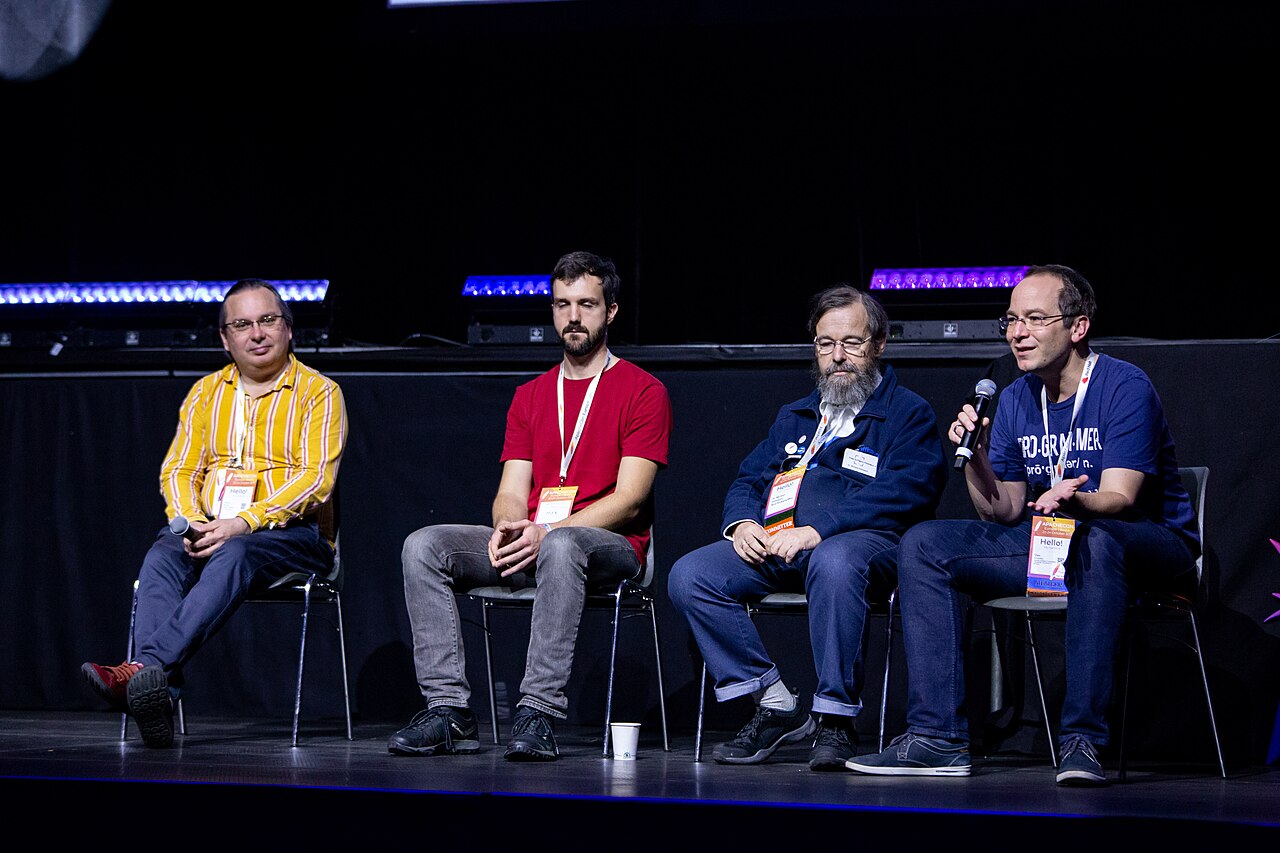
Image context: the cover photograph shows four panelists at ApacheCon Europe 2019, one speaking while the others listen. The official Foundation conference is a fitting scene for a governance story: Apache is not only a catalog of artifacts, but a community in which authority depends on people making arguments, hearing objections, and accepting responsibility together.[7]
The PMC is the unit of project authority
Apache separates three roles that a small repository often collapses into one maintainer account. A contributor can participate without write access. A committer can change code and documentation. A PMC member is a committer elected into the body responsible for the project’s governance, releases, and addition of new committers and PMC members.[1][3]
The distinction is practical. A merge is a short-term technical action; a release exposes the Foundation and the public to a package represented as Apache software. The PMC therefore holds the binding release vote as a body. An individual release manager can prepare a candidate, but cannot confer official status alone. Likewise, the Foundation’s members elect the board, yet membership in the corporation gives nobody automatic technical authority over an unrelated Apache project.[1]
This design also puts an important boundary around employers. Apache describes project roles as “hats” assigned to individuals by peers, not seats held by the companies that pay them. That does not make commercial influence disappear. A project can still depend heavily on contributors from one vendor, and formal individual voting does not prove independent judgment. It does, however, deny a sponsor an automatic block of project authority merely because it funds several engineers.
For an adopter, the useful question is not whether an Apache name sits above a repository. It is whether the relevant PMC still behaves like a committee: more than one organization represented in consequential discussion, multiple people capable of preparing and checking releases, new contributors moving into trusted roles, and decisions explained on durable channels. The legal structure provides a place for health to be demonstrated; it is not health by itself.
The release vote is a supply-chain checkpoint
Apache’s release policy draws a harder line than many users expect. A nightly build, snapshot, or release candidate may be useful for testing, but it is not an official release. The approved object must include source sufficient to build and test the software, a detached cryptographic signature, and package-level LICENSE and NOTICE files that describe what is actually inside. Once approved, artifacts move through the canonical downloads.apache.org distribution channel and are permanently copied into the Apache archive.[2]
Before a binding +1, a PMC voter must validate signatures, build the supplied source, test the result on their own platform, and check policy compliance. The minimum of three affirmative binding votes is therefore meant to represent three explicit acts of review, not three emoji reactions. The normal 72-hour window gives a distributed volunteer team across time zones a chance to participate. An expedited vote is possible for exceptional circumstances such as a critical security fix, but the shortened period must be explained and the deviation reported to the board.[2]
This is not a guarantee of reproducible builds or exhaustive security review. Three voters can share the same blind spot. Tests can miss a platform. A signature proves who signed an artifact, not that every dependency is safe. Binary convenience packages can introduce another verification boundary even when they correspond to the approved source. The policy’s value is narrower: it defines the exact moment a candidate becomes a public Foundation act and assigns people duties at that moment.
That boundary changes procurement behavior. A platform team should distinguish a GitHub tag, a container image published by an unknown automation account, a vendor rebuild, and an artifact named on the Apache project’s official download page. They may all be useful, but they do not carry the same approval path. Teams with strict provenance requirements can record the source archive, detached signature, release-vote thread, and their own build result instead of treating “Apache” as an undifferentiated trust badge.
The board watches the project without writing its roadmap
Every PMC chair is also a Foundation officer, formally a vice president for that project. The chair is responsible for ensuring that the PMC reports to the board four times a year and responds to board questions. Those reports are supposed to describe project health: community activity, releases, legal or trademark issues, and problems that may need attention. Newly graduated PMCs report monthly for their first three months.[3][4]
This creates a deliberate handoff. The PMC controls technical direction; the board supervises the nonprofit’s affairs and checks that the committee remains capable of governing in the public interest. The chair is an interface, not a project CEO. The board can ask for action and, at the corporate level, can establish or terminate a PMC, but routine architectural judgment remains with the project community.[1][4]
Quarterly reporting is a low-bandwidth control, and that is part of its design. It would not catch every toxic review exchange or predict the departure of a sole release engineer. Its value is forcing a project to periodically answer a different class of question from “did CI pass?” A stagnant committer roster, missed releases, absent votes, unresolved legal work, or concentration around one employer becomes a governance matter that can be raised outside the project’s ordinary development loop.
The falsifier is easy to state: if reports become boilerplate while the same depleted group approves every release, the reporting chain is formally intact and operationally weak. The evidence to watch is not the existence of a chair title. It is whether the PMC surfaces uncomfortable capacity problems early enough for new contributors, neighboring projects, or the Foundation to respond.
Incubation tests whether authority can outlive the import
The Apache Incubator is often described as a route for bringing code into the Foundation. Its more important job is teaching a candidate community to operate the governance chain. An incubating project, or “podling,” reports monthly for its first three months and then quarterly to the Incubator PMC. Its own podling committee prepares those reports with mentors and must explain progress toward graduation as well as problems encountered.[5]
That process separates code arrival from institutional readiness. A technically impressive repository can still lack an independent decision-making community, clean intellectual-property records, release discipline, or enough people able to carry trusted roles. Mentors can demonstrate Apache procedure, but they cannot manufacture durable participation. Graduation should therefore be read as evidence that the community can govern a top-level project, not as a benchmark of feature completeness or commercial adoption.
Independent research supplies a useful counterweight to Apache’s formal account. A CHI 2024 study examined mailing-list governance across 208 projects in the Incubator. It found that communities tended to observe formal requirements where those requirements were defined, while their everyday governance attention did not necessarily center on the same topics; formalization itself also had limited association with project sustenance.[6] In plain terms, rules can shape visible conduct without guaranteeing that a community will endure.
That finding does not make incubation empty. It clarifies what its records can and cannot prove. Reports, votes, and role elections show that a project knows how to operate the institution. Sustenance still depends on reviewer time, newcomer pathways, conflict handling, employer diversity, and a reason for contributors to keep returning after the initial code transfer.
How to read the signal before adopting
Apache governance matters most to organizations that depend on a project for years but cannot dictate its roadmap: infrastructure teams, public institutions, vendors shipping the code inside products, and small engineering groups that need upstream continuity. These adopters do not need to imitate the Foundation. They do need enough operational maturity to inspect what its process exposes.
Start at the release boundary. Confirm that the version under consideration appears on the official project site and canonical Apache distribution path. Check whether recent releases have several binding voters and whether more than one person can act as release manager. Read development-list traffic around a consequential change, not just the issue tracker. Look for a current PMC and evidence that contributor trust is still expanding. Then decide who inside your organization will verify artifacts, track security notices, test upgrades, and carry a patch if upstream timing diverges from yours.[1][2][3]
A two-person application team may reasonably consume an official binary and rely on a supported distribution to perform much of this work. A platform group embedding an Apache component across hundreds of services needs a stronger chain: pinned source and signatures, internal rebuild or attestation, an upgrade owner, an incident contact, and budget for contributing fixes. A regulated product team may need a commercial supplier even when upstream governance is healthy, because a volunteer PMC does not promise a private support-level agreement.
The recurring failure modes are legible. A project can have a valid PMC but only one person who understands the release tooling. Three binding votes can come from colleagues with nearly identical incentives. A quarterly report can stay green while the user base moves to artifacts outside the official channel. A polished vendor distribution can outrun upstream and quietly replace community provenance with a company-specific patch stack.
Apache’s model does not remove those risks. It gives an adopter places to look for them. That is why the release vote matters more than the familiar feather or the breadth of the project catalog. The tag says that bytes were named. The vote says that a defined group accepted responsibility for publishing them. When several people still perform that responsibility in public, governance becomes part of the software’s maintenance surface.
Sources
- Apache Software Foundation, “How the ASF works” — Foundation structure, individual roles, PMC authority, board boundary, asynchronous communication, and employer-independent “hats.”
- Apache Software Foundation, “Release Policy” — official-release definition, three binding votes, verification duties, 72-hour review window, signed source packages, licensing files, and canonical distribution.
- Apache Software Foundation, “Project Management Committee Guide” — PMC responsibilities, chair/officer role, project reporting, release authority, and legal-policy duties.
- Apache Software Foundation, “Board Reporting Guidelines for Project Chairs” — quarterly health reports, submission process, board oversight, and the monthly reporting period for newly graduated projects.
- Apache Incubator, “Incubation Policy” — podling constraints, first-three-month monthly reports, subsequent quarterly reports, mentor involvement, and progress reporting.
- Mahasweta Chakraborti et al., “Do We Run How We Say We Run? Formalization and Practice of Governance in OSS Communities,” CHI 2024 — independent study of governance practice across 208 Apache Incubator projects.
- Jan Michalko / newthinking communications, “ApacheCon Europe 2019 — Day 2,” Wikimedia Commons — provenance, event context, and original archival conference photograph used as the article image.