As of 2026-06-03 07:01 UTC, the FAA's critical-infrastructure drone proposal is not an immediate nationwide no-fly order. It is a rulemaking that would create a petition process for certain fixed-site facilities to ask the FAA for unmanned aircraft flight restrictions, with public comments due July 6, 2026.[1]
That distinction matters. The proposal would move a sensitive part of drone policy from ad hoc protection toward mapped, renewable, enforceable airspace boundaries. If finalized, the live issue for drone pilots, infrastructure operators, law enforcement, and app providers will be less "are drones allowed?" than "which specific sites have approved restrictions, how are those boundaries published, and what operations remain authorized?"
The hidden mechanism is Remote ID. The FAA says Remote ID helps officials locate a drone's control station when an aircraft is operating unsafely or where it is not allowed to fly.[3] In this proposal, mapped restrictions, Remote ID, and B4UFLY-style airspace awareness start to look like one operating system.
Fact File
| Item | What is known now | Confidence note |
|---|---|---|
| Rulemaking status | The Federal Register published the FAA proposed rule on May 6, 2026, under Docket No. FAA-2026-4558, Notice No. 26-03, with comments due July 6, 2026.[1] | Strong. This is the official rulemaking notice. |
| Legal shape | The proposal would add a new 14 CFR part 74 for unmanned aircraft flight restrictions and conform parts 91 and 107.[1] | Strong for the proposal text; final rule language could change. |
| Eligible universe | FAA materials describe a petition process for operators of certain critical-infrastructure sites, with 16 sectors eligible, including energy, water, transportation, communications, chemical, health care, nuclear, and financial-services facilities.[2] | Strong for the FAA proposal framing; actual approvals would be case-specific. |
| Boundary design | The FAA says restrictions would have defined lateral and vertical boundaries and would not be a physical or electronic barrier.[2] | Strong. The rule creates legal airspace limits, not a technical geofence by itself. |
| Compliance tools | Remote ID provides identifying and location information, while the FAA's B4UFLY service is intended to show recreational flyers where they can and cannot fly, including information about critical infrastructure.[3][4] | Strong for existing FAA guidance; implementation details for new restrictions still matter. |
| Small-business process | The SBA Office of Advocacy flagged the same May 6 proposal and told affected parties to comment before July 6, 2026.[5] | Strong for the regulatory-alert signal; it does not decide the rule's merits. |
| Policy context | The White House's June 6, 2025 executive order directed federal work on airspace sovereignty and counter-UAS coordination, and the FAA notice cites that policy context.[1][6] | Strong for the document trail; the proposed rule still has to complete notice-and-comment review. |
What The Proposal Actually Does
The simplest reading is that the FAA is trying to turn a site-protection request into a standardized workflow. Today, a facility operator worried about drone overflight may have security concerns, insurance concerns, local-police concerns, and a practical inability to convert those concerns into a durable national-airspace rule. The proposal would create a formal application path for eligible fixed-site operators, require a demonstration of safety or security need, and let the FAA evaluate whether a restriction should be created.[1][2]
The scope is deliberately sector-based. The FAA's public materials list 16 eligible critical-infrastructure sectors, from dams and energy to communications, public health, transportation systems, water and wastewater, and nuclear reactors, materials, and waste.[2] That list is broad enough to matter for many facility owners, but it is not the same as saying every facility in those sectors automatically gets a drone ban. The proposed rule is structured around petitions, facility information, boundaries, duration, FAA evaluation, reconsideration, renewal, cancellation, and access rules.[1]
The second important feature is geometry. The Federal Register notice says the proposed standard restriction would generally be limited to 400 feet above ground level, aligning with the ordinary operating ceiling for many small UAS and recreational operations.[1] That is a practical clue. The FAA is not mainly regulating high-altitude aviation here. It is trying to manage the low-altitude layer where inspection drones, hobby flights, news gathering, law-enforcement aircraft, emergency-response drones, and facility-security concerns can collide.
Why Remote ID Is The Enforcement Layer
The FAA's press release made the enforcement logic explicit: if a drone enters a restricted area, a site operator could contact law enforcement, and authorities could use Remote ID to locate the control station or operator.[2] That is the operational bridge between a line on an airspace map and a person who can be warned, cited, investigated, or cleared.
Remote ID does not make a drone bounce off an invisible wall. It broadcasts identity and location information, including information about the drone and control station, through approved equipment or modules for drones that must comply.[3] In a mapped-restriction regime, that data becomes more valuable because the question is no longer only whether an aircraft is visible. It is whether the aircraft is in a particular legal box, at a particular altitude, for an authorized purpose.
That is why B4UFLY and similar data distribution matter. The FAA says B4UFLY services provide situational awareness and include information about controlled airspace, special-use airspace, critical infrastructure, airports, national parks, and military training routes.[4] If the FAA starts approving more site-specific UAFRs, the quality, timeliness, and usability of those map layers becomes a compliance issue, not just a convenience feature.
Who Should Care
Drone pilots and Part 107 operators should care because a flight that was legal yesterday could become illegal around a newly approved facility boundary later. That does not mean commercial drone work stops. The proposed text includes access paths for certain authorized operations, including Part 107 operations with an airman certificate, but those operations would have to meet the rule's conditions rather than rely on ordinary assumptions about open low-altitude airspace.[1]
Infrastructure operators should care because the proposal would create an application burden as well as an opportunity. A facility would need more than a general worry about drones. It would need to show eligibility, define boundaries, describe need, handle incident-response planning, and keep information current.[1][2] The petition process may be attractive for high-risk facilities, but it also creates a record that competitors, pilots, local governments, and civil-liberties groups may scrutinize.
Local law enforcement and emergency managers should care because approved restrictions will only work if they can be understood during real incidents. A responder needs to know whether a drone is unauthorized, whether it belongs to a public agency, whether it is performing an inspection, whether Remote ID is broadcasting properly, and who has authority to act. The proposal points toward a more formal airspace regime, but the street-level workflow will still be messy.
Decision Impact
Next 24 hours: affected pilots and facility operators should read the docket, not only the press release. The key details live in the definitions, eligible-facility criteria, boundary rules, access provisions, enforcement language, and the FAA's questions to commenters.[1]
Next 7 days: drone-service companies should map recurring routes against the sectors most likely to seek restrictions: utilities, water systems, chemical plants, transportation nodes, government facilities, and health-care campuses. The risk is not a single surprise ban. It is a growing patchwork of mapped restrictions that changes route planning and customer commitments.[2][4]
Next 30 days: trade groups, civil-liberties organizations, emergency-response agencies, and infrastructure owners should prepare comments before July 6, 2026. The most useful comments will be concrete: how boundaries should be published, how fast map data should update, how authorized inspections should work, how sensitive facility information should be protected, and how the FAA should avoid overbroad restrictions.[1][5]
Scenarios
Base case: the FAA finalizes a rule that creates a controlled petition process and approves restrictions gradually. Facility operators with clear security cases get mapped UAFRs, while drone pilots adapt by checking apps, maintaining Remote ID compliance, and building authorization steps into commercial jobs.[1][3][4]
Upside case: the final rule produces clean data feeds, narrow boundaries, clear access rules, and predictable review standards. In that version, lawful drone operations keep growing while sensitive sites get a more legible protection tool.[1][2]
Downside case: the restriction process becomes too broad, too slow to update, or too opaque. If many facilities seek wide boundaries, if app data lags, or if authorized operators cannot tell how to gain access, the rule could chill legitimate inspection, journalism, training, and emergency-response uses without clearly improving security.[1][4]
Action Checklist
- For Part 107 operators: confirm Remote ID compliance, save proof of airman certification, and identify customers whose sites may fall inside the 16 eligible sectors.[1][2][3]
- For infrastructure owners: decide whether the facility has a specific safety or security case, not just a general preference for privacy, and start documenting proposed lateral and vertical boundaries.[1][2]
- For public agencies: test whether dispatchers and field officers can read Remote ID and map-layer information during a time-sensitive incident.[3][4]
- For app and data providers: watch for how the FAA expects approved UAFRs to reach B4UFLY and related services, because stale map data could become an operational liability.[4]
- Invalidation condition: revise this assessment if the FAA extends the comment period, withdraws the proposal, narrows eligibility, changes the 400-foot boundary logic, or materially rewrites the access rules before issuing a final rule.[1]
The bottom line is narrower than the headline phrase "drone-free zones" suggests. The FAA is proposing a process, not flipping a national switch. But if that process is finalized, the practical drone map of the United States will become more facility-specific, and Remote ID will move from a background compliance rule into the day-to-day enforcement layer around sensitive sites.[1][2][3]
Sources
- Federal Register, "Designation-Restrict the Operation of Unmanned Aircraft in Close Proximity to a Fixed Site Facility" (May 6, 2026).
- Federal Aviation Administration, "Restricting Drones Near Critical Infrastructure Sites" (May 6, 2026).
- Federal Aviation Administration, "Remote Identification of Drones" (current FAA guidance page).
- Federal Aviation Administration, "B4UFLY" (last updated July 31, 2025).
- U.S. Small Business Administration Office of Advocacy, "FAA Proposes to Allow Restriction of Unmanned Aircraft Operations Over Certain Fixed Site Facilities" (May 13, 2026).
- The White House, "Restoring American Airspace Sovereignty" (June 6, 2025).
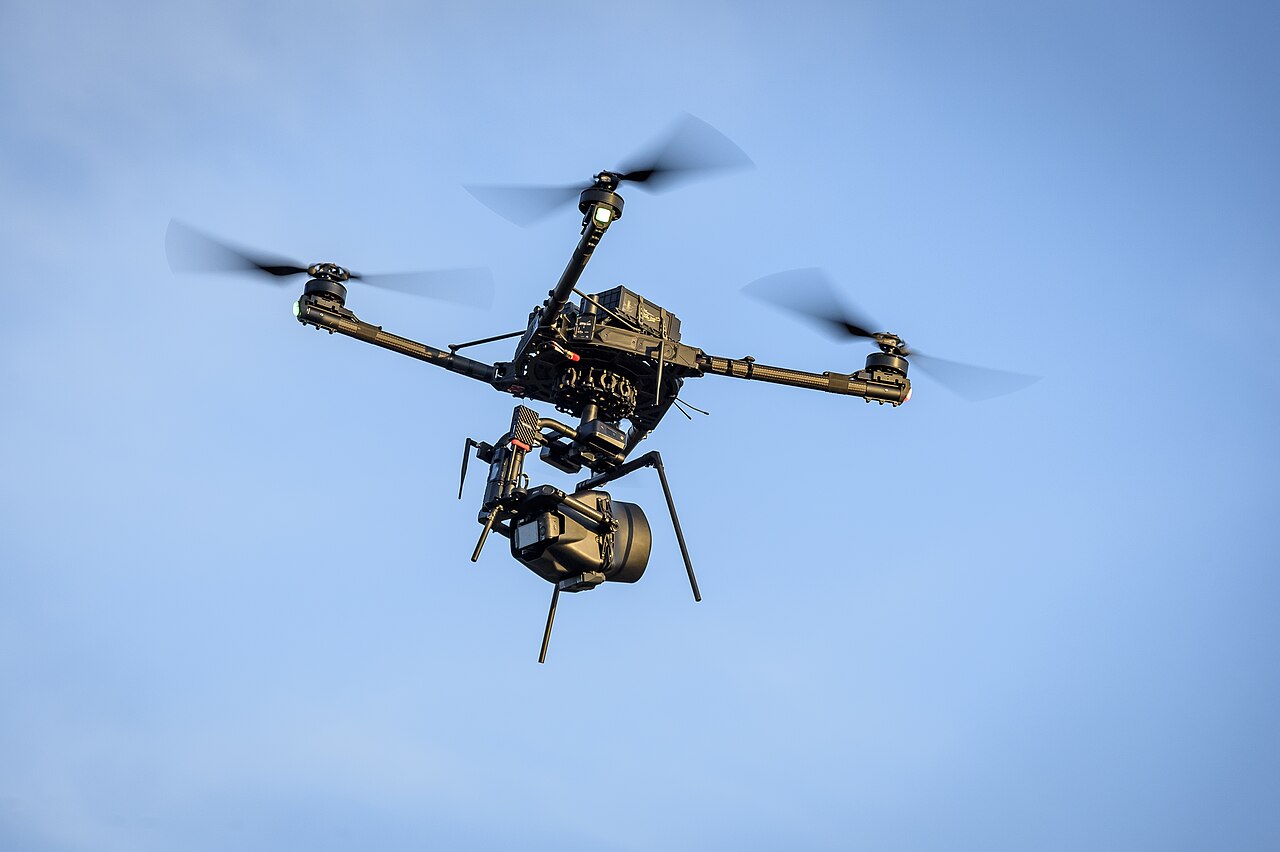
- Wikimedia Commons, "File:Advanced Capabilities for Emergency Response Operations (ACERO) (ACD24-0180-035).jpg" - source page for the NASA Ames photograph.