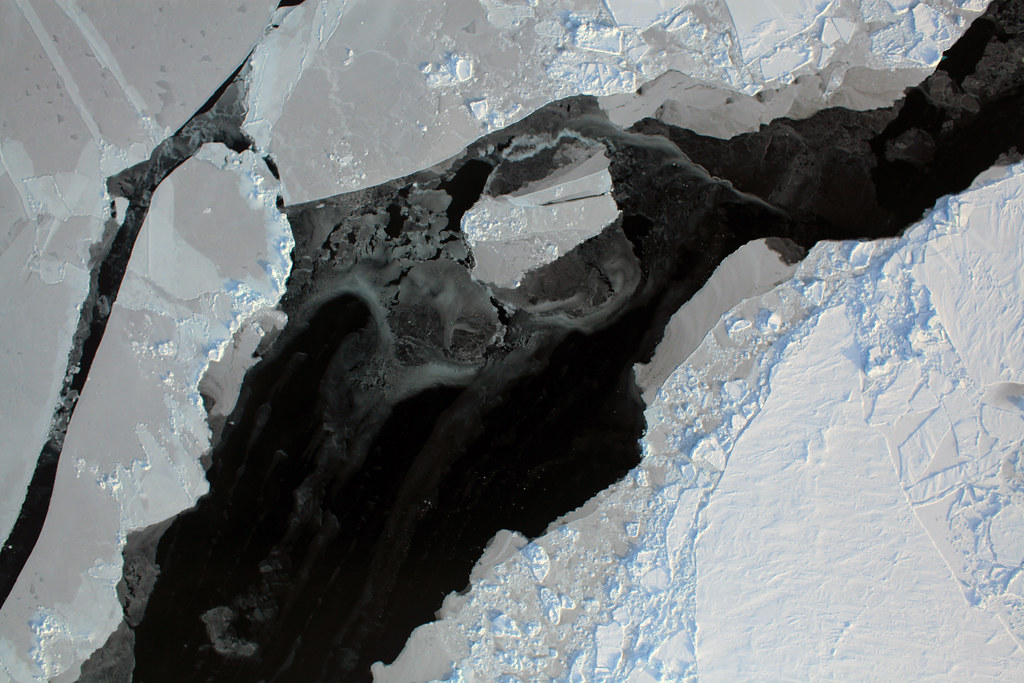
As of 2026-03-26 18:12 UTC, NASA and the National Snow and Ice Data Center say Arctic sea ice reached its winter maximum on March 15 at 5.52 million square miles (14.29 million square kilometers), effectively tying the low peak recorded in 2025.[1] The point is not that the Arctic produced a dramatic new all-time collapse in one jump. The point is that a second consecutive winter has now topped out at the floor of the satellite-era range.
That distinction matters because the headline number is only one layer of the signal. NASA says this winter's peak was still roughly half a million square miles below the 1981-2010 average.[1] At the same time, researchers using ICESat-2 are seeing thinner ice in important sectors of the Arctic, especially in the Barents Sea northeast of Greenland.[1][5] A low maximum paired with thinner regional ice is a weaker starting position for the 2026 melt season than the top-line tie alone suggests.
What actually changed this month
The immediate fact pattern is clear. The Arctic's winter ice cover stopped growing in mid-March, and the maximum extent landed just below last year's peak by a margin small enough that NASA and NSIDC treat the two years as statistically tied.[1] The historical baseline for that comparison comes from NSIDC's Sea Ice Index, which tracks monthly and daily extent across the satellite era beginning in 1979.[2]
Sea ice extent is itself a specific measurement, not a vague impression. NSIDC defines it as the ocean area with at least 15% ice concentration.[1][3] That means the measure is good for tracking the footprint of the ice pack, but it does not directly capture everything that matters about strength, age, or thickness. A winter maximum can therefore look superficially stable even while the pack becomes easier to fracture, export, or melt later in the year.[3][4]
Why a tied record low still matters
One low year by itself can be noisy. NASA quotes NSIDC scientist Walt Meier making exactly that point: a year or two alone should not be overread.[1] The reason this update still matters is the longer sequence around it. NOAA's 2025 Arctic Report Card says the last 20 years have been marked by lower ice extent and a younger, thinner ice cover than earlier decades, and it describes March 2025 as the lowest annual Arctic maximum in the 47-year satellite record.[4] March 2026 did not reverse that structure. It extended it.
That is why a statistical tie can carry real weight. If the Arctic had returned to a clearly higher winter peak in 2026, the conversation would have shifted toward short-run recovery. Instead, the new season stayed pinned near the same record-low ceiling.[1][2] In practical terms, the Arctic did not rebuild much winter margin.
Why thickness is the sharper warning
The most important sentence in NASA's update is not the one about the record tie. It is the one about thickness. Nathan Kurtz, who leads NASA's Cryospheric Sciences Laboratory, said ICESat-2 observations show much of the Arctic ice is thinner this year, with especially weak conditions in the Barents Sea northeast of Greenland.[1][5] That matters because ice age is a rough proxy for durability: older multi-year ice usually grows thicker through repeated winters, while younger ice is easier to melt and deform.[3][4]
NOAA's 2025 assessment makes the same structural point from a longer perspective. It says multi-year ice remains largely confined to the region north of Greenland and the Canadian Arctic Archipelago, while the broader Arctic has spent two decades shifting toward younger and thinner cover.[4] Put those two readings together and the 2026 message becomes sharper: the Arctic is not only small by winter-maximum standards, it is also entering spring with less robust ice in places that help determine how the summer story unfolds.[1][4]
What the data can and cannot tell us yet
This update is a starting-state report, not a summer forecast. A low winter maximum does not mechanically determine the September minimum. Winds, cloud cover, ocean heat, export through gateways such as Fram Strait, and the distribution of thin first-year ice still shape what happens next.[3][4] The current measurement tells readers where the season begins, not where it must end.
There is also a methodological point worth keeping in view. NASA says NSIDC historically relied mainly on satellites in the U.S. Defense Meteorological Satellite Program, while recent real-time monitoring has leaned on JAXA's Advanced Microwave Scanning Radiometer 2; researchers then compare current coverage with older records, including Nimbus-7 data, to preserve continuity across decades.[1][6] That does not weaken the conclusion. It explains why scientists speak carefully about statistical ties and long-run comparisons instead of treating every decimal change as a dramatic new regime.
One more caution helps. NASA's same March 26 update notes that Antarctic summer sea ice, while still below the long-run average, finished well above the record low set in 2023.[1] The two poles can move under different short-run conditions. The Arctic result is serious because it extends a long decline, not because every sea-ice metric everywhere moved in lockstep this year.
Why this matters now
For climate watchers, the message is that the Arctic has entered the warm-season handoff with little spare winter margin.[1][2] For Arctic operators and policymakers, NOAA's report points to the broader consequence: as sea ice declines and thins, access patterns, maritime activity, and security planning all keep changing around it.[4] That last point is an inference from the sources, but it is a straightforward one. A second straight winter at the bottom of the satellite-era range means summer 2026 planning begins from a weaker baseline, not from recovery.
Bottom line
The March 2026 news is not simply that Arctic winter sea ice tied a record low. It is that the Arctic failed to regain winter ground while thickness readings also softened in key regions.[1][4][5] The next decisive evidence will arrive over the melt season, but the starting position is already telling: the footprint stayed near the record floor, and the pack beneath that footprint looks less sturdy than the headline alone would imply.[1][2]
Sources
- James Riordon, "Arctic Winter Sea Ice Ties Record Low, NASA, NSIDC Scientists Find" — current March 2026 maximum extent, comparison with 2025, thickness remarks, and Antarctic contrast.
- National Snow and Ice Data Center, "Sea Ice Index, Version 3" — long-run satellite-era baseline and extent record used for historical comparison.
- National Snow and Ice Data Center, "Sea Ice" — definition of sea ice extent and background on first-year versus multi-year ice.
- NOAA Arctic Report Card 2025, "Sea Ice" — evidence on younger and thinner Arctic ice, the 2025 record-low winter maximum, and broader operational implications of sea-ice decline.
- NASA Science, "ICESat-2" — mission background on the satellite used in NASA's thickness observations.
- JAXA, "Global Change Observation Mission - Water 'SHIZUKU' (GCOM-W)" — background on the AMSR2 platform used for recent real-time sea-ice monitoring.