As of 2026-11-18 05:33 UTC.
The European Space Agency released Euclid’s first major survey dataset on November 12, opening observations of more than 900 million galaxies to researchers. The release, DR1-Foundation, brings together images, spectra and catalogues from roughly 13 months of observing—a substantial expansion of the material available for astronomical discovery.[1]
The mission’s first planned cosmological analyses remain ahead, with full DR1 scheduled for June 2027. Those analyses address Euclid’s central questions about dark matter and the accelerating expansion of the Universe. The new archive already supports research on galaxies, clusters and other objects while the team prepares that next stage.[6]
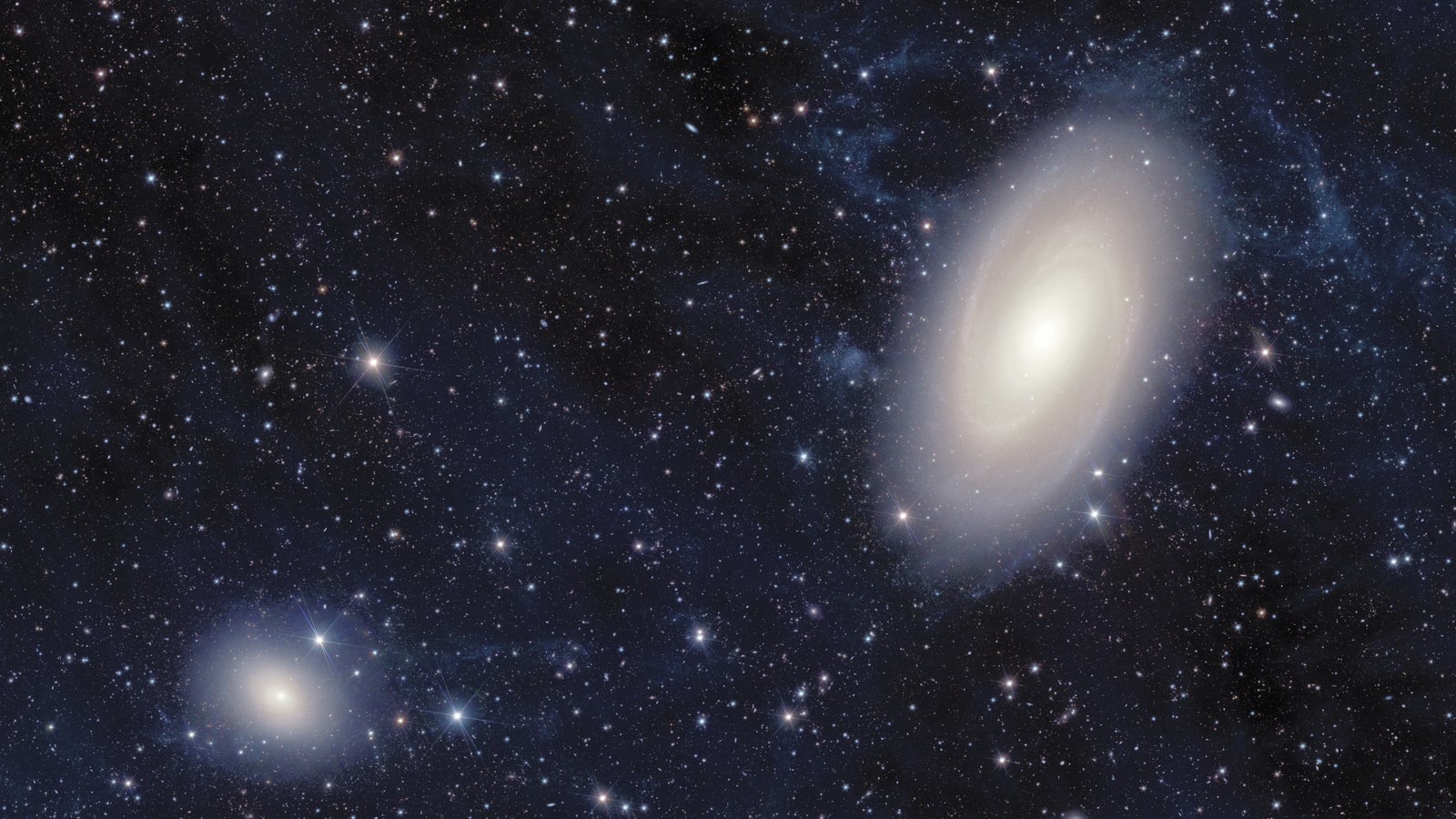
The release’s view of the Messier 81 group gives the scale a tangible form. A bright galaxy occupies the right side; its smaller neighbour, NGC 3077, sits to the left. The blue wisps crossing the field belong to foreground dust in our own Milky Way. ESA says Euclid captured this patch, about five full Moons in area, in just over an hour.[3]
Three figures describe the published release, with their boundaries attached:
- Around 1,900 square degrees: the Wide Survey coverage quoted in ESA’s November 12 announcement, about 14% of the mission’s planned survey area—not 14% of the entire sky.[1]
- Around 15,000 strong-lensing candidates: a catalogue of promising systems, rather than a claim that every entry is conclusively confirmed.[1]
- More than 160 million sources with spectra: observations that divide light by wavelength and can help establish an object’s properties and distance.[1]
Rare objects become a population to study
Strong gravitational lenses occur when foreground mass bends light from a more distant object into conspicuous arcs or multiple images. Finding enough examples has long constrained the field. The Euclid Consortium reports that its new candidate catalogue emerged from a combination of artificial intelligence, citizen-science inspection and expert validation applied across the survey.[4]
The consortium also reports automated modelling of thousands of candidates. Such modelling can estimate the mass of the foreground galaxy and reconstruct the background object’s appearance. The immediate opportunity is therefore broader than finding another remarkable ring: researchers gain a large set of systems on which to compare how galaxies bend light.[4]
That distinction matters when reporting the result. A list of candidates is a resource for investigation. It does not give every object the same evidential status, and a successful model of one system does not settle the properties of all the others. The scientific value grows as selection, checking and interpretation become reproducible.
Nearby, faint objects also benefit. Paris Observatory describes work on galaxies with very low surface brightness and on globular clusters beyond the Milky Way. Its researchers expect Euclid to extend studies previously concentrated on our own galaxy and its neighbours to a much larger population. These are research opportunities described by participating scientists; the release alone does not establish their eventual findings.[6]
Why the cosmology products wait
The images depend on work that is largely invisible in a finished photograph. The Max Planck Institute for Astronomy describes calibration as correcting instrumental effects and translating detector measurements into physical quantities. That includes planning calibration observations, characterising the telescope and checking whether its behaviour changes over time. Processing is distributed across computing centres in Europe and the United States.[5]
The specific obstacle is documented in the release overview. In early 2026, the team found that its model underestimated the size of the VIS camera’s point-spread function—the spread that the instrument gives to an image of a point source. That error would compromise the analysis of gravitational shear, the subtle distortion used in weak-lensing measurements.[2]
Reprocessing and analysis needed more time. The team released validated images, spectra and catalogues in November; the June instalment is intended to add shear measurements, weak-lensing and galaxy-clustering correlations, and cosmological analyses. The paper says Foundation’s existing products will not be re-released then.[2]
This sequence lets different kinds of research advance at different speeds. Researchers can investigate the available observations now; the consortium’s planned cosmological analyses belong to the next stage. Reporting on the release should distinguish those scheduled results from discoveries already supported by the published data.
What to watch after release
These are reporting scenarios, not additional mission deadlines:
- Base case: Foundation supports further astrophysics while the June 2027 stage remains scheduled. New studies using the existing products would be consistent with that sequence.
- Upside: published validation and reproducible follow-up strengthen confidence in the candidate catalogues and forthcoming measurements. Those results would justify more specific claims about what the data reveal.
- Downside: revised calibration assessments or a changed official schedule narrow what researchers can use, or move the next release. Either would require updating the account of readiness.
For researchers, science editors and educators following the release:
- Within 24 hours: distinguish an available dataset from an announced future result. Check newer release notices before repeating the timetable.
- Within seven days: read the documentation for the particular catalogue or measurement being used. A result that drops quality restrictions or treats candidates as confirmed objects needs reassessment.
- Within 30 days: follow studies that show their selection and validation methods. Revise expectations when new evidence changes those methods or the official release plan.
Sources
- European Space Agency, “Euclid lays the foundation for its best-ever 3D map of the Universe,” November 12, 2026; release scale, contents and candidate counts.
- Euclid Collaboration: H. Aussel et al., “Euclid First Data Release 1 (DR1): Data release overview,” manuscript dated November 12, 2026, especially section 2.4; calibration issue and staged release.
- European Space Agency, “Euclid views the core of the Messier 81 galaxy group,” November 12, 2026; observational image, field description and credits.
- Euclid Consortium, “First major data release, opening a new window on the Universe,” November 12, 2026; lens selection, modelling and initial science.
- Max Planck Institute for Astronomy, “Euclid Lays the Foundation for its Best-Ever 3D Map of the Universe,” November 12, 2026; calibration work and distributed data processing.
- Paris Observatory–PSL, “Euclid DR1 Foundation: first major data release from the European satellite,” November 12, 2026; research on faint galaxies and extragalactic globular clusters.