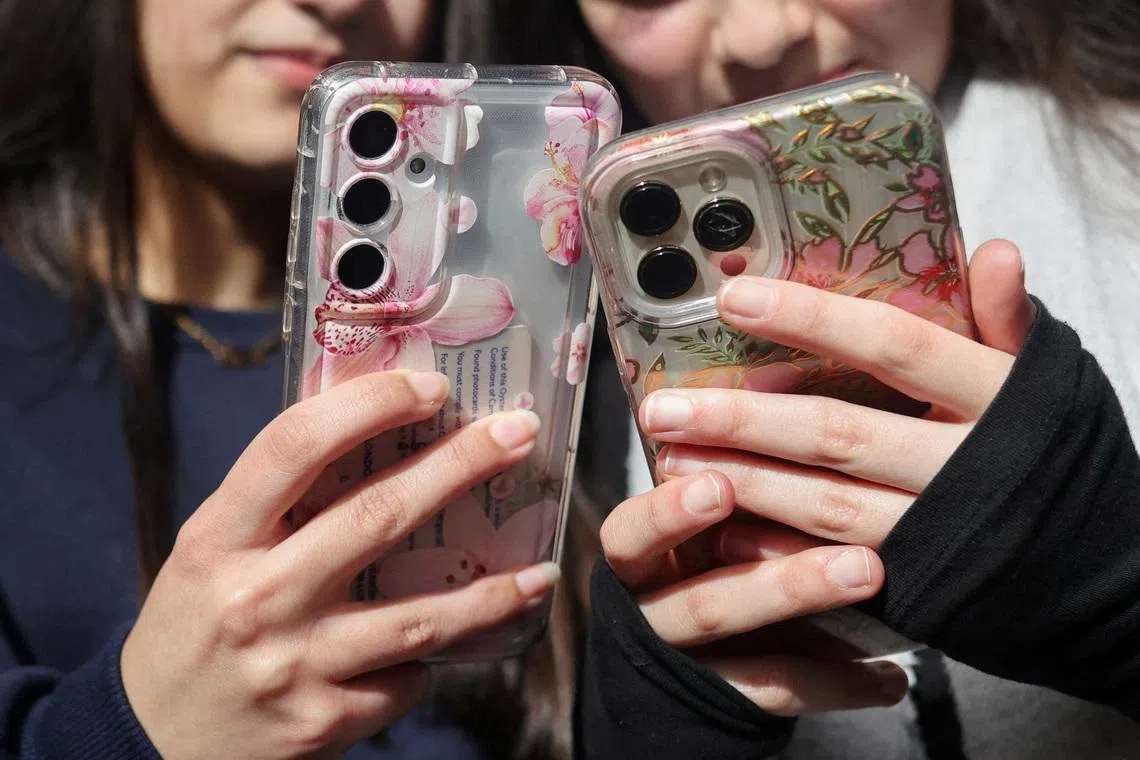
As of 2026-07-15 07:46 UTC, Britain has announced a midnight-to-6 a.m. social-media “curfew” for 16- and 17-year-olds—but the operative word is default. Apps would apply an overnight access block by default, disable videos that automatically play one after another and switch off feeds that continually serve personalized content. A teenager could change the settings.[1][2]
Nothing changes on a phone today. The government expects to lay the first regulations before Parliament by the end of 2026 and bring the wider package into force in spring 2027. The July announcement does not yet name every covered service, explain how an app will reliably distinguish a 16-year-old from a 15- or 18-year-old, specify the override screen, or set public measures of success.[1][7]
That boundary matters because “curfew” suggests a legal lockout. The policy announced for older teenagers is better understood as a product-design intervention: put a quieter choice in place first, then let the user reverse it. Whether that changes sleep and scrolling in the real world is still an open empirical question.
The Briefing File
| Record | What it establishes | Confidence boundary |
|---|---|---|
| Government announcement, July 15 | Midnight-to-6 access, automatic next-video playback and continuously personalized feeds would be off by default for users aged 16–17; users could alter their settings.[1] | High on announced intent. These are not final regulations or live platform controls. |
| Reuters report, July 15 | The overnight block is user-reversible, and implementation is expected in spring 2027.[2] | High on the government’s stated design and timetable. The announced measure was not yet in force, so implementation under it could not be tested at publication. |
| Household pilot, published July 14 | A month-long qualitative study followed 309 households allocated by preference to a no-change control group or one of three restrictions: a 15-minute per-app daily limit, a 9 p.m.–7 a.m. no-access period, or app removal.[3] | Exploratory and self-reported. It did not test the announced midnight-to-6 default, and it cannot establish causal or population-wide effects. |
| Ofcom experiment, published July 13 | Users often retained safer preselected settings in a randomized mock-platform experiment.[4] | Useful evidence about defaults, but it tested location sharing, direct messaging and network expansion—not overnight access, autoplay or real social feeds. |
| Parliamentary record, June 16 | Ministers had already announced the under-16 ban and older-teen defaults for livestreaming and stranger contact, while promising July detail on curfews and scrolling.[5] | Establishes the policy sequence. Platform scope, age assurance, enforcement and appeals still depend on later rules. |
What The Default Does—and Does Not Do
The older-teen measure sits beside a more restrictive policy for younger users. Britain plans to prevent under-16s from using certain social-media services. At 16 and 17, access would return, but several higher-risk functions would begin in a restricted state. Livestreaming and communication with strangers had already been placed in that older-teen default layer; the new announcement adds the overnight window, automatic next-video playback and personalized feeds.[1][5][7]
Those are different legal and technical instruments. An under-16 access rule asks whether a covered service may serve an under-16 user. A default asks which settings apply to an eligible user unless that user changes them. Conflating them would mislead families in both directions: a teenager does not gain an enforceable right to six interruption-free hours of sleep, and a platform does not satisfy the policy merely by displaying a notice called a curfew.
The details that decide whether a default has force are still missing. The announcement does not say whether changing it takes one tap or a deliberate sequence; whether the choice persists forever or is revisited; whether notifications also pause; how time zones, travel and shared devices are handled; or what happens when an account’s age is uncertain. It also does not define a non-personalized replacement feed. Those are implementation questions, not objections to the idea—but they determine what users actually experience.[1]
Age assurance is the common dependency. The government’s June fact sheet said Ofcom would set out options for proving whether a user is over 16 and acknowledged that final service coverage and circumvention controls were still being developed.[7] Separate government-commissioned research published this week examines how 11- to 17-year-olds encounter age checks, get around them and use virtual private networks; its recommendations are evidence for policy development, not rules already adopted.[6]
The Evidence Supports A Trial, Not A Victory Claim
The household pilot gives the government a plausible reason to investigate an overnight intervention. Families assigned to a 9 p.m.–7 a.m. no-access period described it as the most manageable of the three restrictions, and reported the most consistent sleep benefits. Many said they would continue it voluntarily.[3]
But the same report carefully limits that finding. The sample was relatively small and self-selecting; behavior and outcomes were primarily reported in interviews rather than measured from devices; families chose allocation preferences; some participants switched interventions; and the study was not designed to produce causal or statistically generalizable estimates. Participants also reported workarounds, earlier use before the cutoff, morning rebound use and little change in daytime consumption.[3]
The policy is gentler than the pilot in two important ways. Its window is four hours shorter—midnight to 6 a.m. rather than 9 p.m. to 7 a.m.—and the user can turn it off.[1][3] That may make the rule more acceptable to older teenagers, but it also means the pilot cannot tell us how many will retain it or whether any reported sleep effect will survive.
Ofcom’s randomized experiment strengthens one narrower proposition: preselection can influence choices. Across age groups, participants frequently kept safer defaults for location sharing, direct messages and network expansion. Ofcom itself cautions that a mock service cannot reproduce peer pressure and other real-world influences.[4] The experiment therefore supports testing the mechanism. It does not prove that a midnight setting reduces total use, improves mental health or avoids displacement to another app.
The right evaluation question is not simply, “How many accounts left the curfew on?” A useful record would also measure overnight minutes, use immediately before midnight and after 6 a.m., movement to unregulated services or other devices, age-classification errors, appeals, missed access to support or school coordination, and changes in sleep using methods stronger than a press-release testimonial.
Decision Horizon
Next 24 hours: parents and teenagers should treat this as an announcement, not a new household rule or platform outage. Journalists, schools and apps should qualify every use of “curfew” with the fact that it is planned, default-on and user-reversible.[1][2]
Next 7 days: the Department for Science, Innovation and Technology should publish a short operating specification: covered service and feature definitions, age-assurance responsibility, default and override behavior, notification treatment, accessibility, appeals and privacy safeguards. Platforms should preserve current usage baselines rather than wait until launch to decide what success looked like.
Next 30 days: the government and Ofcom should expose the evaluation design before the regulations are fixed. Teenagers, parents, sleep researchers, schools, child-safety groups, privacy advocates and platforms should be able to challenge both the outcome measures and the failure cases. An independent, pre-registered study would make later claims far more credible than platform-selected engagement statistics.
Three Ways This Could Land
Base path — a modest behavioral speed bump. Most eligible accounts receive the defaults, a meaningful share retain them, and some late-night use falls while many users override or shift activity. Trigger: draft rules preserve an easy reversal but require consistent presentation and retention reporting across covered services.
Upside path — quieter nights without a new access barrier. Retention remains durable, measured overnight use declines without an equal pre-midnight or cross-platform rebound, and independent evidence finds better sleep or daytime functioning with limited social disconnection. Trigger: transparent platform data and a credible comparison group point in the same direction.
Downside path — the label outruns the control. Platforms misclassify ages, hide equivalent features behind new names, or make the default trivial to dismiss; teenagers route around it or concentrate use on other screens; families assume a protection exists when little behavior changes. Trigger: high override and error rates, stable total usage, or migration to services outside the final scope.
Action Checklist
- Keep three statuses distinct in public communication: announced, made into regulations, and implemented by a service.
- Publish the exact account journey, including age classification, the default screen, override friction, re-prompting, time-zone behavior and appeals.
- Measure retention after one, four and twelve weeks—not only on the day a setting appears.
- Track substitution around the six-hour window and across apps, browsers and devices; a lower midnight count alone can conceal displacement.
- Provide exceptions and support routes that do not force a teenager to disable every protection to reach trusted contacts or urgent help.
- Require independent access to privacy-preserving evaluation data and publish age-assurance error rates as well as compliance rates.
- Compare the final rule with the government’s own evidence boundary: the household study was exploratory, and the Ofcom trial used a mock platform.[3][4]
The brief’s central description should be revised if the final regulations remove the user override, impose a mandatory overnight prohibition, materially change the age band or window, or abandon the measure. Its assessment of the evidence should also change if a preregistered real-world trial establishes sustained effects. Until then, Britain has announced a default whose real-world effects still need testing—not a six-hour outcome it can already claim.
Sources
- UK Department for Science, Innovation and Technology, “New social media curfews and crackdown on addictive features to better protect 16- and 17-year-olds online” (15 July 2026) — announced defaults, user choice and implementation timetable.
- Reuters via NDTV, “UK To Announce Midnight Social Media Curfew For Teenagers” (15 July 2026) — independent event report and explicit description of the user-reversible overnight setting.
- Savanta for the UK Department for Science, Innovation and Technology, Social media restriction pilots: Qualitative research with 13 to 17-year-olds in the UK (14 July 2026) — interventions, reported experience, methodology and limitations.
- Ofcom, “Protective defaults for social media platforms” (13 July 2026) — randomized mock-platform findings on default retention and the regulator’s real-world caveat.
- UK Parliament, Hansard, “Social Media Ban for Under-16s” (16 June 2026) — policy sequence, proposed older-teen defaults and parliamentary questions about scope, age assurance and enforcement.
- BMG Research for the UK Department for Science, Innovation and Technology, Children’s circumvention behaviours online (14 July 2026) — commissioned research scope covering age checks, workarounds and VPN use among 11- to 17-year-olds.
- UK Department for Science, Innovation and Technology, “Fact sheet: New rules to protect children online” (updated 19 June 2026) — under-16 policy, older-teen feature layer, provisional platform scope, age assurance and spring 2027 timetable.
- Reuters via The Straits Times, “Britain pilots social media bans, time limits and curfews for children” (25 March 2026) — reporting on the household pilot and source page for the Reuters cover photograph.