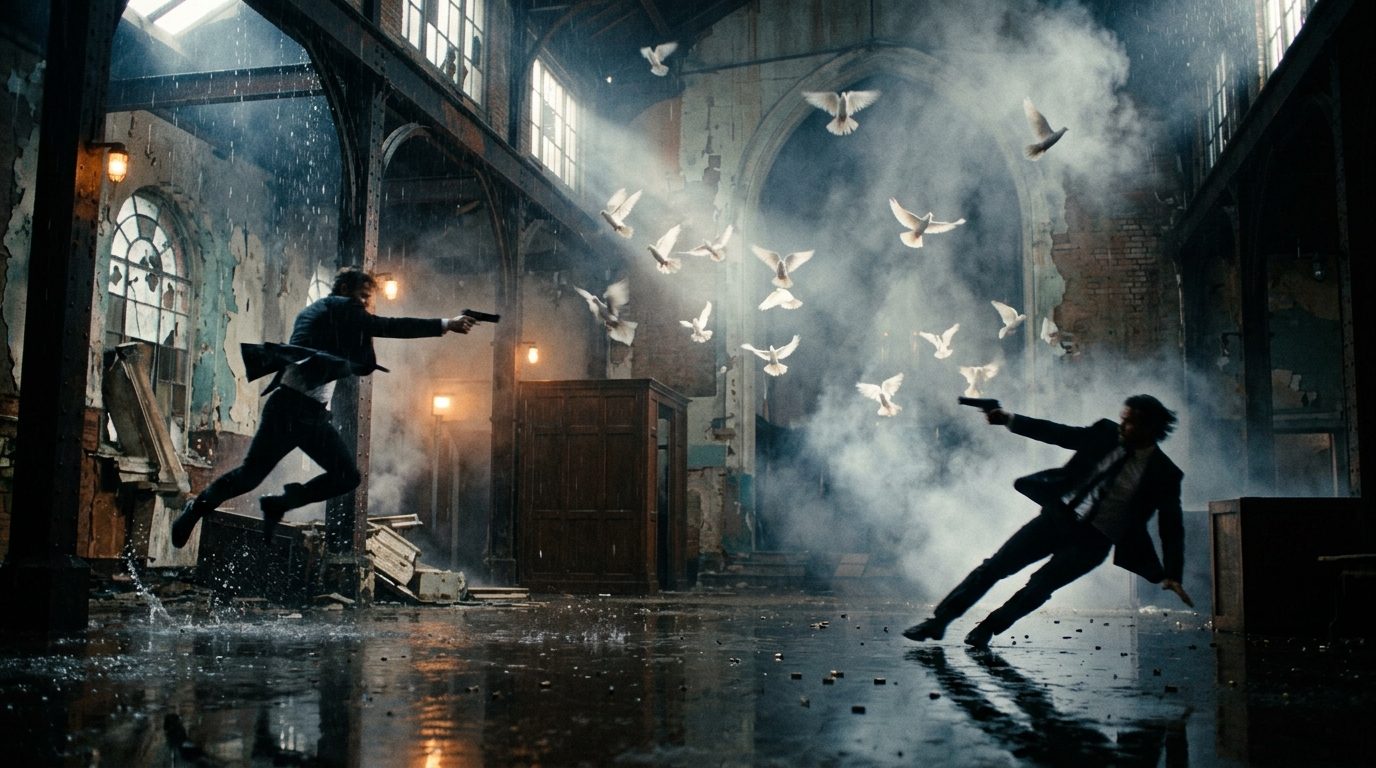
John Woo is often reduced to a grammar of surfaces: two guns, white doves, trench coats, slow motion, bodies diving sideways through smoke. Those details matter, but they become shallow when treated as decorative signatures. Woo's best action scenes are not merely cool images arranged at high speed. They are scenes of obligation. A man steps into gunfire because friendship has narrowed his choices; a cop keeps moving because the institution around him no longer feels trustworthy; a killer seeks redemption in a world where redemption is available only through risk.[1][2][3]
That is the cleaner way to read Woo as a director. His cinema thinks through vows. The gunfight is the visible part of a moral contract already under strain. In the Hong Kong cycle that made him internationally legible - especially A Better Tomorrow, The Killer, Bullet in the Head, and Hard Boiled - action is not a break from melodrama. It is melodrama given physical form.[1][2][4]
Woo's career also makes more sense when the early detour is kept in view. Cannes notes that he spent more than two decades in Hong Kong's film industry and directed more than twenty-six features, but that he was known primarily as a comedy specialist until the mid-1980s, before the violent romantic gangster dramas changed his reputation.[1] That background helps explain the elasticity of his action. The scenes are severe, but their timing often has the precision of comedy: entrance, pause, reversal, glance, impact, sudden stillness. He did not become a great action director by abandoning rhythm. He turned rhythm toward danger.
Violence As Moral Blocking
Cinematek's 2026 John Woo tribute usefully describes his late-1980s breakthrough as highly stylized gunplay, slow-motion dives, and plots of operatic grandeur, while also tying the films to anti-heroes guided by chivalric codes.[2] The chivalric point is important. Woo's characters often live inside criminal or compromised systems, but they keep inventing private codes that are more binding than law. This is why betrayal in Woo hurts more than death. Death can be staged as sacrifice. Betrayal breaks the rule that made sacrifice meaningful.
In The Killer, Criterion frames Chow Yun-fat's assassin as a killer with a conscience, placing slow-motion gun battles inside a corrupt society and a moral drama.[3] That description catches the pressure of the film better than a simple genre label would. The story is built around impossible repair: a professional act of violence harms an innocent singer, and the rest of the movie tries to convert damage into protection. Woo's violence is spectacular, but it is rarely neutral spectacle. Each action beat asks whether a damaged person can still choose loyalty without pretending the damage disappears.
The most misunderstood word around Woo is probably "balletic." It is accurate, but it can make the films sound weightless. His choreography is graceful because the body is under pressure, not because danger has vanished. A dive across a room is beautiful partly because it exposes the body to injury. A two-gun pose is iconic partly because it suspends the character between command and vulnerability. The style is not an escape from consequence. It is a way of making consequence visible as movement.
Friendship Is The Engine, Not The Ornament
Woo's male friendships are sometimes described as excessive, and they are. That excess is the point. His heroes inhabit worlds where official trust has thinned out: police departments leak, triad codes decay, partners conceal too much, cities feel historically unstable. Against that background, friendship becomes both refuge and trap. It gives characters a reason to act, but it also creates obligations that can get them killed.
This is why The Killer and Hard Boiled should not be filed only as action peaks. They are also studies in how men recognize each other across institutional lines. Criterion's The Killer page emphasizes the film's mixture of Eastern and Western genre transformation, and its credit listing makes Woo's authorship unusually direct: director and screenwriter.[3] The film's power comes from that authorship becoming emotional architecture. The killer, the cop, the singer, and the city are arranged so that recognition arrives too late to remain clean.
Hard Boiled shifts the pattern. Criterion's film page describes Tequila as a jaded detective, Tony as an undercover counterpart, and the climactic hospital sequence as the film's unforgettable culmination.[4] Barbara Scharres's Criterion essay presses further, arguing that Hard Boiled resonates as Woo's last Hong Kong film before his move to the United States and that its images of departure, closure, fear, and regret are tied to Hong Kong's uncertain approach to 1997.[5] This changes how the action reads. The hospital is not only a set-piece machine. It is an institution meant to preserve life that becomes a battlefield, a public system transformed into a zone of flight.
That is why the partnership between Tequila and Tony feels colder than the bond in The Killer. Scharres notes that the two men know each other too little and too late for the total bonding that usually opens the path to redemption in Woo.[5] The action is still magnificent, but it has a harsher aftertaste. Woo is not just perfecting a style; he is testing whether the style can carry an ending where escape may be possible and redemption may not.
The Hong Kong Exit Route
The 2025 Cannes Classics framing of Hard Boiled is valuable because it refuses to treat the film as pure mayhem. Cannes describes the movie as two hours of highly choreographed action, but it also quotes Woo explaining that he wanted to counterbalance the increased violence he saw in Hong Kong and make a positive film.[6] That sounds almost paradoxical until one watches how his scenes are built. Woo does not deny violence by softening it. He tries to impose moral shape on it.
The Hong Kong-to-Hollywood move also matters because it reveals the fragility of that shape. Cannes's director profile notes that after Hard Boiled, Woo went to Hollywood for Hard Target, then made Face/Off, Mission: Impossible II, and other American projects.[1] In Hollywood, he gained bigger machinery but often had to translate his moral system into industrial forms built around stars, franchises, and studio expectations. Face/Off works so well because it gives him a premise already obsessed with identity exchange, mirrored enemies, family injury, and performance. The style has a new container, but the old questions survive: who is bound to whom, and what does violence do to the self that performs it?
That does not mean the Hong Kong films are pure and the Hollywood films are compromised. The better distinction is density. In the Hong Kong masterpieces, gesture, plot, city mood, star image, and genre inheritance feel fused. A slow-motion dive is simultaneously a kinetic thrill, a star moment, a moral wager, and a historical pressure point. In the weaker American work, the same devices can become detachable flourishes. The doves still fly, but the vows underneath them are not always as binding.
Why The Style Still Travels
Woo's influence is easy to overstate vaguely and hard to deny specifically. Cinematek points to his mark on Hollywood action, naming descendants from Quentin Tarantino to The Matrix and John Wick.[2] The visible borrowings are obvious: gun-fu clarity, slow-motion impacts, dual-wielding, emotionalized shootouts, and action staged as spatial choreography rather than random coverage. But the deeper borrowing is the idea that action can be legible without becoming merely functional. Woo taught later filmmakers that a gunfight could have musical structure, emotional weather, and ethical direction at once.
The risk is that imitation often copies the punctuation and loses the sentence. Two pistols are not a worldview. Slow motion is not automatically feeling. Doves do not create transcendence by themselves. Woo's signature works because the image arrives after pressure has accumulated. The pose is earned by the vow, the betrayal, the memory of obligation, or the fear that the city itself has stopped offering safe routes.
That is why John Woo remains more than a style source. He is a filmmaker of impossible loyalties. His camera makes action beautiful, but the beauty is not there to excuse violence. It is there to reveal how badly his characters need form when everything around them is collapsing into appetite, panic, corruption, or departure. The bullet ballet matters because it gives shape to people trying to keep faith under conditions that make faith nearly impossible.
Sources
- Festival de Cannes, "John WOO" director profile, career overview, Cannes appearances, and Hollywood transition note.
- CINEMATEK, "Heroic Bloodshed: A tribute to John Woo," Offscreen Film Festival program note, 2026.
- The Criterion Collection, "The Killer" film page, synopsis, credits, and special features.
- The Criterion Collection, "Hard Boiled" film page, synopsis, credits, and special features.
- Barbara Scharres, "Hard Boiled." The Criterion Collection, 1998.
- Festival de Cannes, "Hard Boiled: the fight is on at Cannes Classics," 2025.