Charles Vidor's Gilda (1946) is remembered so strongly that it can seem reducible to two or three isolated images: Rita Hayworth tossing her hair into the frame, the black satin glove sliding down her arm during "Put the Blame on Mame," and Glenn Ford staring as if desire had already curdled into grievance.[1][3][4][5] But the film survives because those images are not detachable icons. They belong to a system. Gilda keeps turning attraction into an event that must be witnessed, interpreted, and punished in public. The movie is not really about one femme-fatale entrance or one famous musical number. It is about what happens when erotic display becomes inseparable from surveillance, resentment, and blame.[1][2][3]
That is why the film feels stranger than a standard noir romance. MoMA's program note places the story inside Ballin Mundson's glamorous Buenos Aires casino, a setting where money, performance, and hidden power already overlap.[2] BFI's noir survey gets to the heart of the matter when it describes the movie as a maelstrom of erotic tensions and perverse powerplay.[1] The film's emotional engine is not simple seduction but a triangular structure of control, humiliation, and theatrical reprisal. Johnny Farrell does not merely desire Gilda. He manages her, watches her, interprets her, and repeatedly acts as though her visibility itself were an injury aimed at him.[1][2][5]
That pressure is what makes Hayworth's performance so enduring. Pamela Hutchinson's Criterion essay is especially sharp on this point. She argues that Hayworth's screen presence is never pure spontaneity; it is performance made visible, allure built out of posture, dance training, facial timing, and a controlled awareness of how she is being seen.[3] In Gilda, that control becomes the film's deepest subject. Hayworth does not only play a glamorous woman trapped in male fantasy. She plays someone who knows the fantasy is already in the room and answers it with exaggeration, mockery, and occasional self-wounding bravado.[3][4]
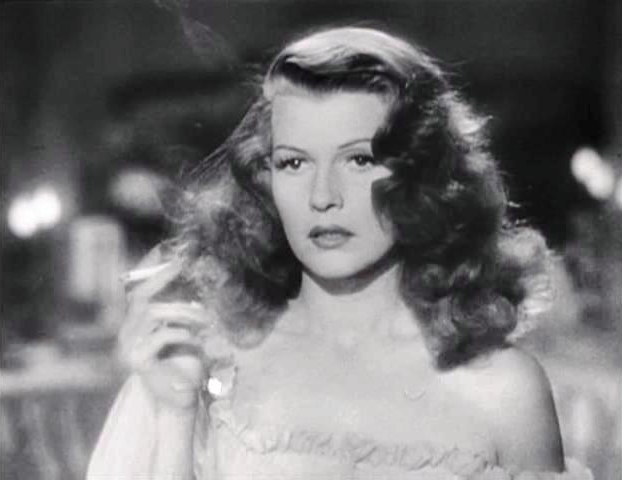
Image context: the lead image uses a real trailer still of Rita Hayworth as Gilda preserved on Wikimedia Commons. It fits this essay because the argument depends on Hayworth's face as an active force in the film, not a passive emblem of star beauty. The still catches the exact tension the movie keeps exploiting: glamour offered to the viewer and defiance aimed back at the act of viewing itself.[6]
Spoiler warning: this essay discusses the marriage arrangement around Ballin Mundson, the "Put the Blame on Mame" sequence, and the ending.
1. The entrance is famous because it is already a duel
The hair flip entrance is one of Hollywood's canonical star reveals, but it lands so hard because it is not simply seductive.[3][4][5] When Johnny opens the bedroom door and asks, "Gilda, are you decent?" the line invites a joke, and Hayworth answers it with a flourish that has become film history.[4][5] Yet the scene does more than launch a star image. It makes "decency" the film's governing accusation. The word arrives before the audience knows the full emotional geometry, and it immediately tells us that sex in Gilda will be filtered through judgment.[4][5]
Sheila O'Malley's Criterion essay on the film's afterlife is useful here because it emphasizes that Hayworth's entrance works as both invitation and challenge.[4] Gilda enters the movie already overdefined by other people: Ballin treats her as possession, Johnny reacts to her as unfinished business, and the camera gives her enough radiance to show why a culture would want to freeze her into icon form.[2][4] But Hayworth does not play the entrance as smooth submission to that iconography. The smile is bright; the gaze is edged. The body offers itself to spectacle while the face complicates the offer.[3][4]
That doubleness is the film's method in miniature. Gilda is looked at constantly, but the looking never settles into simple mastery. The more dazzling she becomes, the more unstable the room feels. Johnny's line is ostensibly comic, yet it is also disciplinary. He is not asking whether she is dressed. He is asking whether she is governable.
2. The casino turns romance into a surveillance regime
The Buenos Aires casino matters because it gives the film a social machine big enough to hold all this tension.[1][2] It is not just a glamorous backdrop for noir intrigue. It is a place where everyone is already on display: gamblers before the house, workers before management, wives before husbands, and lovers before rivals.[2] In that environment, intimacy cannot remain private for long. Feeling is routed through staff routines, formal clothes, entrances, exits, and the half-public theater of the gaming floor.
MoMA's note stresses the casino's atmosphere of luxury and menace, and that conjunction is exactly right.[2] Ballin's world looks elegant because elegance is part of the power structure. Johnny enters it first as an operator with no stable social standing, then becomes Ballin's right hand, and finally starts policing Gilda with the zeal of someone who mistakes delegated authority for emotional legitimacy.[2][5] The result is one of noir's nastier emotional arrangements. Johnny behaves less like a betrayed lover than like a floor manager of female visibility. He does not want merely to possess Gilda or escape her. He wants to supervise the terms on which she appears.
That is why the film's erotic charge keeps shading into humiliation. Gilda's beauty does not free her. It places her inside a theater where every gesture can be treated as evidence.[1][3][5] She is blamed for provoking attention, blamed for enjoying it, blamed for weaponizing it, and blamed even when male resentment has already written the script in advance. The casino makes that blame look civilized. Everyone is dressed for the evening; the room glitters; the punishments arrive through etiquette.
3. "Put the Blame on Mame" is not a striptease. It is a public act of retaliation
The glove number remains the film's most famous scene because it concentrates the whole argument into a few minutes.[3][4][5] A lesser reading treats the sequence as a classic tease: Hayworth sings, sways, strips one glove, and drives the room wild. But the number is stranger and harsher than that. Hutchinson notes that Hayworth's mock-striptease performance undercuts the striptease form itself, exposing feminine display as labor and artifice rather than pure invitation.[3] O'Malley pushes the point further by treating the scene as Gilda's decision to seize public space and turn it against the people who think they already own her image.[4]
That reading fits the scene's emotional temperature. Gilda is not serenely in command. She is furious, reckless, and half intent on forcing the room to show its own ugliness.[3][4][5] The lyrics distribute blame onto a woman named Mame for every disaster under the sun, and the joke works only because the film knows the logic is absurd.[4][5] Blame female sexuality for fire, for weather, for social disorder, for male loss of self-command: Gilda stages that reflex so nakedly that the sequence becomes both performance and indictment.[3][4]
The crowd's reaction matters as much as Hayworth's movement. Once the men push toward the stage, the scene stops reading as glamorous release and starts reading as collective appetite demanding punishment.[4][5] Johnny's intervention is often described as jealous outrage, but jealousy is only part of it. What he cannot bear is that Gilda has made the structure visible. She has shown that the room wants to consume her while pretending it is disciplining her. By singing the accusation out loud, she turns patriarchal blame into cabaret material. The slapdown that follows is the system trying to hide itself again.
4. Hayworth's star image is the movie's real battleground
One reason Gilda lasted so powerfully in popular memory is that it fused the character with the Rita Hayworth image without letting the fusion feel stable.[3][4] Hutchinson's essay helps explain why. Hayworth's performances are built from precise bodily intelligence: dance training, calibrated posture, a deliberate relationship to glamour, and a capacity to make the camera register both poise and resistance at once.[3] In Gilda, that means the star image becomes a battleground rather than a fixed commodity.
The film needs Hayworth to look iconic. It also needs the icon to hurt.[3][4] That is why the emotional force of Gilda cannot be reduced to noir plotting or to the era's censorship games around sexuality. What remains vivid is the friction between a studio-manufactured ideal of desirability and a performance that keeps exposing the wear, anger, and tactical intelligence required to inhabit that ideal.[3] Gilda does not only appear glamorous. She appears tired of the uses to which glamour is being put.
This is also what makes the ending so uneasy.[1][4][5] The plot supplies revelation, death, and nominal reconciliation, but the film does not erase the damage its rituals have already done. Public accusation has shaped the emotional world too completely. The couple may be released by the script, yet the viewer has seen too much of the punishment mechanism to mistake closure for innocence restored.
5. Why Gilda still feels modern
Gilda still feels modern because it understands spectacle as a political arrangement before later criticism gave that arrangement its vocabulary.[1][2][3][4] The film knows that looking is not neutral, that glamour can function as labor, and that a woman can be asked to perform desirability while simultaneously being condemned for it. It knows as well that male grievance often presents itself as wounded morality. Johnny speaks and acts as if Gilda has wronged him simply by becoming visible in ways he cannot manage.[4][5]
That is the movie's enduring sting. The hair flip is unforgettable, the glove is unforgettable, the casino is unforgettable, but none of them survive as isolated ornaments. Together they build a theme essay in cinematic form. Gilda turns desire into a public trial and then lets Hayworth play both the accused figure and the person who understands the absurdity of the charges before anyone else does.[1][3][4] What lasts is not the fantasy of the "love goddess." It is the sight of a star using that fantasy's own surfaces to reveal how blame gets staged, circulated, and mistaken for order.
Sources
- Sam Wigley, "10 great American film noirs" - BFI list entry on Gilda as a pressure-cooker world of erotic tension and perverse powerplay.
- MoMA, "Gilda. 1946. Directed by Charles Vidor" - program note on the Buenos Aires casino setting and the film's noir structure.
- Pamela Hutchinson, "Rita Hayworth's Artful Indecency." The Criterion Collection, March 18, 2020.
- Sheila O'Malley, "The Long Shadow of Gilda." The Criterion Collection, January 21, 2016.
- The Criterion Collection, "Gilda (1946)" - film page on the Buenos Aires casino setting, cast, and the film's battle-of-the-sexes noir frame.
- Wikimedia Commons, "File:Gilda trailer rita hayworth.JPG" - source page for the lead image.
Editor’s Pick Review
This piece wins today’s pick because it turns a familiar classic into a clear argumentative structure rather than a nostalgia recap. The essay keeps a stable thesis from opening to close, ties each section back to source-backed scene reading, and avoids plot-summary drift while still staying readable. The lead image is a topic-grounded archival still directly tied to the argument, which satisfies the stricter immersive-image policy and avoids analytical visual shortcuts. The Chinese translation also holds up well on rhythm, terminology, and semantic fidelity, so the EN+ZH package is editorially consistent.