At Mill City Museum in Minneapolis, you take a seat in the elevator. The room moves, the lights come up on a mill floor, and someone who worked in the Washburn A Mill starts talking. Over eight levels, the people who spent their shifts here get to show you around. When Minneapolis residents were asked where to take a visitor interested in infrastructure, one singled out this ride and the view at the top. They make a good pair. Upstairs you can see what made all that noise downstairs possible. [1][2]
From the Blue or Green light rail line, get off at U.S. Bank Stadium. Walk half a block west to Park Avenue, then four short blocks north. The Gold Medal Flour sign will steer you to the right stretch of riverfront. The museum door is next door to the sign, at 704 South Second Street. Aim for 10 on a Thursday morning and leave yourself until noon. Individual visitors buy admission at the desk. An adult pays $15, a child aged 5–17 pays $8, and younger children go free. [3][4][5]
Ask for your Flour Tower time while you’re at the desk. The show has assigned departures, and it’s easy to spend the first half of a visit downstairs before discovering that the part you came for runs on its own clock. If there’s time before your ride, spend it in the Water Lab. Set falling water to work there and you have a small version of the problem mill engineers faced on this bank of the Mississippi. If a sudden bang would make the ride uncomfortable, the desk has earplugs. The show includes the sound of an explosion. [2][5][6]
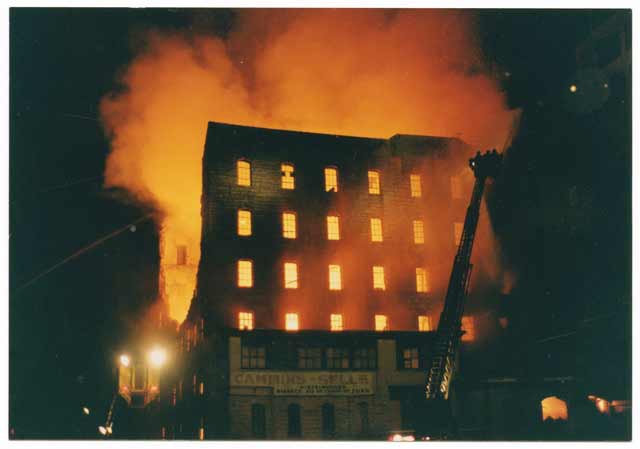
The blast you hear and the broken walls you can see belong to two different mills on the same patch of ground. In 1878 a spark caught flour dust suspended in the air. The explosion destroyed the first Washburn A Mill and killed eighteen people. Its replacement milled flour until 1965. In 1991, long after the last shift, fire gutted that building. The city shored up the surviving limestone walls. Those are the walls around the museum courtyard today. [7]
When the rooftop deck is open, go to the river side and pick out the lip of St. Anthony Falls. The important dimension in this view is the drop. Millers drew water from above the falls into a covered canal. On the way down, it turned turbines that drove machinery like the kind you’ve just heard. At the industry’s peak, more than twenty stone mills lined that canal. From up here you can take in the width of the Mississippi in a glance. It takes a little longer to picture a piece of it running under the street to work. [2][7][8]
Sources
- Minneapolis residents recommend the Flour Tower and rooftop to a visitor interested in infrastructure, June 2026.
- Minnesota Historical Society, Mill City Museum exhibits, former workers’ recordings, timed departures and weather-dependent rooftop access.
- Minnesota Historical Society, directions to the entrance from the light rail station.
- Minnesota Historical Society, Mill City Museum hours and admission.
- It’s Minnesota, local visitor guide to Mill City Museum, including ticketing and suggested visit length, November 2026.
- Minnesota Historical Society, sensory guide and accommodations at Mill City Museum.
- Minnesota Historical Society, history of the Washburn A Mill and archival photograph of the 1991 fire.
- Minnesota Historical Society, the Minneapolis flour milling boom and the water supply along the covered canal.