Watch the lantern. When the Chief Yeoman Warder comes out of the Byward Tower a few minutes before ten, he has a candle in one hand and the King’s keys in the other. At the archway he hands the light to a soldier. It is easy to follow the light in the dark. Keep your eye instead on the man who has just freed a hand. He has a gate to close. [1]
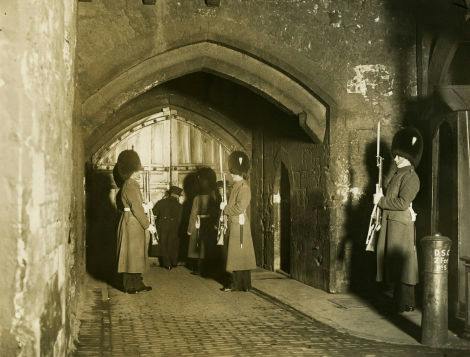
Before the gates close
For centuries the hour of closing moved with the sunset. In 1826 the Duke of Wellington, then Constable of the Tower, fixed the hour so the soldiers stationed here knew when they had to be home. A visitor has an earlier deadline. Aim for 21:15 at the West Gate, the main entrance, ten minutes ahead of the arrival cutoff. From Tower Hill Tube station, look for the small plaque at the entrance. If you arrive early there are benches nearby. London With Littles, whose writer attended with children, points out that your position in the queue outside has little bearing on the view you get inside. [1][2][3]
The queue that matters forms a month earlier, online. For the following month’s tickets, the palace opens bookings at 13:00 on the first working day, with one wrinkle worth putting in your calendar. If that day is a Friday, the release moves to Monday. The November 2026 booking page gives a choice of £10–£50 per person and suggests £30. If a night fills up, check the calendar again for returned places. Have the e-ticket open at the gate and the person who booked it with you. The escort admits the group at 21:30. [3]
People planning a daytime visit sometimes wonder whether to trade it for this cheaper evening ticket. On the LondonTravel forum, one visitor who did both remembers paying closer attention by daylight to places they had passed the night before. That order makes sense if you want to linger. During the ceremony you stand where the warder places you, then wait for a signal to move to the second viewing spot. Wear something warm enough to stand still outdoors in, and pocket the phone once you are through the ticket check. Photography is forbidden during the ceremony. [4][2][3]
On the return walk
The outer gates close, then the inner ones. Listen on the way back. A sentry calls out to the approaching party, and the warder identifies what he carries. That first answer, “The keys,” gets him a second question. Whose? The sentry lets the party pass when the warder names the King. At this point even someone too far back to see the key turn can follow exactly where it is and whose business it is on. [1][5]
The warder’s signal to the visitors matters here. The exchange at the gate is over, but there is one more place to look. On the Broad Steps the guard presents arms. The Chief Yeoman Warder lifts his bonnet, the clock strikes ten, and a soldier sounds the Last Post. The group leaves under escort at about 22:05. The warder still has an errand of his own. He takes the keys to the Resident Governor at the King’s House. London has heard the hour, the visitors have heard the bugle, and someone has to put the keys away. [1][2][3][5]
Sources
- Historic Royal Palaces, “The Ceremony of the Keys and other Tower traditions,” including the 1930 Byward Tower photograph
- Lisa, London With Littles, “Attending the Ceremony of the Keys with children,” a firsthand account of the entrance and viewing positions
- Historic Royal Palaces, Ceremony of the Keys public tickets, release times and arrangements for arrival
- LondonTravel community, “Ceremony of the Keys vs Normal Tower of London Tour,” visitors on sequencing the two visits
- The Household Division, “Ceremony of the Keys,” the sentry’s challenge and the salute on the Broad Steps