Leopold Bloom enters Ulysses without heroic staging. Joyce gives him breakfast, errands, advertising work, funeral attendance, drifting thought, and marital dread. The result is one of modern literature’s most durable character designs: not a grand conqueror of events, but a man who keeps choosing attention over domination inside an ordinary day.
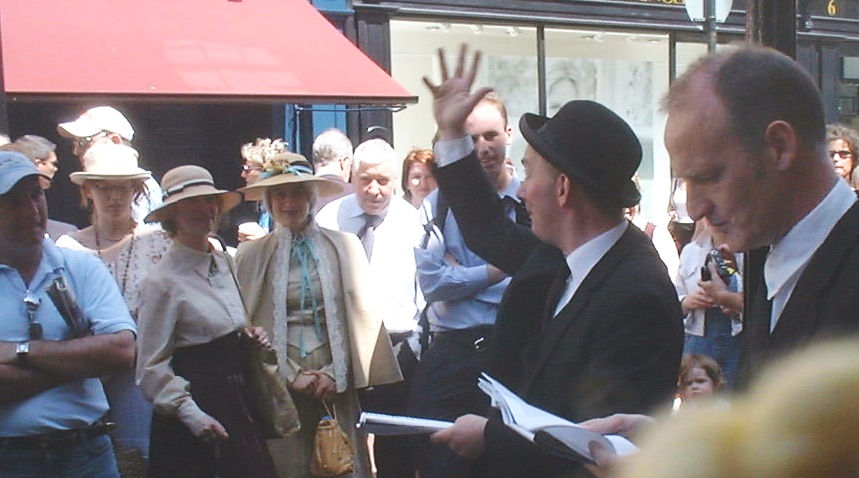
The lead image, a Bloomsday scene outside Davy Byrne’s Pub in Dublin, anchors Bloom’s afterlife in lived civic ritual rather than museum-like reverence.
The opening line of Bloom’s first episode is famously practical: “Mr Leopold Bloom ate with relish the inner organs of beasts and fowls.”[1] That sentence is not comic garnish. It declares method. Bloom is a sensory, embodied reader of the city. He notices smells, prices, ad copy, tram rhythms, street talk, and social temperature, then decides where to place himself without demanding that the world revolve around him.
1) Appetite as moral scale
A lot of readings flatten Bloom into “the everyman.” That label is partly true but too soft. Joyce is more specific: Bloom’s appetite is linked to ethics.
He is curious about bodies and material life without turning other people into props. In the same novel that gives us nationalist bombast, pub aggression, and masculine pose-work, Bloom repeatedly moves in a lower register: he asks, observes, and adjusts. Even his wandering has a different force from epic conquest. It is less “I will impose order” and more “I will keep contact with reality as it is.”
That is why small details matter in character analysis. Bloom thinks about kidneys and soap, but he also thinks about the poor, the dead, the embarrassed, and the socially exposed. His practical consciousness does not cancel reflection; it grounds it.
2) Outsider status without purity performance
Bloom’s social position is structurally unstable: he is native enough to know Dublin’s inner weather, yet marked enough—religiously, culturally, temperamentally—to be treated as not fully inside.[2][6] Joyce uses that partial exclusion to produce perspective.
Bloom sees the same city institutions as everyone else, but he is less captured by their prestige rituals. He can read rhetoric from the side. He can hear when language is doing social sorting rather than truth-telling. Characterologically, this gives him a rare combination: vulnerability plus interpretive flexibility.
Importantly, Joyce does not romanticize this into moral purity. Bloom can be evasive, desirous, self-protective, and sometimes passive. The strength of the character is not saintliness. It is elastic decency under pressure.
3) Why Bloom matters in a novel about talk
Ulysses is crowded with speech performances: legal talk, journalistic inflation, pub debate, catechism, parody, interior monologue.[1][2] Bloom survives this noise partly because he is not addicted to winning every verbal contest.
A line often quoted from his reflections catches this anti-grandiose intelligence: “A good puzzle would be to cross Dublin without passing a pub.”[1] It is observational, funny, and infrastructural at once. Bloom is always mapping systems through lived movement.
Later, the novel gives another compact self-diagnostic line: “Longest way round is the shortest way home.”[1] For Bloom, detour is not failure. Detour is how a person with limited power preserves agency in a dense social field.
4) Bloom with Stephen: care instead of ideology
The Bloom–Stephen relation is one reason the character remains alive for modern readers. Joyce does not stage a triumphant father-son replacement; he stages a temporary shelter relation in a city that can easily grind both men down for different reasons.[1][3]
Bloom’s importance here is practical. He offers food, space, and conversation before doctrine. He does not demand ideological conversion from Stephen. He offers provisional care. In character-study terms, this is decisive: Bloom’s masculinity is organized around maintenance, not command.
That choice also reframes the so-called “everyman” label. Bloom is not universal because he is bland. He is universal because he models a repeatable survival ethic in modern urban life: keep contact, reduce harm, avoid theatrical cruelty, and continue despite humiliation.
5) Reception and afterlife: why Bloom keeps returning
Bloom’s afterlife—Bloomsday walks, endless criticism, adaptation culture—works because the character solves a recurring modern problem: how to represent dignity without heroics.[2][4][5]
Joyce’s answer is neither sentimental nor cynical. He lets Bloom be compromised, desirous, and socially vulnerable, then makes those very conditions the ground of ethical intelligence. The famous slogan-like line “Love loves to love love” is easy to mock out of context, but inside Bloom’s profile it reads as a commitment to relation over performance.[1]
That is the core of the character study. Bloom is not built to dominate a narrative universe. He is built to keep a human scale inside systems that reward noise, certainty, and status display. In 2026, that design still feels not only legible but urgently practical.
Sources
- Project Gutenberg, Ulysses (1922 text; quotations and episode structure)
- British Library, “An introduction to Ulysses” (work context and modernist framing)
- James Joyce Digital Archive (manuscript/compositional context)
- James Joyce Centre, Bloomsday background (cultural afterlife)
- UCL Special Collections, James Joyce collection (archival/reception context)
- Wikipedia, “Leopold Bloom” (character background and publication-linked references)
- Image source (Wikimedia Commons, Bloomsday at Davy Byrne’s Pub)