It is easy to say that Whitman's grass stands for democracy and leave it there. That reading catches one truth, but it misses the poem's real mobility. In Song of Myself, grass is not a single emblem with one stable translation. It keeps changing scale. It begins as the tiny "spear of summer grass" beside a loafing body in section 1, becomes the object of a child's question in section 6, turns into a "uniform hieroglyphic" that crosses race and class, and then darkens into the "beautiful uncut hair of graves."[1] Grass is how the poem learns to move from one body to many bodies, from present touch to burial and return, without sounding like it has switched subjects.[1][2]
That matters because Song of Myself was built to carry such expansions. In the 1855 Leaves of Grass, Whitman placed the poem first among the twelve untitled poems, and when he shaped the book's final structure in 1881 he still kept it in the lead position, now arranged into 52 sections.[2] The Library of Congress exhibition on Leaves of Grass makes the larger point plainly: Whitman kept revising the book across decades until it became an "ever-transforming kaleidoscope of poems."[3] Grass belongs to that same method. It is not a decorative meadow detail. It is a portable device for turning one patch of earth into a whole theory of relation.
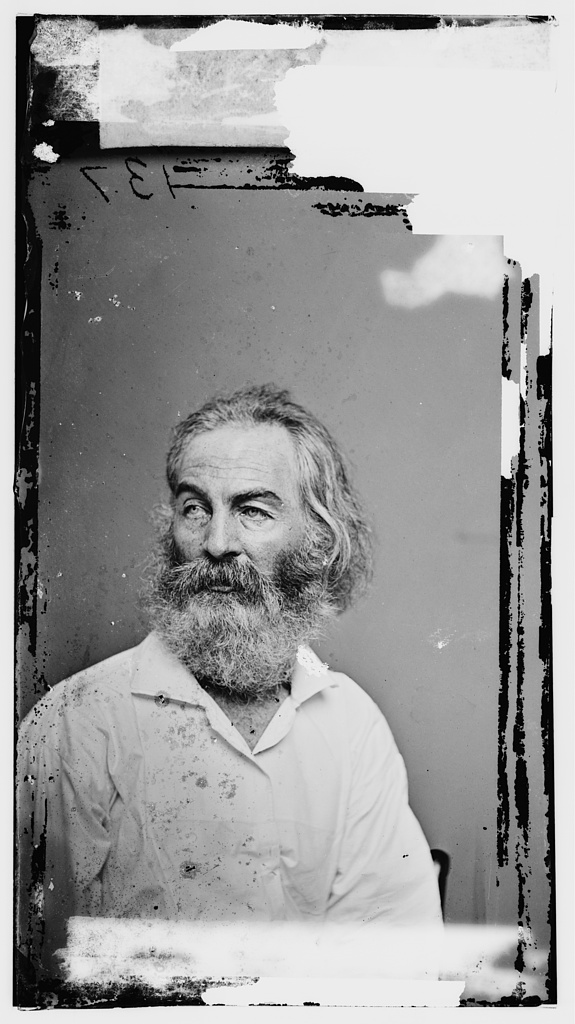
Image context: the cover uses an 1862 portrait by Brady's National Photographic Portrait Galleries rather than a facsimile page from Leaves of Grass. That choice keeps the essay near Whitman's central wager. The poem does not rise away from the body into abstraction. It starts with breath, stance, touch, and address, then widens outward. The portrait helps because it keeps the bodily source of that expansion in view.[4][5]
1. The first blade is not scenery. It is the poem's measuring stick.
Section 1 begins with one of the most famous claims in American poetry: "every atom belonging to me as good belongs to you."[1] The line sounds cosmic, but Whitman immediately lowers the scale. He loafs, invites his soul, leans at ease, and observes one spear of summer grass.[1] That sequence is crucial. The poem does not move from grand idea to minor detail as if the grass were an illustration. Instead, the blade sets the measure by which the grand idea can feel earned. Whitman must get the body onto the ground before he can ask the reader to share atoms with him.
This is one reason grass works better than a more monumental image would. A mountain or a star would signal sublimity too fast. Grass keeps Whitman close to the ordinary. Britannica's summary of Whitman's achievement stresses how Leaves of Grass challenged poetic convention through free verse and a new relation to common life.[4] The blade in section 1 is one of the earliest practical signs of that choice. It is common, low, plural by nature, and impossible to isolate from the field that surrounds it.
Once the reader notices that first spear, the poem's later expansions stop feeling like leaps. Whitman has already shown his method: start with something small enough to touch, then let it widen until it carries a whole social argument.
2. Grass lets Whitman keep body and democracy in the same syntax.
The most important turn arrives when the child asks, "What is the grass?"[1][2] Whitman answers by refusing a single answer. It may be the "flag" of his disposition, the Lord's handkerchief, the child of vegetation, or a uniform hieroglyphic.[1] The sequence matters more than the individual guesses. Each answer changes the category. Mood becomes object, object becomes divine token, token becomes child, child becomes script. Grass keeps slipping between private feeling, theology, generation, and language.
The democratic pressure enters right at the point where the emblem becomes writing. The "uniform hieroglyphic" grows among "black folks as among white," among named and unnamed Americans, without granting one group cleaner access than another.[1] Whitman does not present equality as a legal formula here. He materializes it as growth pattern. Grass spreads laterally. It refuses aristocratic singularity. Because it is everywhere, it can hold the poem's argument that no life is outside the field.
This is where Whitman's bodily poetics matter. The poem does not imagine democracy as an abstract constitution floating above flesh. The same voice that speaks of equality also speaks through lungs, blood, beard, hips, feet, and contact.[1][2] Grass lets those levels stay joined. It rises from the soil into politics without ceasing to be touchable.
3. Roads in Whitman are made from the same material as fields.
Whitman is often read as the poet of the open road, and rightly so, but Song of Myself never lets the road become pure escape. The road grows out of the same sensuous field-work as the grass. Even before the famous later road poems, section 3 sends the speaker's eyes "down the road," asking for exact value, while the poem refuses reduction into arithmetic.[1] What matters is not a destination. What matters is the possibility of onwardness.
Grass and road therefore belong together. Grass is lateral spread; road is directional spread. One teaches simultaneity, the other sequence. Together they allow Whitman to imagine movement without hierarchy. The field is full of innumerable blades; the road is open to innumerable walkers. The Whitman Archive's encyclopedia entry is useful here because it describes the poem as a "journey into knowing" launched by awakening and sustained through direct contact with the world.[2] Grass gives that journey a ground texture. The road is never detached from earth.
That is why Whitman's catalogs do not feel like random accumulation when they work best. The poem keeps widening, but the widening is tethered. People, trades, regions, races, gestures, and erotic energies all seem to grow from the same common surface. The road extends the field rather than escaping it.
4. The grave-turn darkens the poem without breaking it.
The most haunting thing Whitman does with grass is let it pass from growth into burial without changing material. "And now it seems to me the beautiful uncut hair of graves" is one of the poem's unforgettable lines because it preserves tenderness and shock at once.[1] Grass is still soft, still living, still curlable in the hand. But it is now also what rises from the dead. The field becomes archive.
This turn matters because it keeps Song of Myself from becoming a simple hymn of health. Earlier sections insist on bodily exuberance, appetite, nakedness, and sensory abundance.[1][2] The grave image proves that Whitman does not secure vitality by looking away from death. He absorbs death into the same growing system. The line immediately after the grave passage pushes further: the smallest sprout shows there is really no death; dying is "different from what any one supposed."[1] That claim can sound merely consoling if read in isolation. Inside the grass passage it becomes stranger and tougher. Death is not denied. It is redistributed.
This is also where the motif's emotional intelligence becomes clearest. Whitman does not monumentalize the dead with marble. He gives them back to the field. Grass is democratic not because it ignores mortality, but because it refuses to separate the living ground from the buried lives beneath it.
5. Why the motif still feels modern
Grass lasts as a motif because it can carry incompatible scales without strain. It is one blade and the whole field. It is present-tense touch and deep time. It is child, script, flag, road-edge, and grave-hair.[1][2] The larger publication history of Leaves of Grass helps explain why this flexibility matters. Whitman kept revising the book across nine editions, and the poem remained central to that evolving structure.[2][3][4] Grass, likewise, is a form that can survive revision because it is already designed to change shape while remaining recognizably itself.
That is why Whitman's emblem never feels as stiff as a lesson. He does not pin the meaning down once and for all. He keeps asking what the grass is, as if the right answer were the continued ability to ask at different scales. Private body, shared polity, open road, common grave: the poem can move among them because the grass has already made them neighbors.
Sources
- Walt Whitman, "Song of Myself." Leaves of Grass (1891-1892 text), The Walt Whitman Archive.
- James E. Miller Jr., "'Song of Myself' (1855)," The Walt Whitman Archive.
- Library of Congress, "Revising Himself: Walt Whitman and Leaves of Grass."
- Encyclopaedia Britannica, "Walt Whitman."
- Library of Congress Prints and Photographs Online Catalog, "Walt Whitman" (1862 Brady portrait, source page for the lead image).