Primo Levi's authority does not come from grandeur. Many twentieth-century writers of catastrophe remain memorable because they enlarge the event until it acquires mythic scale. Levi does something harder. He keeps bringing language back to calibration. He writes as if exactness were a moral obligation: the right noun, the measured analogy, the scene observed without decorative panic, the judgment that stops where evidence stops.[1][2] That habit is why his books still feel so bracing. They do not console by turning history into uplift, and they do not stun by turning suffering into spectacle. They insist that clear seeing is one of the last forms of dignity still available after degradation.[1][3]
That pressure is inseparable from the fact that Levi was not only a writer but a chemist.[1][2] Britannica's biography gives the essential outline: Turin-born, trained in chemistry, deported to Auschwitz, later a factory manager as well as an author whose major books kept returning to the camp and its aftermath.[1] The International Primo Levi Center's chronology fills in the deeper continuity. Curiosity about materials, a taste for problem-solving, and a habit of description were not secondary traits that he happened to carry into literature. They were part of the same cast of mind.[2] Read across If This Is a Man, The Periodic Table, The Truce, and The Drowned and the Saved, Levi's work-centered profile becomes remarkably coherent. He keeps asking how one can know what happened, how one can speak without falsifying scale, and how one can preserve complexity when the public prefers cleaner stories.[1][2][3][4][5][6]
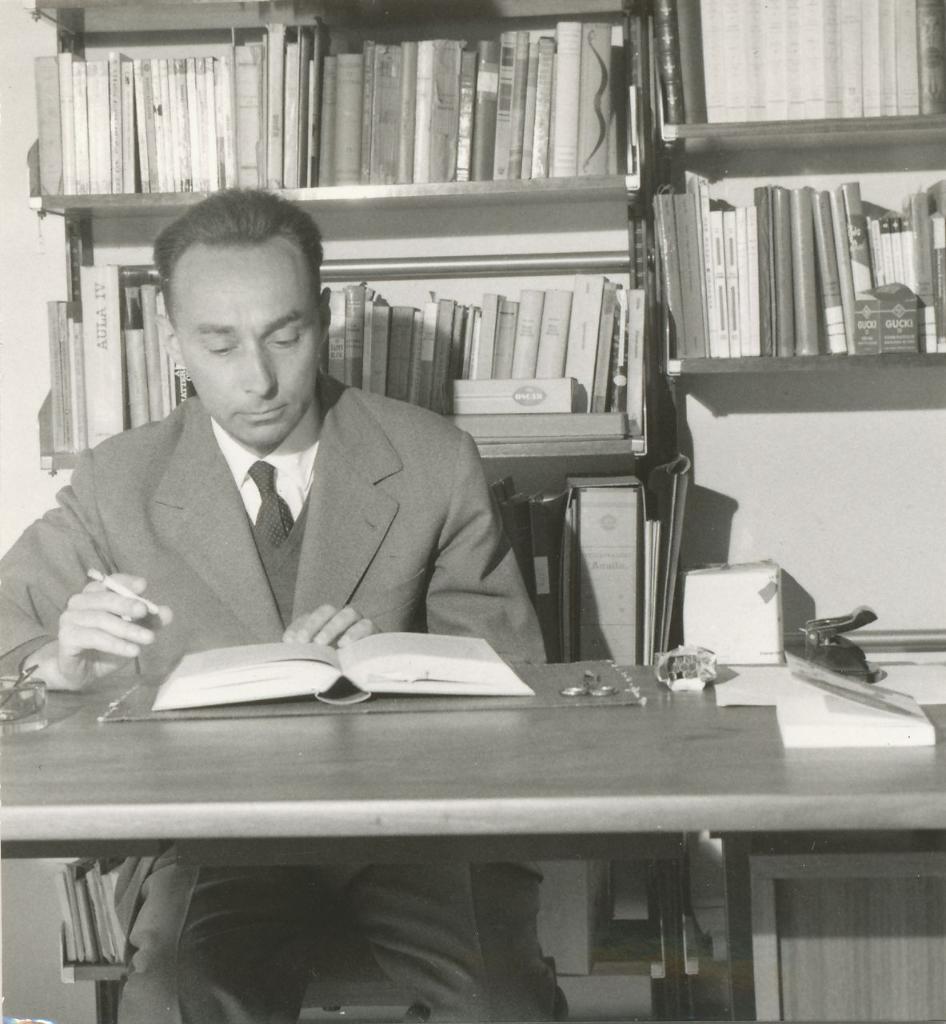
Image context: the cover uses a real archival desk photograph rather than barbed wire, camp ruins, or a symbolic chemical diagram. That choice is deliberate. Levi's singular force lies not in emblematic horror alone, but in the disciplined intelligence that keeps examining people, substances, shame, and memory after the event.[7]
1) If This Is a Man makes witness exact before it makes it monumental
The International Primo Levi Center's page on the 1947 edition calls the book Levi's "first-born," and that description matters because the work already contains the method he would keep refining.[3] The book was, as the same page says, "written right away," but not in the sense of undisciplined outcry.[3] What emerges instead is a form of witness that distrusts blur. Even when describing hunger, cold, selections, and humiliation, Levi keeps trying to sort processes, roles, timings, and material conditions. The prose does not ask for reverence in advance. It asks the reader to understand what a camp is, how it operates, what kinds of language break inside it, and what kinds still barely hold.[1][3]
That is where chemistry enters as method rather than biography. The Center's account of the book's formation notes that Levi and Leonardo De Benedetti's early Auschwitz Report was "as anthropological as it is clinical, as political as it is scientific."[3] That phrase helps explain why If This Is a Man never reads like raw testimony alone. Levi is not purifying experience into sterile objectivity; he is trying to save it from rhetorical fog. Even the famous laboratory episode, where his chemistry training briefly changes the conditions of survival, matters as more than plot.[3] It shows that technical knowledge and human vulnerability are never cleanly separable in his work. Matter can kill, shelter, sort, and deceive; a sentence about matter therefore has to be exact.
The Center also preserves one of Levi's best retrospective descriptions of the book's growth: it came from episodes that gradually revealed themselves as a chronology.[3] That is a beautiful statement of craft. The witness does not impose grandeur from above. He arranges facts until they disclose structure. Levi's restraint is therefore not emotional absence. It is ethical form.
2) The Periodic Table turns chemistry into literary conscience
If If This Is a Man shows Levi learning how to witness, The Periodic Table shows what sort of writer that witness became. Britannica calls the book a set of meditations on the physical, chemical, and moral spheres and says it may be his greatest popular and critical success.[1] The Primo Levi Center goes further, calling it his most complete and many-faceted book.[4] That feels right because the book does not treat chemistry as a colorful profession attached to an otherwise separate literary self. Chemistry becomes the grammar through which family history, Fascism, apprenticeship, labor, danger, craft, and intellectual temperament can all be narrated without losing their textures.[4]
The structure says everything. Twenty-one pieces are named for elements, and the Center notes that the titled material often becomes the catalyst of a chapter's "moral and narrative energy."[4] That is the right phrase. Levi does not use matter as decoration. He uses it to think. Argon lets him start with ancestral air and Piedmontese Jewish particularity; later elements give him ways to narrate experiment, error, stubbornness, contamination, extraction, patience, and transformation.[2][4] A weaker writer might have turned this into a clever conceit. Levi turns it into a full autobiography of mind.
One reason the book lasts is that it preserves manual intelligence. The Center describes Levi's chemists as "foot soldiers in hand to hand combat with materials," people who adapt their five senses and common sense in order to work.[4] That description reaches beyond laboratory romance. Levi is drawn to professions in which reality pushes back. His prose does the same. It tests, distinguishes, revises, and names. What looks at first like plain style is often the result of a great deal of moral and sensory discrimination. The Periodic Table reveals that clarity in Levi is never mere transparency. It is skilled handling.
3) The Truce restores motion, plurality, and appetite without pretending the camp is over
Readers who know Levi only through Auschwitz can miss how large a writer of return he became. The Truce is crucial here. The Primo Levi Center describes it as an "Odyssey" after the deadly "Iliad" of the Lager, a crowded story full of languages, wanderings, anxiety, and joy.[5] That shift matters enormously. Levi does not move from darkness into neat redemption. He moves into noise, delay, barter, chance encounter, absurd logistics, appetite, and provisional life. Catastrophe is followed not by purity, but by mixed human traffic.
This is why the book belongs near the center of his profile. It shows that Levi's witness was never interested only in atrocity as a frozen absolute. He wanted to know what kinds of people, voices, habits, and comic energies reappeared afterward.[5] The Center's summary points to Hurbinek, the child who "had never seen a tree," and then to the procession of unforgettable fellow travelers who fill the route home.[5] The juxtaposition is very Levi-like. Absolute sorrow remains present, but it does not erase the density of ordinary human variety.
The page's description of Levi as "a great observer and portrait-artist of people, places, animals, and objects" is especially useful.[5] It explains why The Truce feels less like an appendix than a widening. The same concise intelligence that anatomized camp life becomes, here, a way of registering vitality without sentimentality. Levi can honor survival without turning it into innocence. He lets history back into motion, but he keeps the moral weather unstable.
4) The Drowned and the Saved refuses the reader every clean alibi
Levi's late greatness is visible in how firmly he resists simplification even when public memory is asking for it. The Center's page on The Drowned and the Saved says the book completes, at a distance of forty years, the reflections that gave life to If This Is a Man.[6] Completion, though, does not mean closure. It means harsher precision. Levi is now writing against fading memory, skeptical students, denial, and the rhetoric that wants victims and persecutors cast into permanently rigid roles.[6]
That last point is decisive. The Center notes that the book pivots around the chapters "The Gray Zone" and "Shame," where Levi argues that the space between victim and perpetrator is not empty.[6] This is one of the bravest things in his oeuvre. He does not blur guilt in order to be humane. He clarifies structures of coercion, compromise, privilege, and survival so that moral language does not become theatrical.[6] He knows that readers often want a cleaner script because clean scripts are easier to admire from a distance. Levi refuses them because they are false to the human wreckage he is trying to understand.
The same page describes his prose as cutting "with his verbal scalpels."[6] That image fits. Levi's late essays keep their pity, but the pity is inseparable from incision. He investigates memory's distortions, the shame of survival, and the obscenity of enforced complicity because witness without discrimination can become ritual noise. In this sense, The Drowned and the Saved is not only a Holocaust classic. It is a statement about how literature should behave when history has already been overexplained, sentimentalized, and denied in turn.
Why Levi still matters
A work-centered portrait of Primo Levi finally resolves into one governing trait: he treats lucidity as a form of responsibility.[1][2][3][4][5][6] If This Is a Man makes testimony precise enough to resist inflation. The Periodic Table reveals that exactness is not coldness but a way of giving matter, labor, and character their due. The Truce restores the untidy plurality of life after catastrophe. The Drowned and the Saved strips away the reader's favorite simplifications just when memorial culture would most like to settle into them.
That is why Levi remains so necessary inside literature rather than history alone. He proves that style can be morally serious without becoming solemn, that witness can be exact without becoming thin, and that clarity can carry residue rather than washing it away. He writes as a chemist of language, but the compounds he studies are human: shame, appetite, memory, work, fear, irony, damage, survival. What survives in the end is not merely testimony to an event. It is a standard for how a sentence should behave when the facts are almost unbearable.
Sources
- Encyclopaedia Britannica, "Primo Levi" (biographical overview, major works, and chemistry-literature framing).
- Centro Internazionale di Studi Primo Levi, "Biography" (chronology and intellectual formation).
- Centro Internazionale di Studi Primo Levi, "If This is a Man - The 1947 version" (publication history, composition process, and early scientific witness).
- Centro Internazionale di Studi Primo Levi, "Il sistema periodico" (work overview and chemical-moral structure).
- Centro Internazionale di Studi Primo Levi, "La tregua" (return journey, tonal breadth, and observational style).
- Centro Internazionale di Studi Primo Levi, "I sommersi e i salvati" (late reflections on memory, the gray zone, and survivor shame).
- Wikimedia Commons, "File:Primo Levi (1960).jpg" (source page for the lead photograph).