Wangari Maathai is often remembered through the clean arithmetic of trees: millions planted, forests defended, a Nobel Peace Prize in 2004. That memory is true but incomplete. The more revealing history begins at a smaller scale, with rural Kenyan women reporting that streams were drying up, firewood was farther away, and food security was weakening.[2] Maathai's answer in 1977 was not to invent a grand environmental bureaucracy. It was to make a seedling into a civic tool.
This microhistory asks how a tree-planting project became a democratic practice. The answer is not that trees automatically produce politics. It is that Maathai and the Green Belt Movement built a workflow that made local damage visible, gave women practical authority over repair, created records and nurseries, and then carried that same logic into public-park and forest-defense campaigns. By the time the Nobel Committee honored her for sustainable development, democracy, and peace, it was recognizing a link Maathai had spent decades making on the ground.[3]
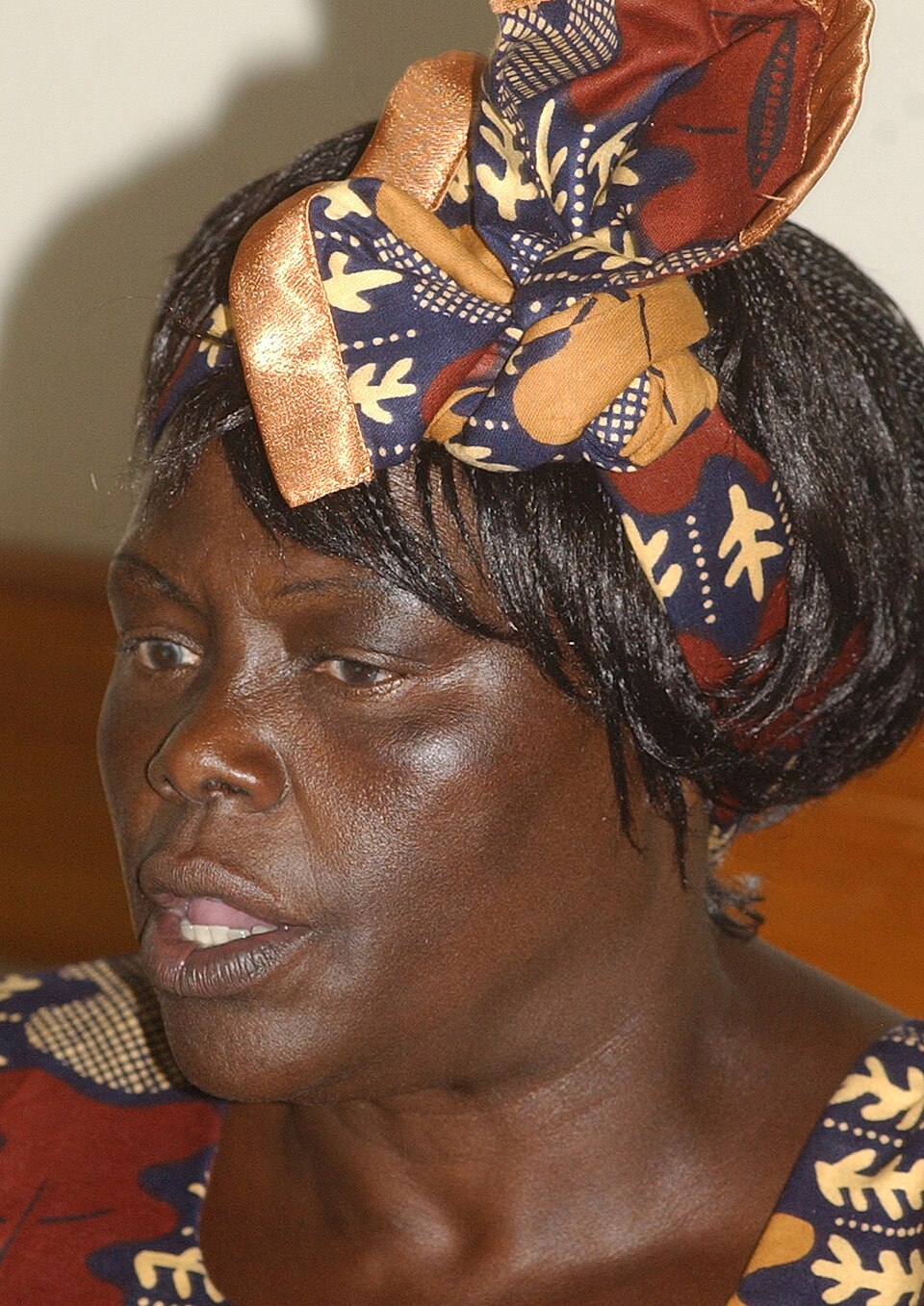
The portrait above was taken in Brazil in 2006, after Maathai had become an international figure.[6] It is useful precisely because it comes late. It shows the laureate, but the story underneath is about the unglamorous mechanisms that made the laureate possible: holes dug, seedlings raised, groups organized, parkland defended, and environmental claims translated into public rights.
Timeline anchors
- 1940: Wangari Muta Maathai was born in Nyeri, Kenya.[1]
- 1964-1971: she earned degrees in biological sciences, completed graduate study, and received a Ph.D. from the University of Nairobi, later becoming the first woman in East and Central Africa to earn a doctorate and to hold senior academic posts in her field.[1]
- 1977: under the National Council of Women of Kenya, she founded what became the Green Belt Movement.[2][4]
- 1989-1999: the movement's tree work widened into confrontations over Uhuru Park, political-prisoner advocacy, and Karura Forest.[4]
- 2004: Maathai received the Nobel Peace Prize for connecting sustainable development, democracy, and peace.[3]
- 2011: she died in Nairobi, leaving an institution that still presents tree-growing as an entry point to environmental management, community empowerment, and livelihood improvement.[1][2]
These dates resist a simple "woman planted trees" story. Maathai's life moved from academic biology to village-level environmental repair, from village repair to rights language, and from rights language to a global peace argument.
The seedling solved a listening problem
The Green Belt Movement's official account matters because it starts with testimony rather than theory. Its current history says the organization began in 1977 under the National Council of Women of Kenya in response to rural women who reported drying streams, less secure food supplies, and longer walks for firewood.[2] That detail is the hinge of the story. Maathai did not begin by asking communities to admire biodiversity in the abstract. She began with the daily labor costs of environmental degradation.
That is why the seedling was such a strong unit of action. A tree could bind soil, hold water, provide fuel or food, and make degraded land visible as something that might be repaired.[2] It also gave women a task that could be organized locally. The Green Belt Movement describes its mission as better environmental management, community empowerment, and livelihood improvement through tree-growing as an entry point.[2] The phrase "entry point" is important. Tree planting was not the whole politics. It was the door into politics.
The Goldman Environmental Prize account gives the origin a physical scale: seven seedlings planted on World Environment Day in 1977, followed by rows of trees that became "green belts."[4] The number is small enough to matter. Seven seedlings could not transform Kenya's forests. They could, however, demonstrate a method: gather a group, grow a seedling, put it in the ground, tend it, and connect survival to responsibility. Maathai's genius was to treat that method as repeatable civic infrastructure rather than as symbolic charity.
The nursery made authority local
Maathai's early biography helps explain why the movement did not remain a vague moral appeal. The Green Belt Movement notes that she studied biological sciences in Kansas, earned a master's degree at Pittsburgh, pursued doctoral work in Germany and Nairobi, and received her Ph.D. in 1971.[1] Scientific training gave her a practical respect for process: living things need conditions, not slogans. Seedlings need nurseries, water, knowledge, and follow-up.
The Green Belt Movement's work therefore depended on local organization as much as on ecological concern. Its own description says it empowers communities, particularly women, to conserve the environment and improve livelihoods.[2] Goldman reports that over time hundreds of thousands of women became involved, more than 5,000 nurseries were established, and more than 51 million trees were planted in Kenya.[4] Those figures should not be read only as scale. They show a governance pattern. Nurseries are small institutions. They require division of labor, survival checks, local trust, and a standard for deciding whether work has actually succeeded.
That point separates Maathai's history from feel-good environmental memory. A planted tree is not the same as a grown tree. A ceremony is not the same as restoration. The movement's power came from making communities responsible for a cycle: seed selection, nursery care, planting, protection, and local benefit. It turned environmental repair into a public habit that could be learned and repeated.
Firewood became rights language
The political turn in Maathai's work was not a departure from tree planting. It was the tree-planting logic pushed into harder terrain. If women were walking farther for firewood because forests had been degraded, then the problem was not only personal hardship. It was land use, public accountability, corruption, and who had standing to object when common goods were taken.
The Nobel ceremony speech made that wider interpretation explicit. The Committee framed Maathai's work as a holistic approach to sustainable development that embraced democracy, human rights, and women's rights.[3] That was not an after-the-fact prize committee embellishment. It described the route by which local environmental work had become a challenge to the systems that produced degradation.
Goldman's history of the movement gives the pressure points. In 1989, Maathai and the Green Belt Movement opposed a proposed 60-story development in Uhuru Park, a central Nairobi public space.[4] In 1992, Uhuru Park became a site of hunger-strike activism for political prisoners, and Maathai was beaten unconscious by police.[4] In 1999, during protests against privatization in Karura Forest, movement members were beaten by private guards.[4] These episodes show the same mechanism at a higher level. A tree was no longer only a planted object. A park or forest was a public claim: who owns shade, soil, watershed, and civic space?
The phrase "environmental democracy" can sound tidy until it is placed beside those confrontations. Maathai's movement made environmental harm discussable by people who were supposed to endure it quietly. Once that happened, tree planting exposed larger questions: who benefits from land allocation, who can contest development, and whether women organized around daily needs can be treated as political actors.
The Nobel Prize recognized a method, not just a cause
The 2004 Nobel Peace Prize is sometimes presented as a surprising expansion of what peace could mean. The Committee's statement, quoted in the ceremony speech, honored Maathai for her contribution to sustainable development, democracy, and peace.[3] The novelty was real, but the logic was already present in the movement's practice. If environmental degradation deepened poverty and resource conflict, then repair was not separate from peace. If repair required participation, rights, and accountability, then democracy was not separate from ecology.
Maathai herself made that connection in the Green Belt Movement's Nobel page, saying the work was not simply about planting trees but about people taking charge of their environment, the system that governed them, their lives, and their future.[5] The sentence is often remembered because it is expansive. Historically, its force comes from being grounded. The people taking charge were not abstract citizens in a seminar. They were women making nurseries, defending parks, and connecting practical survival to political voice.
That is why this is a microhistory rather than a monument. The grand recognition only makes sense if the small unit is kept in view. A seedling was a living object, but it was also a test of agency. Could local women define the problem? Could they organize a response? Could the response survive long enough to become visible? Could visibility become authority? Could authority confront the state when forests and parks were threatened?
What Maathai's mechanism leaves behind
The Green Belt Movement's present-day self-description still emphasizes restoration of ecosystems, sustainable livelihoods, gender advocacy, environmental sustainability, and policy influence.[2] That continuity matters because Maathai's mechanism was never only personal charisma. It was a durable operating model: start from local ecological pain, organize around a repairable unit, build women's leadership into the workflow, and let environmental stewardship become a language for public accountability.
The strongest historical lesson is therefore not that every political problem can be solved by planting trees. Maathai's own life shows the opposite. Trees opened the question; they did not close it. The movement met repression, police violence, land-grabbing pressure, and the difficulty of keeping planted life alive after the ceremony ended.[4] Its achievement was to make those struggles harder to hide.
Wangari Maathai made seedlings into democratic infrastructure because she understood that power can enter history at the scale of ordinary work. A woman who grows a seedling, keeps a record, joins a nursery, defends a park, and insists that land policy belongs to the public is not merely helping the environment. She is practicing citizenship. The Nobel Prize turned that practice into a global symbol, but the history began when a small tree made a public claim possible.
Sources
- Green Belt Movement, "Wangari Maathai" - official biographical page covering Maathai's birth, education, academic milestones, books, Nobel recognition, and death.
- Green Belt Movement, "Who We Are" - official organizational overview of the 1977 founding under the National Council of Women of Kenya, mission, women's empowerment, and tree-growing model.
- NobelPrize.org, "Award ceremony speech - The Nobel Peace Prize 2004" - Nobel Committee framing of Maathai's contribution to sustainable development, democracy, human rights, women's rights, and peace.
- Goldman Environmental Prize, "The Green Belt Movement: 40 Years of Impact" - account of the seven seedlings in 1977, Uhuru Park, Karura Forest, repression, nurseries, women participants, and tree totals.
- Green Belt Movement, "The Nobel Peace Prize" - official page quoting the Nobel citation and Maathai's own explanation of why the work extended beyond tree planting.
- Wikimedia Commons, "File:Wangari Maathai, 2006 (cropped).jpg" - Agência Brasil photograph by Antônio Cruz used as the article image.