The Lavender Scare is often remembered as the anti-gay underside of the Cold War Red Scare. That is true, but it is still too broad to explain how the purge worked. The sharper historical question is procedural: how did a climate of fear become an operating system capable of removing thousands of federal workers and deterring many more from public service?
The answer sits in a chain. Congressional investigators and agency officials first treated homosexuality as a sign of moral unreliability and blackmail vulnerability. Then the federal personnel system converted that assumption into questionnaires, interviews, case summaries, security standards, and dismissal authority. Finally, Executive Order 10450, signed on April 27, 1953, gave agencies a government-wide security language broad enough to fold sexuality into national-security review.[1][2][3][4][5]
The result was not only prejudice in high places. It was prejudice made administratively portable. Once sexuality could be filed under security, agencies did not need to prove espionage, sabotage, or an actual leak. They could treat identity, rumor, arrest records, associations, and coerced admissions as signs of unfitness for federal employment.[3][4][5] That is why the Lavender Scare lasted beyond the loudest years of McCarthyism. It had become a personnel process.
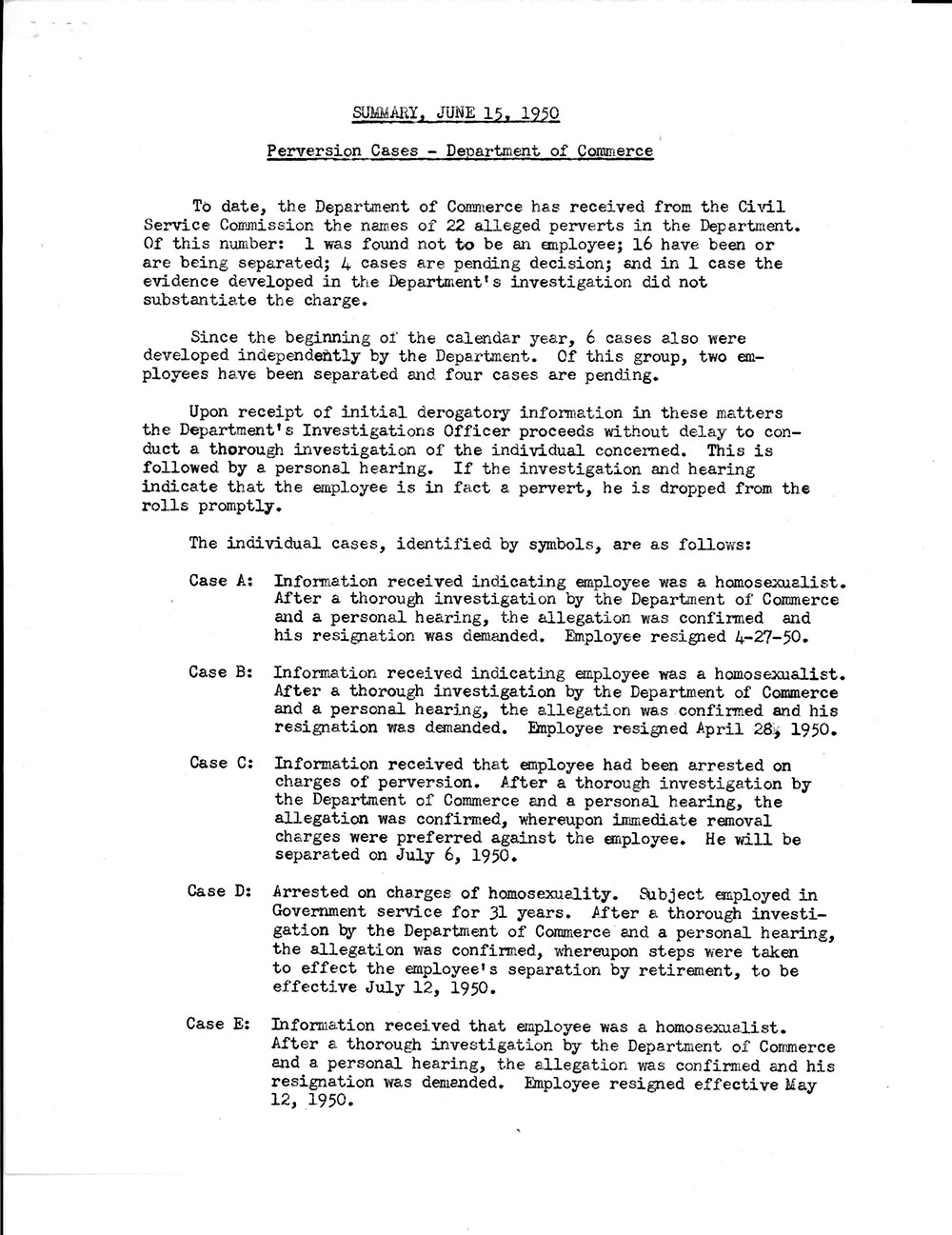
Image context: the cover image is an archival National Archives scan of a June 15, 1950 Department of Commerce summary used in Judith Adkins's Prologue article on the Lavender Scare. Its historical language is dehumanizing; that is part of why the document is useful evidence. It shows how agencies reduced workers to case letters, allegations, and separation decisions before Executive Order 10450 made the pattern more durable across the federal government.[3]
Timeline anchors
- 1947: U.S. Park Police in Washington, DC, begin a "Sex Perversion Elimination Program," one early local sign of official repression before the Eisenhower order.[3]
- February 1950: Senator Joseph McCarthy publicly links alleged subversion and homosexuality in the federal government; State Department testimony soon reports 91 homosexual employees ousted as security risks.[3]
- June 1950: the Commerce Department prepares case summaries showing how suspected homosexuality could be turned into investigation, hearing, resignation, or removal.[3]
- April 27, 1953: Eisenhower signs Executive Order 10450, requiring security review for government employment and listing disqualifying categories that included "sexual perversion."[1][2][4][5]
- 1957-1961: Frank Kameny is fired from the Army Map Service and fights the decision through administrative and court channels, helping turn federal exclusion into a civil-rights claim.[5][6]
- 1975: the Civil Service Commission announces that gay people can no longer be barred or fired from federal civilian employment solely because of sexuality.[3][4][5]
- 1995, 1998, 2017: later executive actions end sexual-orientation discrimination in security clearances, federal employment, and finally repeal EO 10450 itself.[5]
1. Congressional panic supplied the category before the order supplied the machinery
The Lavender Scare did not begin with Eisenhower's signature. National Archives historian Judith Adkins traces the campaign into the late 1940s, when Washington officials, police, and congressional investigators were already framing gay federal workers as a security problem.[3] That distinction matters because EO 10450 did not invent the suspicion. It standardized and extended it.
McCarthy's February 1950 speeches created one public accelerant. Adkins shows that McCarthy folded homosexuality into the same rhetorical field as communism, treating gay men as "unsafe risks" and implying vulnerability to subversive recruitment.[3] The point was not evidentiary precision. It was category formation. Once gay employees could be discussed as security risks in the same breath as alleged communists, agencies gained a ready-made vocabulary for treating private life as a public danger.
The Hoey committee investigation then moved the panic into administrative form. Its staff contacted military branches and 53 civilian departments and agencies, asking about suspected homosexuals, removals, policies, and suitability for employment.[3] That questionnaire process is historically important because it asked every agency to translate fear into countable personnel information. The government was not merely denouncing a group. It was learning how to inventory, compare, and manage that group through records.
The Department of Commerce document used as this article's image shows the result in miniature. Individual workers appear as cases, not as full people; the relevant verbs are "investigation," "hearing," "resignation," and "separation."[3] That bureaucratic compression was the Lavender Scare's first mechanism. It turned rumor and identity into a file path.
2. Executive Order 10450 made exclusion sound like ordinary security administration
Executive Order 10450 is not written as an anti-gay manifesto. Its title is bland: "Security Requirements for Government Employment." The opening rationale speaks of reliability, trustworthiness, conduct, character, and loyalty.[1][2] That blandness is the point. The order's power came from embedding moral judgment inside personnel security.
The order required each department and agency head to ensure that employment was "clearly consistent with the interests of the national security."[1][2] It listed grounds that could count against a worker, including sabotage, espionage, treason, criminal conduct, addiction, mental illness, and the category then called "sexual perversion."[1][2] The historical violence lies in the list's architecture. By placing sexuality among other disqualifying risks, the order made firing gay employees appear as one part of a sober security checklist rather than as a civil-rights violation.
That structure also explains why the order traveled so effectively. Agencies did not have to create a separate anti-gay rule from scratch. They could cite the order's broad security framework and fit suspected sexuality into it. NARA's federal-employment research guide states the result plainly: the order barred homosexuals from federal government work and caused an untold number of people to lose jobs.[5] The National Park Service gives an estimated range of 7,000 to 10,000 federal employees fired or forced to resign because of sexuality during the Lavender Scare.[4]
The exact number will remain difficult because personnel files, coerced resignations, quiet withdrawals, and deterrence do not leave one clean ledger. But the uncertainty should not weaken the central mechanism. The order made exclusion routine. It lowered the threshold from proving a worker had harmed national security to deciding that the worker's private life made them an unacceptable risk.[1][2][3][4][5]
3. The purge worked by making secrecy both the accusation and the trap
The Lavender Scare's blackmail argument had a circular quality. Officials claimed gay workers were vulnerable because their sexuality could be exposed. But federal policy itself made exposure catastrophic by threatening workers with job loss, humiliation, and investigation.[3][4] The government helped create the vulnerability it then cited as evidence of risk.
Adkins's article is especially strong on this point because it keeps returning to anonymity. Unlike the Red Scare's public hearings and named confrontations, many Lavender Scare victims remained hidden in personnel records, agency summaries, and scattered anecdotes.[3] That anonymity could protect some people from even greater public exposure, but it also made the purge appear abstract. Workers vanished from jobs, resigned under pressure, or were discussed through anonymized cases rather than as citizens whose livelihoods had been taken.[3]
The process was intimate and invasive. Agencies and investigators could look for arrests, associations, informants, rumors, and admissions. Once a file existed, the question became less "Did this person betray the government?" than "Can this person be certified as reliable under the moral assumptions of the security state?"[1][2][3] That was a much more elastic test. It let agencies police sexuality without having to say openly that same-sex desire itself was the only real offense.
This is the second mechanism: the Lavender Scare converted privacy into suspicion. A worker who hid could be described as blackmailable; a worker who was discovered could be described as immoral; a worker who fought could be described as challenging the government's right to decide its own security standards. The trap was procedural, not only cultural.
4. Frank Kameny exposed the weak point in the system
Most fired workers had strong reasons not to fight. Publicity could destroy careers, families, and future employment. Frank Kameny mattered because he refused the personnel system's preferred ending: quiet disappearance.
Kameny was fired from the Army Map Service after officials learned of his arrest for consensual contact with another man; the JFK Library Archives blog describes his case as part of the EO 10450 world and notes that he carried his claim all the way toward the Supreme Court.[6] NARA's federal-employment guide identifies him as one of the central figures who turned dismissal into activism.[5] His challenge did not immediately win reinstatement, but it changed the frame. He argued that discrimination against gay workers was a civil-rights problem, not a valid security judgment.[5][6]
That reframing mattered because it attacked the order's strongest disguise. EO 10450 had made sexuality look like a security input. Kameny and later activists insisted that it was a constitutional and employment-rights question. Once that argument became public, agencies could no longer rely entirely on silence, shame, and private case handling. They had to answer a growing claim that the security standard itself was unjust.[5][6]
The National Archives Prologue account draws the line from Kameny's 1957 firing through the Mattachine Society of Washington, public demonstrations, legal pressure, and the 1975 Civil Service Commission shift.[3] The victory was incomplete; security-clearance discrimination continued in other forms, and later executive actions were still needed in 1995, 1998, and 2017.[5] But 1975 remains a hinge because it weakened the civilian employment rule that had made sexuality alone sufficient for exclusion.[3][5]
5. The historical lesson is about paperwork as power
The Lavender Scare should not be remembered only as a moral panic with cruel ideas. It was a moral panic that learned how to file, classify, investigate, and terminate. That is why it endured. Speeches created public permission; committee inquiries created agency-level data; case summaries turned private lives into administrative objects; Executive Order 10450 supplied government-wide authority; and personnel offices carried the work forward long after the most theatrical Red Scare moments had faded.[1][2][3][4][5]
That sequence also explains why the archive matters. The Commerce Department summary is painful to read because its categories are ugly, but its form is just as important as its language.[3] It shows people being converted into cases before the reader can know their names. That is the core of the mechanism. The Lavender Scare made discrimination efficient by making it procedural.
The deeper historical lesson is therefore not only that gay and lesbian federal workers were wronged, though they were. It is that a bureaucracy can make a political fear durable by translating it into neutral-looking standards. Once that translation happens, repeal requires more than changing the public mood. It requires breaking the forms, orders, investigative habits, and personnel assumptions that let fear act like law.[3][5][6]
Sources
- DocsTeach / National Archives, "Executive Order 10450: Security Requirements for Government Employment" - full citation, document transcript, date, signature, and National Archives identifier.
- National Archives, "Executive Order 10450--Security requirements for Government employment" - codified text and source note for the April 27, 1953 order.
- Judith Adkins, "'These People Are Frightened to Death': Congressional Investigations and the Lavender Scare." Prologue Magazine, National Archives, Summer 2016 - on congressional investigations, agency questionnaires, Commerce Department case records, McCarthy-era rhetoric, Kameny, and the 1975 Civil Service Commission change.
- National Park Service, "Executive Order 10450: Eisenhower and the Lavender Scare" - overview of EO 10450's effects, estimated removals, Robert Cutler, activism, and later repeal.
- National Archives, "LGBTQIA+ Federal Employment in the Records at the National Archives" - research guide on EO 10450, Frank Kameny, the 1975 Civil Service Commission shift, and later executive-order changes in 1995, 1998, and 2017.
- Stacey Flores Chandler, "Frank Kameny, JFK, & the Case for LGBTQ+ Rights." JFK Library Archives blog, June 2, 2021 - on Kameny's firing, legal challenge, and the civil-rights framing of federal anti-gay discrimination.