A balloon inside the body's largest artery offers a compelling emergency intervention: interrupt blood flowing toward an internal injury while preserving circulation to the heart and brain. The technique, resuscitative endovascular balloon occlusion of the aorta, or REBOA, aims to keep a patient alive until bleeding can be controlled by an operation. Its cost begins immediately, too: tissues below the balloon lose their normal blood supply.[1]
That bargain depends on time. The balloon must be placed, the patient must reach definitive treatment, and circulation must eventually be restored. The UK-REBOA trial asked whether adding this sequence to emergency care improved survival. To understand its answer, it helps to follow the patients who never reached balloon inflation.
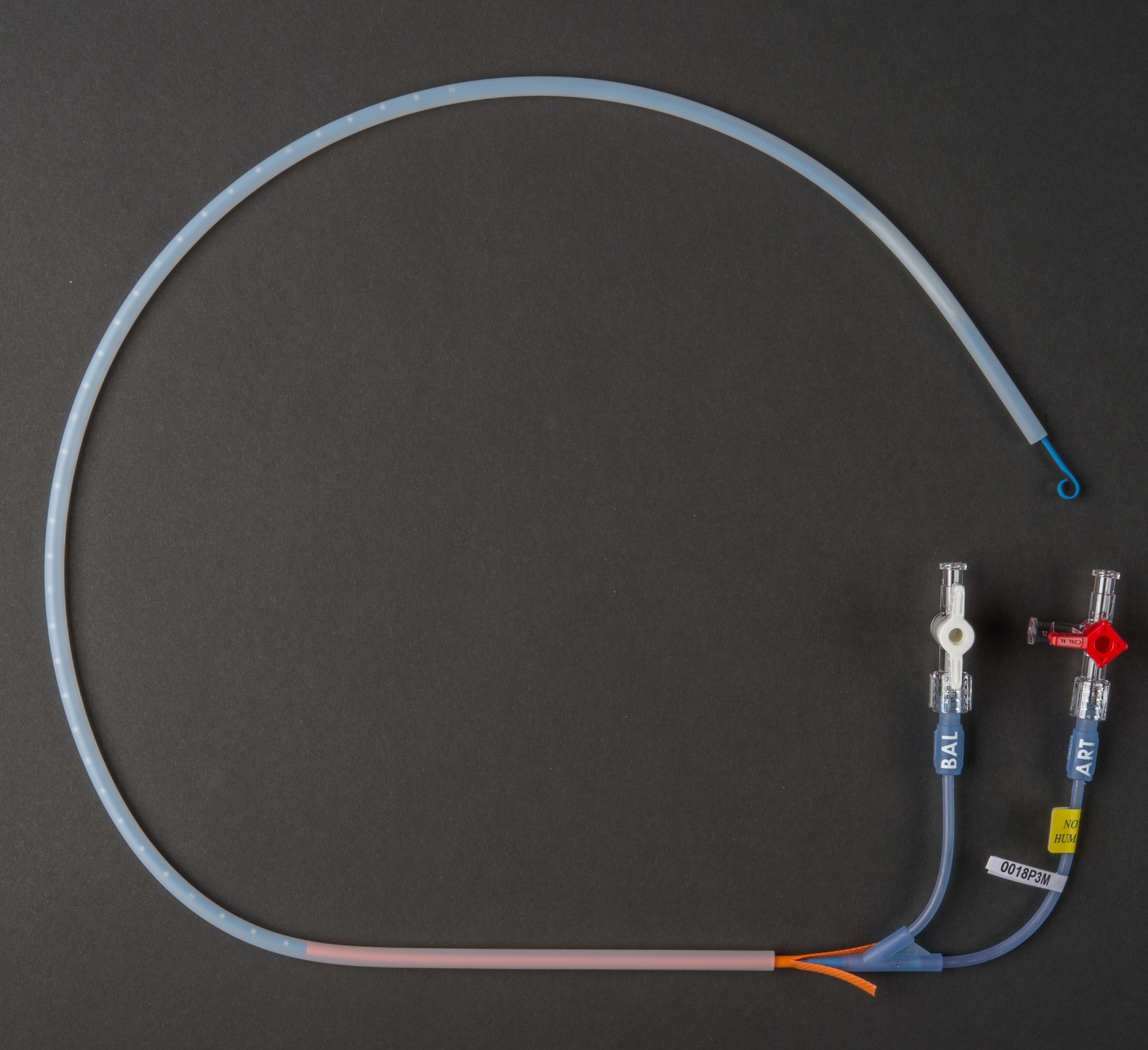
The trial began before inflation
The protocol, published in 2022, allowed clinicians to stop pursuing REBOA if a patient improved with resuscitation, deteriorated toward imminent death, or proved difficult to access through an artery when surgery could be reached faster. Usual care continued in both groups. The study also planned to analyze patients according to their randomized assignment.[3]
These provisions make clinical judgment part of the intervention. A team has to choose a treatment before it knows whether a patient will improve during preparation or prove impossible to catheterize. The decision and the eventual procedure are separated by uncertainty.
The accompanying editorial highlights those paths. Of 46 patients assigned to the REBOA strategy, 19 had a balloon inserted and inflated. Seventeen improved with other resuscitation; eight could not have arterial access established; two deteriorated before access was obtained.[6]
Removing the patients without inflation would therefore change the comparison. It would select people partly by events occurring after assignment, including improvement and technical difficulty. Keeping them in their original groups preserves the question facing a trauma service: what happens when its team begins a strategy that includes REBOA? This is the reasoning behind the protocol's choice of analysis.[3]
Reading the survival result
Jan Jansen and colleagues' report appeared online in JAMA on 12 October 2023. Sixteen UK trauma centers randomized 90 patients during 2017–2022, mostly after blunt injuries. One control-group patient withdrew permission for continued participation and data collection, leaving 89 in the primary analysis.[4]
At 90 days, 25 of 46 patients assigned to REBOA plus standard care had died, compared with 18 of 43 assigned to standard care alone: 54% versus 42%. The estimated odds ratio was 1.58, with a 95% credible interval of 0.72–3.52. The Bayesian analysis assigned an 86.9% probability to increased odds of death, conditional on its model and prior assumptions.[4]
The interval spans benefit and harm, but uncertainty does not erase the unfavorable direction of the evidence. The trial did not establish improved survival. And 86.9% concerns the direction of the treatment effect; it is not an individual patient's probability of dying.[4]
Where the minutes went
The expanded September 2024 report supplies timing details. Among patients with a qualifying definitive bleeding-control procedure and timing data, the median interval from randomization to the procedure was 83 minutes with the REBOA strategy and 64 minutes with standard care. These samples contained only 12 and 19 patients, respectively.[5]
This is a clue about delivery, not a randomized experiment in a nineteen-minute delay. Patients had to survive and proceed to a qualifying procedure to enter that comparison. Differences in their injuries and treatment paths could affect the times. The numbers cannot establish that delay caused the excess deaths, or calculate how many lives faster placement would have saved.
The report's authors nevertheless considered delayed or unsuccessful definitive bleeding control a plausible explanation for the early mortality pattern.[5] That interpretation returns attention to the promise with which REBOA began. A temporary intervention has to improve the patient's passage to the next treatment. Successful inflation alone cannot establish that it did.
How far the finding travels
In an accompanying editorial, Samuel Tisherman and Megan Brenner argued that experience and organization could change the result elsewhere. They emphasized infrequent procedures at participating centers and the time required to reach inflation, and called for studies in experienced trauma centers with clearer specifications for training and treatment delivery.[6]
That is a substantive limit on generalization. It does not demonstrate a survival benefit in the proposed alternative setting. The investigators emphasized that changing patient conditions and difficult access belonged in any evaluation of a REBOA service.[5] These positions identify different ambitions: testing a technique under favorable conditions and testing what happens when a health system puts it into practice.
A randomized comparison in a clearly defined setting, with faster delivery and better survival, could address that disagreement. The proposed advantage needs evidence from its own setting. UK-REBOA's enduring contribution is to keep the attempted procedure inside the frame. For a patient bleeding internally, preparation, unsuccessful access and the journey to an operating room are all part of the treatment they receive.
Sources
- Health Research Authority, “UK REBOA Study” — research summary explaining the proposed mechanism, downstream blood-flow risk and reason for testing the procedure.
- Matthew Breitbart / National Museum of Health and Medicine, “ER-REBOA catheter in the museum collection” (photographed 6 March 2017), DVIDS image 3601654 — photograph and object provenance.
- Jan O. Jansen and colleagues, “UK-REBOA trial protocol,” Trials 23:384 (2022) — intervention modification, continuing care and intention-to-treat analysis.
- Jan O. Jansen and colleagues, “The UK-REBOA Randomized Clinical Trial,” JAMA 330:1862–1871 (12 October 2023 online) — original trial report and primary outcome.
- Jan O. Jansen and colleagues, “UK-REBOA multicentre RCT,” Health Technology Assessment 28(54) (September 2024) — Table 12 and discussion; expanded report of the same trial.
- Samuel A. Tisherman and Megan L. Brenner, “Contemporary Adjuncts to Hemorrhage Control,” JAMA 330:1849–1851 (12 October 2023 online) — accompanying editorial on experience, implementation and the limits of generalization.