
British Pathé's Polio Treatment (1951) is valuable because it does not pretend that recovery from polio begins with a cure.[1] The clip arrives from the late pre-vaccine era, when the disease still sat in public memory as a summer terror and when treatment often meant long sequences of management rather than one decisive intervention.[2][3] The film description identifies Queen Mary's Hospital for Children in Carshalton, Surrey, and the footage moves through water therapy, braces, examination, office work, craft work, and bedside exercise.[1] Taken together, those scenes make a sharper claim than the title first suggests. "Treatment" here means building a route back toward function, however partial and uneven that route may be.
That is why the clip is more revealing than a simple medical curiosity. The CDC's Pink Book explains that poliovirus destroys motor neurons and that paralysis may persist even when acute illness has passed.[2] The CDC Museum's historical overview adds the atmosphere around the disease: parents feared summer outbreaks, institutions raised money for care and research, and machines, wards, and rehabilitation centers became part of everyday public-health language.[3] In that setting, the Pathé film is not showing an afterword to disease. It is showing the central labor of the period. Once a child survived the fever and the acute neurological injury, the next question was how much movement, autonomy, and social participation could be rebuilt.
The scenes matter for another reason as well. Modern viewers often remember polio through the most dramatic images: iron lungs, vaccine lines, and the triumphant announcement of Salk's results.[3][4] This film shifts attention away from headline drama and toward repetitive practice. Legs are supported in water. Bodies are lowered carefully into a pool. Callipers, frames, and hands all appear as tools for distributing effort.[1] That emphasis changes the emotional register of the history. Instead of one great breakthrough story, we see a chronic choreography of therapy, patience, frustration, and adaptation.
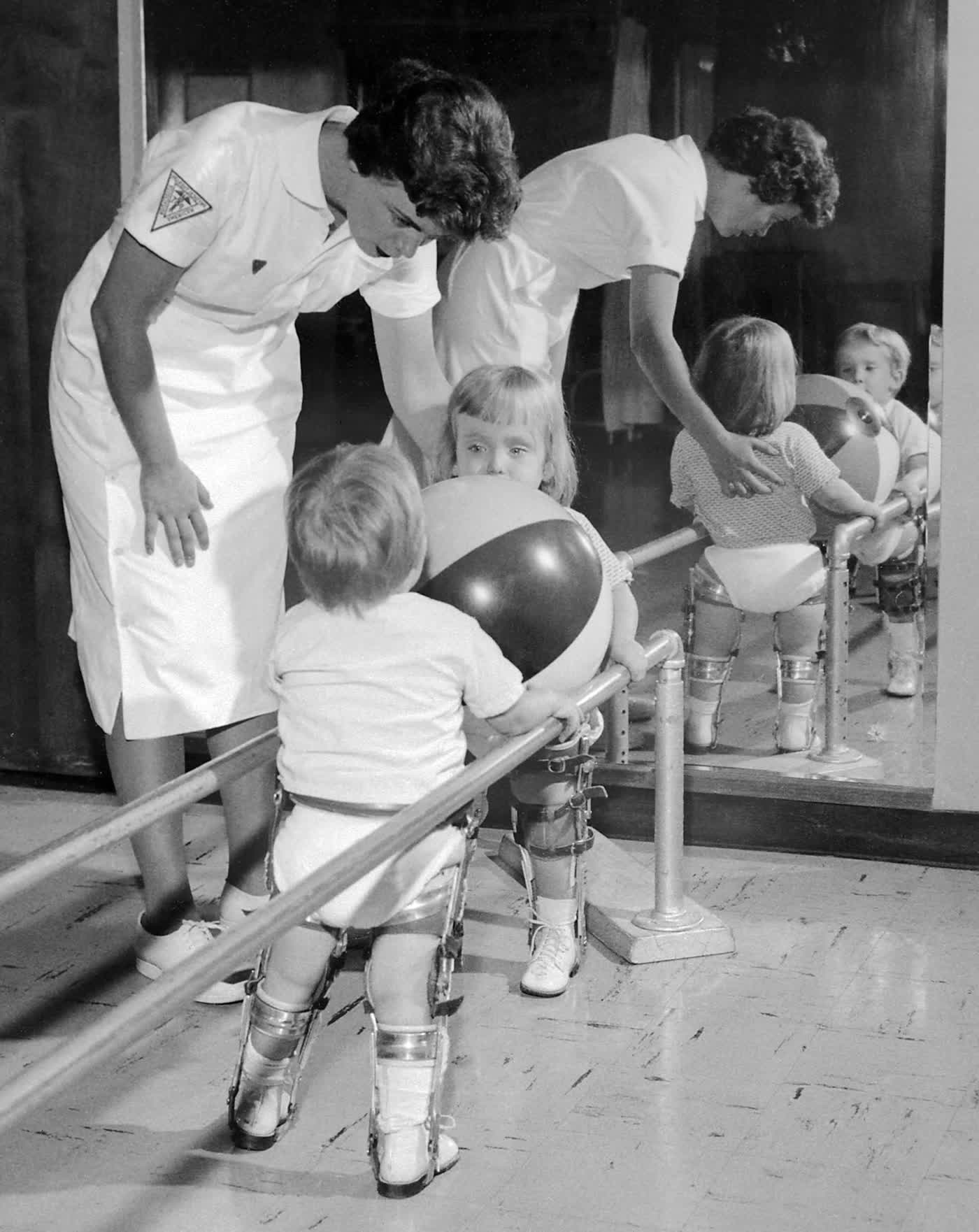
Image context: the cover uses a real 1963 CDC photograph from the Public Health Image Library showing a therapist assisting two children with polio at a rail.[6] That documentary image belongs here because it keeps the article centered on rehabilitation as physical routine rather than on polio as abstract historical fear.
In the opening stretch, water is presented as a machine for reducing gravity rather than as a miracle cure
The first part of the clip stays with children in a therapy pool, and the logic is immediately legible even without narration.[1] Rubber rings support the waist, ropes give the hands a line of direction, and nurses work close to the body rather than from a distance. The point is not spectacle. The point is to subtract some weight from damaged limbs so that movement can be practiced before the ground fully allows it. The scene feels almost architectural: water, rails, floats, and staff together create a temporary environment in which an impaired gait can be rehearsed.
That emphasis fits the broader rehabilitation culture around polio in the first half of the twentieth century. Warm-water exercise and corrective walking became closely associated with institutions such as Warm Springs, where patients worked through repeated routines rather than waiting for spontaneous normalization.[4][5] The National Park Service account of Toinette Bachelder's treatment history is useful here because it describes rehabilitation as a learned routine with braces and crutches, not a single restorative event.[5] British Pathé's pool scenes make that same point visually. Therapy is an arrangement of supports that allows effort to happen in small, repeatable increments.
The clip also resists the temptation to sentimentalize the children. The movements are slow, limited, and visibly supervised.[1] That restraint matters. It keeps the viewer from mistaking rehabilitation footage for proof of easy recovery. The historical reality was harsher: many infections were asymptomatic, but a small share led to the distinctive, sometimes permanent paralysis produced by motor-neuron injury.[2] The pool does not erase that injury. It offers a narrower, more practical promise. Perhaps a limb can be trained. Perhaps a gait can be steadied. Perhaps a child can recover some function that dry land alone is not yet ready to support.
In the middle, callipers, examinations, and tears bring the neurological boundary back into view
The next movement of the film shifts from the pool to walking frames, braces, and clinical inspection.[1] A child with a calliper is lowered into the water. Another works inside a wheeled frame. Then the clip cuts to a crying child on a bed while a doctor and nurse examine legs and feet and write notes. That sequence is structurally important because it stops the viewer from reading therapy as a clean ascent. The film keeps reminding us that rehabilitation begins from impairment that is concrete, measured, and often distressing.
This is where the Pink Book's clinical description becomes especially clarifying. Paralytic polio is distinctive precisely because the virus destroys motor neurons, producing weakness that is often asymmetric, more severe proximally, and sometimes permanent.[2] The exam scenes in the Pathé film feel shaped by that fact. Clinicians are not merely watching for pain. They are reading which movements remain, which reflexive patterns are gone, and what kind of assistance the patient will need next. The brace, in that context, is not a symbol of cure. It is a mechanical answer to a neurological deficit.
The film's honesty lies in how little it hides this boundary. A frame may help. A nurse may guide the leg. Notes may be taken and routines adjusted. Yet the basic injury is not magically removed.[1][2] That is why the title's blandness becomes revealing. "Treatment" in 1951 meant a continuous negotiation with the aftermath of damage. It could include hydrotherapy, massage, bracing, supervised walking, and long observation, but it could not yet close the story in the way post-1955 vaccine memory sometimes suggests.[2][4]
Later on, the office and studio scenes widen treatment into a social question about how a disabled life is supposed to continue
One of the strongest turns in the clip comes when it leaves bedsides and therapy spaces for office desks and a craft studio.[1] Two women type in a crowded office. Other women paint children's furniture, and one wheelchair user shows her work to another painter. These are easy scenes to miss if the viewer expects a purely medical film, but they may be the most important images in the entire piece. They imply that polio treatment was not only about limbs. It was also about whether a patient could return to work, acquire a trade, remain economically visible, and inhabit adulthood without being reduced to hospital status.
That broader frame fits the institutional history around polio. March of Dimes did not only fund research; it also built a nationwide aid structure around care, support, and the practical burdens borne by families and patients.[4] Its own history describes polio care as a large organizational effort, one that treated disability and assistance as public matters rather than private misfortune.[4] The vocational turn in the Pathé film belongs to that world. If paralysis persisted, then treatment had to ask what forms of labor and social participation were still possible.
This is also why the footage feels unexpectedly modern. It shows disability not only as medical deficit but as a problem of environment, equipment, training, and role.[1][4] The woman in the wheelchair painting furniture is not presented as cured; she is presented as working. That distinction gives the clip its real intelligence. It understands that a rehabilitation system is judged not only by muscle charts but by the kinds of ordinary life it makes reachable afterward.
The closing bedside exercises show the limit of the era and the discipline it demanded
Near the end, a patient lies in bed while a nurse adjusts a sun-ray lamp, lifts an arm, and encourages movement.[1] The scene is intimate, repetitive, and a little severe. No crowd is present. No triumphant voice enters. We are left with guided exercise, limited range, and the possibility that progress may be measured in very small increments. This ending quietly reframes the entire clip. The film is not a parade of therapeutic options. It is a document of how much labor had to be invested because prevention had not yet taken command of the problem.
That is what makes the clip worth watching now. After vaccines, polio history is often told as a story whose ending became so decisive that the middle has faded from view.[2][3][4] Pathé's footage restores that middle. It shows a treatment regime built from pools, braces, records, furniture, bedside coaching, and institutions willing to organize long care around uncertain outcomes.[1][3][5] The real lesson is not that pre-vaccine medicine had no ideas. It is that many of its ideas were slow, bodily, and infrastructural. They tried to return people to movement and to social life before medicine could reliably stop the disease upstream.
Sources
- British Pathé, "Polio Treatment (1951)" - archival footage identified as treatment scenes at Queen Mary's Hospital for Children in Carshalton, Surrey.
- CDC, "Chapter 18: Poliomyelitis" (Pink Book) - clinical course, motor-neuron injury, paralysis patterns, and vaccine-era decline.
- David J. Sencer CDC Museum, "Polio and The Epidemic Intelligence Service" - historical framing of fear, March of Dimes, vaccine rollout, and iron-lung era care.
- March of Dimes, "History of March of Dimes" - NFIP aid structure, Roosevelt's role, and the shift from patient care and research toward vaccine success.
- U.S. National Park Service, "Toinette Bachelder: From Warm Springs to the White House" - corrective walking, pool-based rehabilitation, and life after childhood polio.
- Wikimedia Commons, "File:Polio physical therapy.jpg" - 1963 CDC/Charles Farmer rehabilitation photograph used for the lead image.