Cholera feels like the wrong disease for oral treatment. It can drive such rapid fluid loss that the intuitive answer seems obvious: only intravenous rescue could possibly matter. That intuition is partly right. Patients with severe cholera do need immediate IV fluids. But it misses the mechanism that changed diarrhoeal medicine in the second half of the twentieth century. Cholera does not turn the intestine into a dead pipe. It leaves one crucial transport pathway intact, and that surviving pathway is exactly the one oral rehydration therapy exploits.[1][3]
That is why a packet of salts and glucose became one of the most consequential medical technologies of the modern era. The breakthrough was not that clinicians discovered a gentler substitute for IV therapy. The breakthrough was that physiology showed the gut was still capable of pulling sodium and water inward even while cholera toxin was pushing chloride and water outward.[1][2] Oral rehydration solution, or ORS, works because those two movements are not the same process.
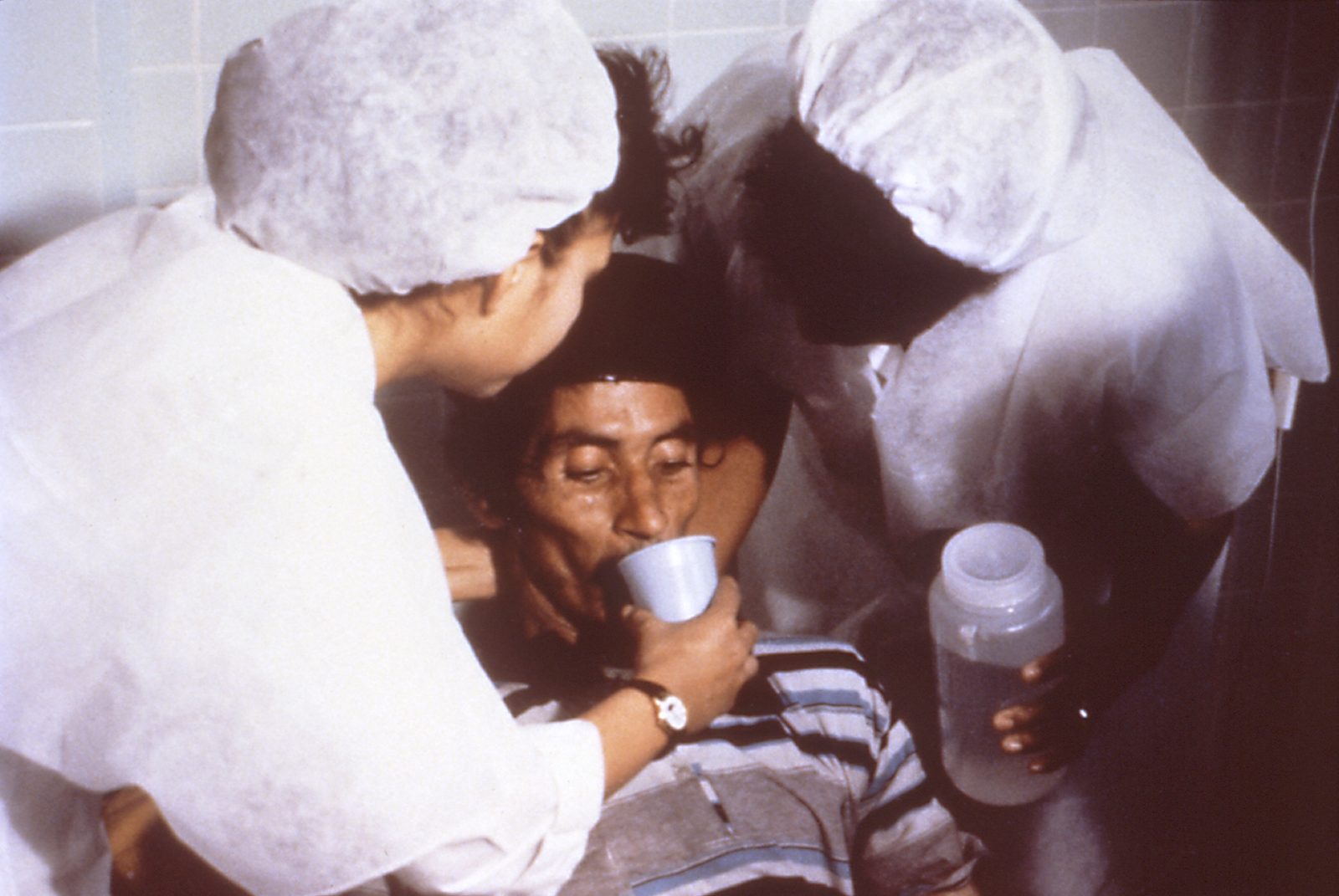
Lead image: cholera rehydration nurses in a treatment setting. It fits this article because ORS is not only a formula on paper; it is a repeated bedside practice of measuring loss, replacing it quickly, and keeping patients inside a narrow survival window.[5]
Timeline anchors before the mechanism
- Early 1960s: intestinal physiology work established that glucose absorption required luminal sodium and that sodium absorption rose sharply in the presence of glucose.[1]
- August 17, 1968: Nalin, Cash, Islam, Molla, and Phillips published their Lancet report on oral maintenance therapy for cholera in adults, showing that the new physiological idea could work at the bedside.[2]
- 2005: WHO's diarrhoea treatment manual summarized more than two decades of subsequent work and formalized the low-osmolarity ORS formulation that replaced the older standard mixture in most settings.[4]
- 2014: a major review in Current Gastroenterology Reports restated the key physiological point: cholera-triggered secretion and glucose-stimulated sodium absorption are separate processes, which is why ORT still works during secretory diarrhoea.[1]
1) The paradox starts with what cholera actually does
The core lesion in cholera is not mechanical damage to the bowel wall. The intestine remains structurally present, but its ion traffic is radically distorted. As the 2014 ORT review explains, cholera enterotoxin raises cyclic AMP in intestinal epithelial cells, which stimulates active chloride secretion and inhibits electroneutral sodium-chloride absorption.[1] Water follows the secreted electrolytes into the gut lumen, and the patient can lose fluid at a rate fast enough to collapse circulation in hours if replacement lags.[3]
This matters because it tells you what cholera is and is not. It is a disease of overwhelming secretion. It is not a universal shutdown of absorption. If the toxin had disabled every useful absorptive pathway in the small intestine, ORS would be a fantasy. The fact that ORS works means some transport machinery remains available even in the middle of severe secretory loss.[1]
2) The pathway that stayed open was glucose-coupled sodium uptake
The decisive physiological observation came before ORS became a public-health tool. Work summarized by Binder and colleagues showed that glucose absorption in the mammalian small intestine required luminal sodium, and that sodium absorption was markedly enhanced when glucose was present in the lumen.[1] Later work identified the transporter as SGLT1, but the practical point came first: if sodium and glucose entered together, water followed them.
What made this revolutionary for cholera was the second observation. The same review states that cholera enterotoxin did not inhibit glucose-stimulated sodium absorption and the associated fluid absorption.[1] In other words, the secretory current triggered by cyclic AMP and the absorptive current driven by glucose-coupled sodium transport could coexist. Cholera pushed fluid out, but it did not silence the channel through which clinicians could pull some of it back in.
That distinction is the whole mechanism in one line. ORS does not neutralize cholera toxin. It exploits the intestine's remaining absorptive capacity faster than the disease can empty it. The therapy is elegant because it does not need to cure the secretory signal first. It needs only to keep the absorptive signal supplied with the right substrate mixture.[1][4]
3) The bedside proof arrived in 1968
Physiology alone does not change care. Someone still has to show that a transport principle can survive contact with a profoundly dehydrating disease. That is what the 1968 Lancet paper provided. Nalin and colleagues described oral maintenance therapy for adults with cholera, translating the sodium-glucose transport insight into a clinical method rather than a laboratory curiosity.[2]
The historical importance of that paper is easy to miss because the article itself is short. Its force lies less in literary flourish than in the clinical inversion it made possible. Before this work, the natural image of cholera treatment centered on intravenous rescue, hospitalization, and tight procedural control. After it, a substantial share of fluid replacement could be done enterally once the patient was able to drink or receive fluid through the gut, with IV therapy reserved for the initial severe deficit and for patients who could not keep up orally.[2][3]
That was the hinge. ORT did not abolish the need for IV fluids. It changed the denominator of who needed IV fluids for how long. Once clinicians knew the gut could still absorb through glucose-coupled sodium transport, cholera management no longer had to assume that every liter lost demanded a liter delivered through a vein.
4) Why the later formula changed even though the mechanism did not
The original WHO formulation worked, but it was not the endpoint of the story. The mechanism remained the same; the mixture improved. Binder's review describes the earlier standard WHO solution as roughly 311 mOsm/kg H2O, while later hypo-osmolar formulations came in around 245 mOsm/kg H2O and performed better in randomized trials.[1] WHO's treatment manual makes the policy shift explicit: the reduced-osmolarity ORS contains 75 mmol/L of sodium, 75 mmol/L of glucose, and total osmolarity of 245 mOsm/L.[4]
That change mattered because the lower-osmolarity solution reduced the osmotic burden inside the intestinal lumen while preserving the sodium-glucose transport logic. WHO reports that, compared with the older solution, the reduced-osmolarity formula lowers the need for unscheduled IV therapy by about 33%, stool volume by about 20%, and vomiting by about 30%.[4] Those are not cosmetic gains. In a cholera ward or a crowded diarrhoeal treatment center, each of those percentages means less fluid to replace, fewer failed oral courses, and fewer escalations to resource-intensive care.
This is a useful place to be precise about what the formula did not change. The later ORS did not overturn the old insight; it refined it. The life-saving idea was already present in the first generation: the intestine still had one reliable handle. Reduced osmolarity simply made that handle easier to use at scale.[1][4]
5) Why ORS is powerful but not sufficient by itself
Because ORS is famous, it is easy to flatten cholera treatment into a moral tale about simplicity. The actual boundary is stricter. WHO states that most cholera patients have mild or moderate diarrhoea and can be treated with ORS, but patients with severe disease still require intravenous fluids in addition to ORS and antibiotics.[3] The therapy therefore belongs inside a sequence: rapid triage, immediate correction of severe dehydration, then sustained replacement of ongoing losses.
That sequence is exactly why ORS changed mortality. It moved care out of the narrow space where survival depended entirely on IV access, enough trained staff, enough tubing, and enough time. WHO's treatment guidance emphasizes that more than 90% of patients with acute diarrhoeal dehydration can be treated successfully with ORS alone.[4] Cholera remains frightening because the losses are fast; ORS matters because it converts the problem from a purely vascular emergency into something that can be managed continuously, orally, and much farther down the health-system ladder than an IV-only model would allow.
Why this mechanism still matters
The deepest lesson of ORT is not merely that a cheap packet can save lives. It is that good treatment sometimes comes from refusing the surface appearance of a disease. Cholera looks like a total intestinal failure. The decisive physiological work showed that it was a selective transport failure instead.[1] Once that distinction became visible, the treatment logic changed with it.
That is why oral rehydration works in cholera. The toxin never stopped the intestine from listening to glucose and sodium together. Medicine learned how to speak through the pathway that was still open.
Sources
- Binder HJ, Brown I, Ramakrishna BS, Young GP, Oral rehydration therapy in the second decade of the twenty-first century (Current Gastroenterology Reports, 2014; mechanism of cholera secretion versus glucose-stimulated sodium absorption, original and reduced-osmolarity formulas).
- Nalin DR, Cash RA, Islam R, Molla M, Phillips RA, Oral maintenance therapy for cholera in adults (Lancet, August 17, 1968; early bedside demonstration of cholera ORT).
- World Health Organization, "Cholera" fact sheet (current treatment boundary: most cases can use ORS, severe cases need IV fluids plus ORS and antibiotics).
- World Health Organization, The treatment of diarrhoea: a manual for physicians and other senior health workers, 4th revision (reduced-osmolarity ORS composition and effect sizes versus the older formula).
- Wikimedia Commons, "Cholera rehydration nurses.jpg" (documentary photograph used as the article image).