An earplug is easy to overrate because it looks like protection the moment it leaves the packet. The real intervention happens later, in a narrower place: the ear canal. Until the plug is inserted well enough, worn long enough, and matched to the noise dose around it, it is only a small object with a promising label.
That distinction matters because noise-induced hearing loss is usually cumulative and often invisible while it is happening. NIOSH frames the workplace limit as a dose problem: 85 dBA averaged over an 8-hour workday, with every 3 dBA increase cutting the recommended exposure duration in half.[1] A tool, compressor, mower, venue, or shop floor can therefore become hazardous not only because it is loud, but because the loudness persists. Hearing protection works only if it changes that dose at the ear.
The causal chain is simple but unforgiving: sound energy reaches the ear; enough exposure damages delicate inner-ear structures; the damage can show up as hearing loss, tinnitus, or difficulty understanding speech in noise; and the lost hearing does not reliably come back.[1][4] The prevention chain has to be just as concrete. Measure or estimate the noise. Reduce it at the source when possible. Then use protectors that actually fit the person, the task, and the full exposure window.[2][3][6]
Image context: the cover shows a shipyard worker using hearing protection in an industrial setting, not a product still life, diagram, or generated illustration. That choice fits the argument because protection succeeds or fails under real exposure: fit, comfort, task duration, supervision, and repeat use each time the noise returns.[7]
Timeline anchors
- 1998: NIOSH's occupational-noise criteria treated individual fit testing as the ideal, but still relied on derating approaches because fit-test systems were not broadly available.[6]
- 2021: WHO's World Report on Hearing placed preventable hearing loss inside a broader life-course public-health agenda, including occupational and recreational noise exposure.[5]
- 2024: CDC/NIOSH public guidance continued to define hazardous occupational dose around 85 dBA over 8 hours and a 3 dBA exchange rate.[1]
- January 2025: NIOSH updated its science policy to recommend individual, quantitative fit testing for hearing protection devices, replacing older reliance on estimated attenuation from labeled ratings.[6]
Dose comes before the device
The first mistake is to treat "wear earplugs" as the whole safety plan. NIOSH does not begin there. It begins with exposure: how loud, for how long, and how often.[1][3] The arithmetic is harsh because decibels are logarithmic. A small-looking increase in dBA can represent a large increase in sound energy. That is why NIOSH's 3 dBA exchange rate matters. At 85 dBA, the recommended occupational exposure limit is 8 hours. At 88 dBA, the comparable duration is cut to 4 hours. At 91 dBA, it is 2 hours.[1]
This dose logic explains why hearing protection has to be selected from the noise backward, not from the packaging forward. A plug that is adequate for intermittent moderate noise may be inadequate for a high-noise task. A protector worn for the loudest five minutes but removed for repeated "short" exposures may fail because those short intervals still accumulate. A worker who needs to hear speech, alarms, or machine changes may loosen or remove an uncomfortable plug, which turns a nominally strong protector into a weak real-world one.[2][4]
The more useful question is not "Does this product have a high number on the package?" It is "After this person fits it, during this task, for this duration, does enough sound reduction reach the ear?" That wording sounds less tidy, but it is the actual mechanism.
The label is not the achieved protection
Most hearing protectors carry a noise reduction rating, and NIDCD's public guidance tells readers to look for that number when choosing protection.[4] The label is useful because it gives a standardized starting point. It is not the same as the protection achieved by a specific person on a specific day.
CDC's NIOSH guidance makes the practical point plainly: almost any hearing protector, when fit correctly, can reduce noise by 10 dB.[2] That sentence is stronger than it first appears. It means a modest, well-fitted protector can matter. It also means a high-rated protector with a poor seal may not deliver what the wearer thinks it is delivering. The ear canal is not a lab fixture. It varies by person, by insertion technique, by jaw movement, by sweat, by hair, by eyewear and helmet interference for earmuffs, and by whether the user is willing to keep the device in place.
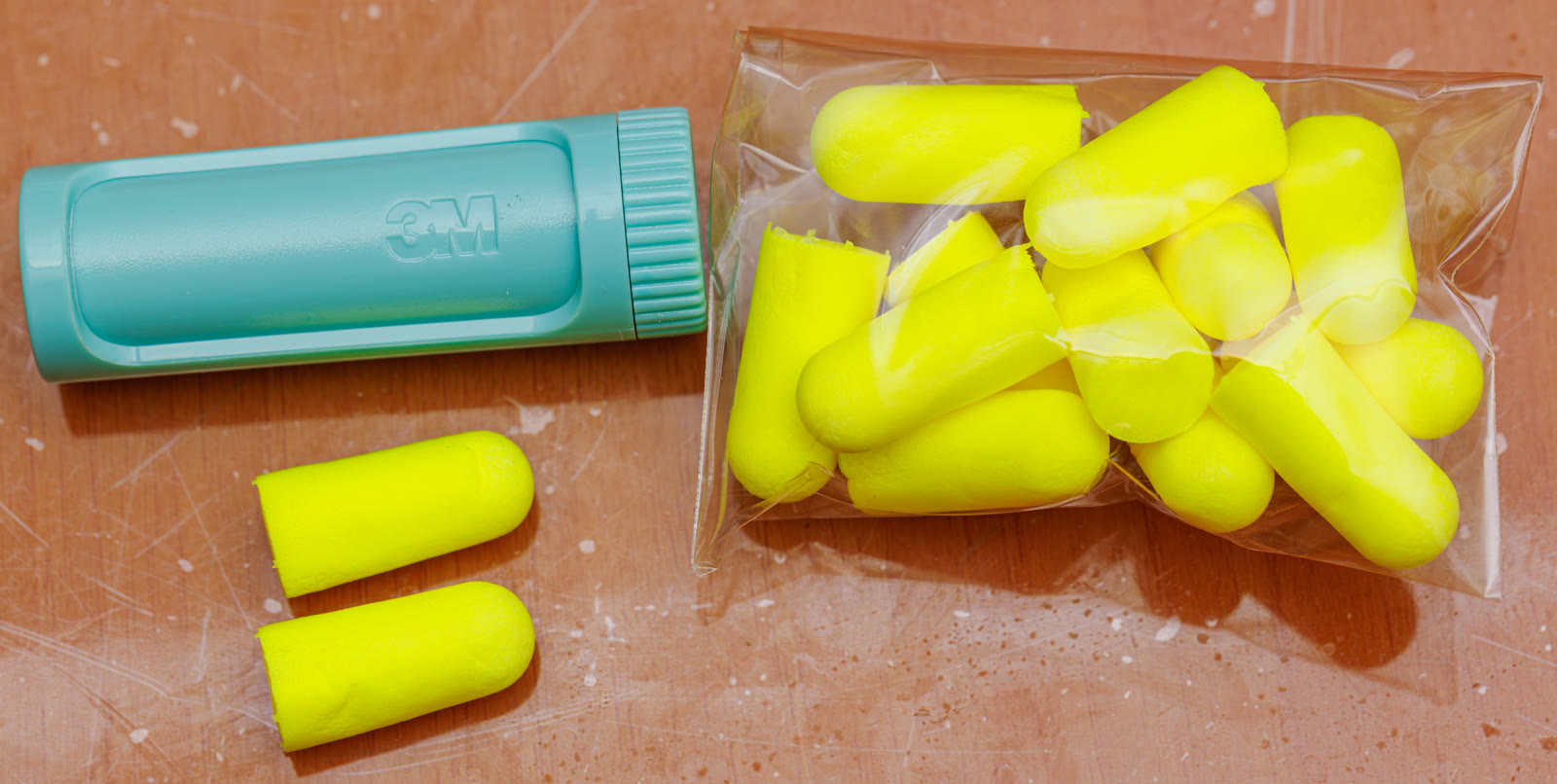
Foam plugs illustrate the mechanism. They have to be compressed, inserted deeply enough, and held while they expand. If the plug sits shallowly, folds against itself, or leaves an acoustic leak, the sound path remains open. Earmuffs have a parallel failure mode: the cup may be sound-rated, but a broken cushion, glasses temple, hard-hat conflict, or poor headband tension can create a leak around the ear. In both cases, the object is not the intervention. The seal is.
That is why the 2025 NIOSH policy update is important. It recommends individual, quantitative fit testing because old derating estimates cannot tell whether a particular worker is receiving the needed attenuation from a particular protector.[6] Fit testing changes the claim from assumed protection to measured protection. For a prevention program, that is a different level of evidence.
Comfort is not a soft variable
Hearing protection fails quietly when comfort is treated as cosmetic. A protector that hurts, blocks all useful communication, traps heat, or constantly slips will be handled, loosened, or removed. That behavior is not a separate human-factors problem added after the science. It is part of the causal mechanism, because protection requires duration.
NIDCD makes this practical by listing different protector types - including foam plugs, pre-molded plugs, canal caps, and earmuffs - and emphasizing that people need protection they can use correctly in the environments where loud sound occurs.[4] CDC's guidance similarly pushes employers to fit test workers and provide individualized instruction, rather than assuming a generic device will work for everyone.[2]
The best protector is often the one that produces enough attenuation and can actually stay in place. Sometimes that means a different plug size. Sometimes it means earmuffs because a worker cannot consistently insert plugs. Sometimes it means protectors designed for communication, because isolation itself creates a safety problem. The mechanism is not maximum silence. It is enough reduction, reliably worn, without creating a new operational hazard.
Source control still outranks personal protection
Earplugs are valuable, but they are downstream controls. CDC/NIOSH prevention guidance says workers should be protected with an effective hearing loss prevention program until workplace noise levels are reduced under 85 dBA.[3] That wording keeps the hierarchy visible. Quieter tools, acoustic barriers, maintenance, isolation, damping, scheduling, and distance can reduce the dose before it reaches the person. Personal protection then handles the remaining exposure.[3]
This hierarchy matters because hearing protectors are fragile in ways engineering controls are not. A quieter machine protects everyone nearby without asking each person to insert foam correctly every time. A barrier works even when a worker is tired. A redesigned process can shrink exposure time before PPE has to compensate. Earplugs still matter, but the safest program does not make them carry the entire burden.
WHO's larger hearing agenda points in the same direction. The public-health goal is not to sell more devices; it is to prevent avoidable hearing loss across settings where people work, learn, travel, and spend leisure time.[5] That requires turning hearing protection from an individual afterthought into a system: assess noise, reduce sources, choose protectors, fit test, train, monitor, and revisit the plan when tasks or equipment change.[2][3][5][6]
How to read an earplug honestly
The honest reading is neither "earplugs solve noise" nor "earplugs are useless." They are powerful when the mechanism is complete. They are weak when the visible object is mistaken for the achieved dose reduction.
A serious hearing-protection plan asks a few concrete questions:
- What is the measured or likely noise exposure, including duration?[1]
- Has the noise been reduced at the source as far as practical?[3]
- Does the protector fit this person and this task, and can the worker keep it on for the full exposure window?[2][4]
- Has fit been checked directly rather than inferred only from the package rating?[2][6]
- Will the program catch drift when equipment, work pace, protectors, or user technique change?[3][6]
That is the causal mechanism in one line: hearing protection works when it converts a hazardous sound dose into a lower dose at the inner ear, repeatedly enough that cumulative injury does not build. The plug is only the tool. The seal, the time, and the system around it are the intervention.[1][2][3][6]
Sources
- Centers for Disease Control and Prevention / NIOSH, "Noise-Induced Hearing Loss" - exposure-dose framing, 85 dBA recommended exposure limit, and 3 dBA exchange rate.
- Centers for Disease Control and Prevention / NIOSH, "Provide Hearing Protection" - fit, fit testing, individualized instruction, and the practical 10 dB reduction point for correctly fitted protectors.
- Centers for Disease Control and Prevention / NIOSH, "Preventing Occupational Noise-Induced Hearing Loss" - hearing loss prevention program framing and source-control priority before relying on PPE.
- National Institute on Deafness and Other Communication Disorders, "Hearing Protectors" - public guidance on noise-induced hearing loss, protector types, NRR, tinnitus, and choosing protection for loud environments.
- World Health Organization, World Report on Hearing (2021) - global public-health framing for preventable hearing loss across the life course.
- Centers for Disease Control and Prevention / NIOSH, "NIOSH Science Update: Individual Fit-testing Recommendation for Hearing Protection Devices" (Publication No. 2025-104, January 2025).
- Wikimedia Commons, "File:AVONDALE SHIPYARD WORKER WEARS SPECIAL EAR MUFFS FOR PROTECTION FROM THE HEAVY LEVEL OF INDUSTRIAL NOISE POLLUTION - NARA - 546041.jpg" - archival workplace photograph used as the article image.