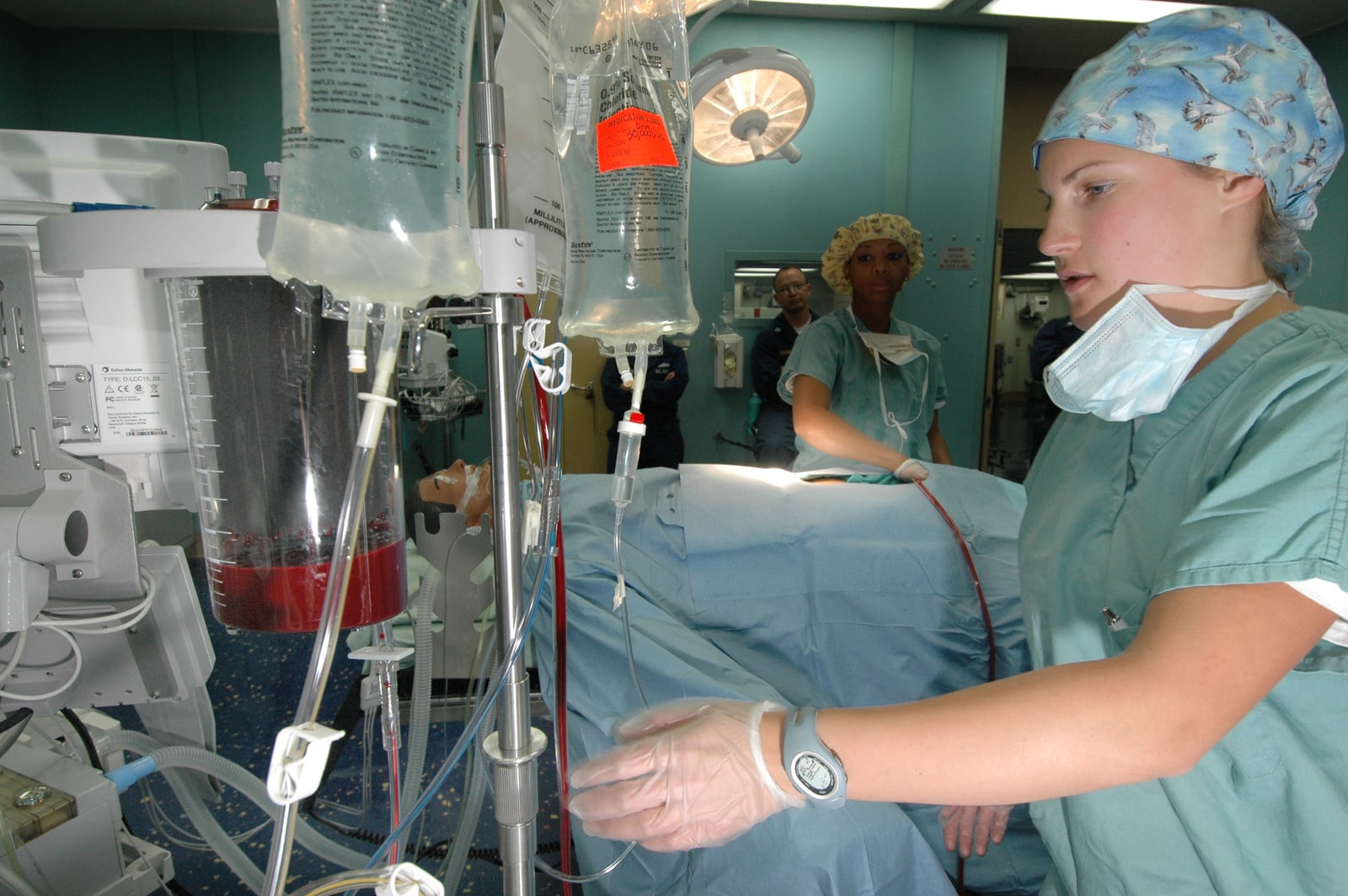
The useful detail in this photograph is the person watching the machine. On 5 May 2006, aboard the hospital ship USNS Mercy, Hospital Corpsman Megan Beach was checking a cell saver during transfusion training.[1] The apparatus promises an appealing loop: blood lost during surgery can return to the patient. But the loop contains a separation. Some material goes back; some goes into waste.
That division explains both the usefulness and the limits of intraoperative cell salvage. To understand the machine, follow the ingredients rather than the red colour.
From surgical field to collection reservoir
The Royal Cornwall Hospitals guideline describes blood being drawn from the surgical field while an anticoagulant prevents it from clotting in the collection system. A filter at the reservoir removes larger debris. Suitable collected blood then undergoes centrifugal separation, washing, and suspension in saline before it is returned to the patient.[2]
These stages solve different problems. Anticoagulation keeps the collected material processable. Filtering intercepts particles. Centrifugation separates the red cells from the surrounding fluid, and washing carries unwanted material away. The return bag contains the recovered red cells in saline; the waste bag receives removed plasma, platelets, anticoagulant, and other material.[2]
Calling this “recycling blood” can obscure that selectivity. The reservoir and the return bag are different products, even when both look red. A volume collected at the suction tip is therefore not a volume of finished transfusion: processing changes what the fluid contains.
The component that comes back
The distinction becomes especially important during heavy bleeding. Red cells carry haemoglobin, which transports oxygen. Platelets and plasma clotting factors perform other work in stopping blood loss. Recovering one component does not automatically recover the others.
The joint Norfolk and Norwich–James Paget obstetric guideline, approved in September 2024, describes saline washing and centrifugation removing plasma and platelets, among other material. It explicitly identifies the processed product as lacking platelets and clotting factors.[3]
This is the central tradeoff: the separation that produces a usable red-cell transfusion also leaves essential parts of whole blood behind. A patient can receive salvaged cells and still need treatment for impaired clotting. The machine's successful completion of a wash cycle cannot answer whether the patient's bleeding has been controlled or whether clotting components need replacement.
Think of two questions running alongside each other: how much oxygen-carrying capacity has been recovered, and what is needed to stop further loss? They belong to the same emergency, but the answer to the first does not settle the second.
Washing has a boundary
The word “washed” also needs care. It describes a process, not a guarantee that every unwanted ingredient has disappeared. Obstetric cell salvage makes the distinction unusually clear: maternal and fetal blood can mix during delivery. North Bristol NHS Trust's patient information explains the possibility of antibody formation after exposure to the baby's red cells, and the role of blood testing and anti-D where indicated.[4]
That concern survives the appealing idea of returning “your own blood.” The material collected from an operative field still needs clinical interpretation. North Bristol also explicitly allows for patients receiving both salvaged blood and donor blood.[4] The two sources can be complementary within one operation.
For the same reason, collecting blood is not a commitment to return it. The collection, processing, and transfusion decisions have to remain connected to the patient's needs and to what has entered the system.
A working machine is only one part of an outcome
Clinical benefit has to be measured in a defined setting. The 2017 SALVO trial tested routine cell salvage during caesarean sections among women considered at risk of haemorrhage. Across 26 UK obstetric units, 3,028 women were randomized and 2,990 were included in the analysis.[5]
Donor transfusions occurred in 2.5% of the cell-salvage group and 3.5% of the standard-care group. The adjusted odds ratio was 0.65, with a 95% confidence interval of 0.42–1.01. Transfusions were numerically less frequent, but the trial did not establish a statistically significant reduction in its primary outcome.[5]
Only about half of the intervention group actually received salvaged blood. The trial evaluated a policy of routine use in this obstetric population, rather than the effect of a completed reinfusion in every participant.[5] Its result neither establishes a benefit for every operation nor demonstrates that red-cell recovery is useless. It shows why a sound physical mechanism and a service's measured benefit are separate questions.
The service around the centrifuge
In October 2019, Royal Papworth Hospital described its investment in cell salvage as equipment plus trained people: a machine for each operating theatre, five for critical care, and a service available around the clock. Its account also acknowledged situations in which blood cannot be collected or bleeding outpaces recovery, leaving donor blood necessary.[6]
That operational detail returns us to the photograph. A machine on a trolley is a capacity; someone able to run it when bleeding occurs makes that capacity usable. The collection system must be available in time, the recovered cells must reach the patient when needed, and the wider team must continue treating the haemorrhage.
The waste bag deserves as much attention as the return bag. It reveals what the machine has removed, and therefore what the rest of care may still have to supply. Cell salvage earns its place by recovering a valuable component while clinicians keep track of the whole patient.
Sources
- Mike Leporati, U.S. Navy, photograph 060505-N-2832L-050, 5 May 2006—Megan Beach checking a cell saver during training aboard USNS Mercy; archival photograph preserved by Wikimedia Commons.
- Royal Cornwall Hospitals NHS Trust, Intraoperative Cell Salvage Clinical Guideline, version 5.0—section 2.3: collection, anticoagulation, filtration, centrifugal separation, and the waste stream.
- Norfolk and Norwich University Hospitals and James Paget University Hospitals, Joint Trust Guideline for the Management of Intraoperative Cell Salvage in Obstetrics, approved September 2024—section 3.3: washing and the composition of the returned red-cell product.
- North Bristol NHS Trust, “Cell Salvage”—patient information on donor backup, fetal-cell exposure, antibody formation, and follow-up.
- Khalid S. Khan and colleagues, “Cell salvage and donor blood transfusion during cesarean section: A pragmatic, multicentre randomised controlled trial (SALVO),” PLOS Medicine, 19 December 2017—trial population, transfusion outcome, uncertainty, and intervention delivery.
- Royal Papworth Hospital NHS Foundation Trust, “Cell salvage: Returning a patient's own blood during surgery,” 7 October 2019—staffing, equipment provision, and situations requiring additional donor blood.