BCG is the rare vaccine that is both ordinary and unsettled. In many countries it is given near birth, leaves a small arm scar, and becomes part of childhood memory. In the United States, CDC says it is not generally used because TB infection risk is low, protection against adult pulmonary TB is variable, and vaccination can complicate tuberculin skin-test interpretation.[2] Both positions can be true at once.
That tension is the best way to read BCG historically. The vaccine survived not because it solved tuberculosis in the way measles vaccination can collapse measles transmission. It survived because it solved a narrower and still important problem: reducing the risk that very young children develop the severest forms of active TB, especially TB meningitis and miliary TB, in settings where exposure is common.[1][2][5]
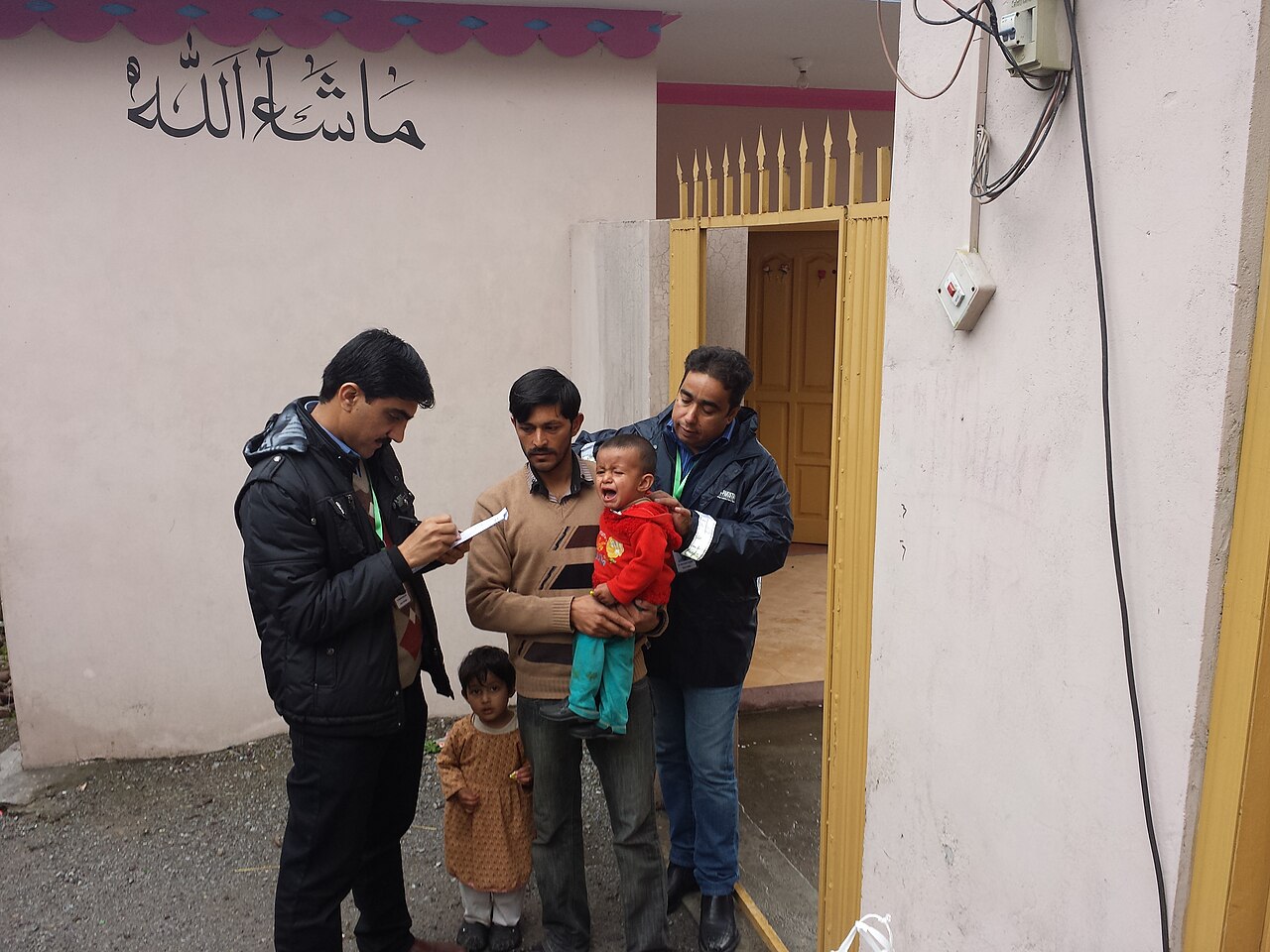
Image context: the cover photograph shows a Pakistan Field Epidemiology Training Program resident checking children for BCG scars. The image belongs here because the scar is an implementation trace: it says a live attenuated vaccine reached a child before any later question about adult pulmonary TB, skin-test interpretation, or national policy can begin.[6]
Timeline anchors for the bargain
- 1908-1921: Albert Calmette and Camille Guerin attenuated a bovine tuberculosis strain through years of passage before first human use in 1921.[4]
- 1930: the Lubeck disaster, caused by contamination of an oral BCG preparation with virulent tuberculosis bacilli, nearly broke confidence in the vaccine and made production discipline inseparable from safety.[4]
- 1956: WHO began keeping lyophilized seed lots of BCG vaccine strains to prevent further drift from the original material.[3]
- 1965-2011: WHO adopted written BCG requirements in 1965, updated them repeatedly, and later revised quality, safety, and efficacy recommendations after a 2009 consultation.[3]
- 2018: WHO's BCG position-paper summary still recommended a single dose at birth or as soon as possible afterward in countries or settings with high TB incidence and/or high leprosy burden, while not recommending revaccination.[1]
Comparison 1: BCG as a childhood severe-disease shield
The case for BCG begins with the biology of early TB. Infants and young children are not merely small adults with smaller lungs. After infection, they are at higher risk of disseminated disease, in which TB spreads beyond the lung into the bloodstream, meninges, or multiple organs. That is the part of the disease spectrum where BCG has been most defensible.
WHO's 2018 position-paper summary states the policy plainly: in countries or settings with high TB incidence or high leprosy burden, a single BCG dose should be given to neonates at birth or as soon as possible after birth.[1] CDC's current clinician page uses the same practical distinction from a U.S. perspective: BCG is given to infants and small children where TB is common and protects children from severe active TB such as TB meningitis and miliary disease.[2]
That is not a trivial endpoint. Tuberculous meningitis is rare compared with pulmonary TB, but it is one of the disease's most devastating pediatric forms. A 2006 meta-analysis summarized the evidence boundary in its opening frame: BCG has shown consistently high efficacy against childhood tuberculous meningitis and miliary tuberculosis, while efficacy against adult pulmonary TB is variable.[5] The vaccine's most durable public-health identity is therefore not "stops all TB." It is "protects young children against the forms of TB that are hardest to tolerate as collateral damage."
The childhood-shield interpretation also explains why birth timing matters. If the intended benefit is protection before early-life exposure or rapid dissemination, then attaching vaccination to the newborn schedule is not only convenient. It is causal. Delay leaves the most vulnerable window less protected.
Comparison 2: BCG as a weak adult pulmonary firewall
The adult-pulmonary story is different. Pulmonary TB is the form that usually drives onward transmission, because bacteria leave the lungs in airborne droplets. A vaccine that reliably prevented adult pulmonary TB would be a transmission firewall. BCG has never consistently played that role across populations.
CDC names that limitation directly when explaining why BCG is not generally used in the United States: one reason is variable effectiveness against adult pulmonary TB.[2] The 1996 ACIP and Advisory Committee for Elimination of Tuberculosis statement made the same policy distinction in older U.S. terms. It said BCG lowers the risk of serious complications of primary TB in children, but recommended considering vaccination only for specific child exposure situations and stated that BCG was no longer recommended for health-care workers or other adults at high risk for acquiring TB infection.[7]
This is the point where a simple pro-vaccine or anti-vaccine story becomes too blunt. BCG can be valuable and still not be the right mass adult strategy in a low-incidence country. In the United States, the public-health system leans on testing, diagnosis, treatment of latent TB infection when indicated, infection control, and targeted evaluation rather than routine BCG vaccination.[2][7] That policy is not a denial that BCG works somewhere. It is a judgment about where BCG's benefits, limitations, and testing complications fit the local epidemiology.
The tuberculin skin-test problem reinforces the distinction. CDC notes that BCG can cause a false-positive skin-test reaction and that there is no reliable way to distinguish a positive skin test caused by prior BCG from one caused by true TB infection; TB blood tests are preferred for people who received BCG because BCG vaccination does not induce positive results on those tests.[2] A vaccine that complicates one diagnostic pathway has to justify that cost through clear benefit in the population receiving it.
Comparison 3: BCG as a product that had to become standardized
BCG's history also warns against treating a vaccine as a fixed object. The name sounds singular, but the living product had to be kept from drifting through manufacturing history.
The early vaccine was developed by repeated passage, and Luca and Mihaescu's history describes the long path from Calmette and Guerin's work to first human use in 1921.[4] The same history makes Lubeck central. In 1930, infants in Lubeck received an oral BCG preparation that had been contaminated with virulent tuberculosis bacilli. The disaster was not proof that attenuated BCG itself was equivalent to wild TB; it was proof that a live vaccine without rigorous production separation and quality control can become a catastrophe.[4]
WHO's standardization page shows the institutional answer. Since 1956, WHO has kept lyophilized seed lots of vaccine strains, and WHO's written standards were adopted in 1965, then updated as knowledge changed about dose, freeze-dried preparations, production, testing, expiry, and later quality recommendations.[3] That dry standards history is part of the vaccine's real biography. BCG could not remain a laboratory lineage or a heroic Pasteur Institute inheritance. It had to become a controlled biological product.
This standardization layer explains why the article's title calls BCG a bargain. Its benefit depends on a live attenuated organism that can train immunity against severe childhood disease. Its risk management depends on knowing that the organism is what the label says it is, that the recipient is not in a group where live vaccination is unsafe, and that the health system can interpret future TB tests correctly.[1][2][3]
The two interpretations
One interpretation says BCG is a disappointing vaccine because it did not end TB transmission. That reading gets the adult pulmonary weakness right. A century-old vaccine that still leaves the world needing better TB vaccines, better diagnostics, shorter treatment, and stronger prevention cannot be treated as a solved problem.[1][2][5]
The stronger interpretation is narrower: BCG is a successful pediatric severe-disease vaccine that was sometimes asked to carry an adult-transmission ambition it could not reliably fulfill. Its value is greatest where infant TB exposure risk is high and where preventing meningitis and disseminated disease is a public-health priority.[1][2][5] Its limits are clearest where adult pulmonary transmission is the main target, local TB incidence is low, and skin-test interpretation matters for control programs.[2][7]
BCG still matters because tuberculosis policy is not one universal lever. In high-incidence settings, the newborn scar can represent real protection against catastrophic childhood disease. In low-incidence settings, the same vaccine may be too blunt a tool for routine use, and targeted testing and treatment may carry more value. The history is not a contradiction. It is a public-health lesson in matching an intervention to the part of a disease it actually controls.
Sources
- World Health Organization, "Summary of the WHO Position Paper on BCG vaccines: WHO position paper - February 2018" - current WHO recommendation summary on birth-dose use, revaccination, HIV-related cautions, and high-incidence settings.
- Centers for Disease Control and Prevention, "Bacille Calmette-Guerin (BCG) Vaccine for Tuberculosis" (Jan. 31, 2025) - U.S. use, adult pulmonary-TB variability, severe childhood TB framing, testing implications, and contraindications.
- World Health Organization, "BCG (Tuberculosis)" - BCG seed-lot preservation since 1956 and WHO standardization timeline from 1965 through later quality recommendations.
- Simona Luca and Traian Mihaescu, "History of BCG Vaccine," Maedica 8(1), 2013 - Calmette-Guerin development, 1921 first use, and Lubeck disaster context.
- L. Rodrigues et al., "Effect of BCG vaccination on childhood tuberculous meningitis and miliary tuberculosis worldwide: a meta-analysis and assessment of cost-effectiveness," The Lancet, 2006 - severe childhood TB efficacy framing and adult pulmonary variability.
- Wikimedia Commons, "File:Checking for Immunization Scars - Pakistan (16437840553).jpg" - CDC Global Health photograph used as the article image source.
- CDC MMWR, "Use of BCG Vaccines in the Control of Tuberculosis: A Joint Statement by ACIP and the Advisory Committee for Elimination of Tuberculosis" (1996) - U.S. policy rationale for limited child use and adult/health-care-worker non-recommendation.