In 1976, U.S. public health leaders faced a familiar nightmare in unfamiliar time: a possible repeat of 1918, signaled by a cluster at a military base, with no guarantee that waiting would be safer than acting.
The swine flu campaign that followed is often remembered as a one-word cautionary tale—“fiasco.” That shorthand is emotionally satisfying and analytically weak. A better reading is procedural: the campaign was a high-speed attempt to convert weak early signal into national protection, then to reverse course when safety signal exceeded policy tolerance.
That sequence—detect, scale, stop, reframe—is why 1976 still matters.
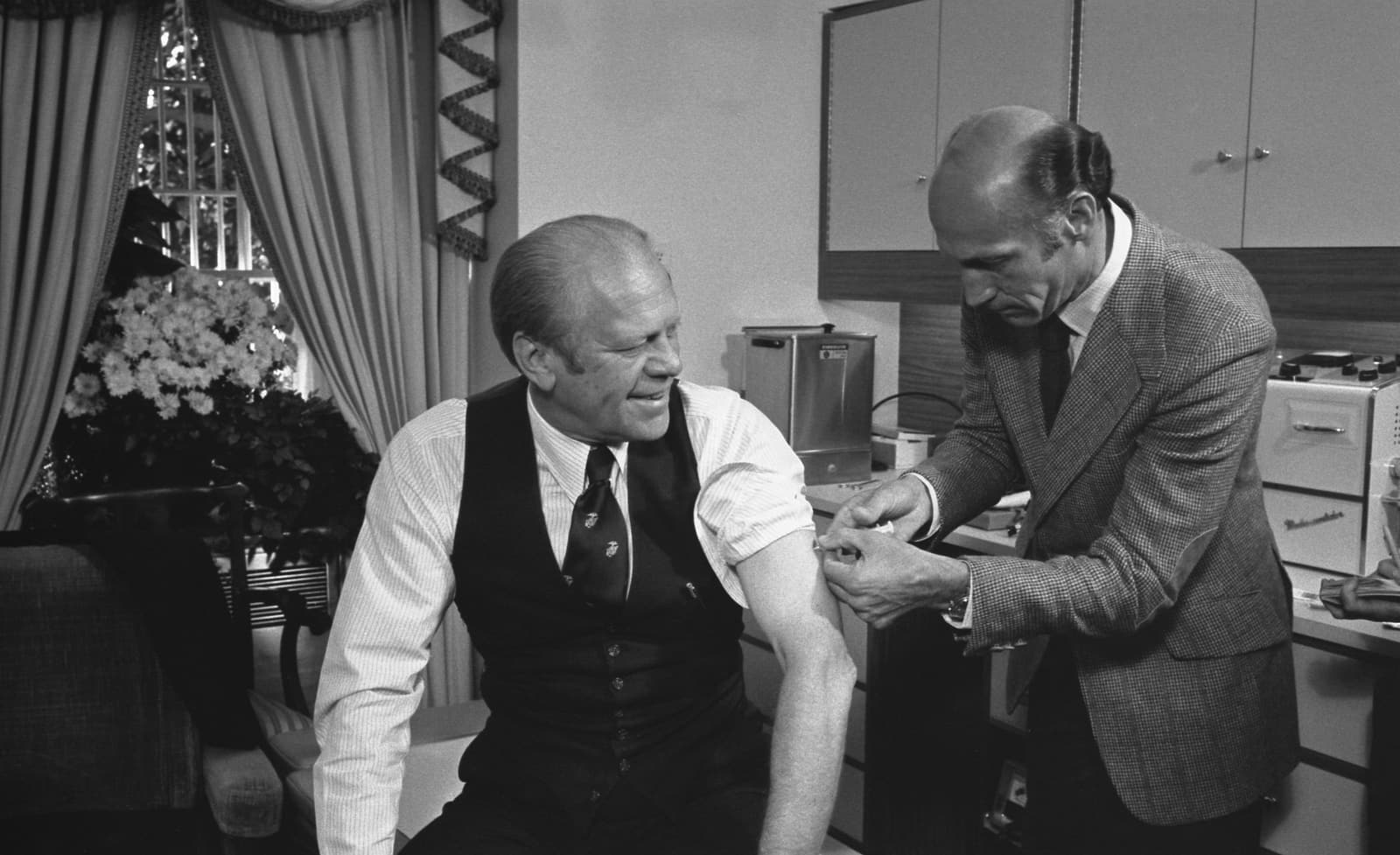
Image context: the cover photo shows President Gerald Ford receiving a swine flu inoculation on 14 October 1976, when public confidence-building had become a central operational task of the campaign.
Act I (January-February 1976): the signal appears before certainty exists
At Fort Dix, New Jersey, a winter respiratory outbreak among trainees turned from routine military epidemiology into a national alert. A/New Jersey/76 (Hsw1N1) was identified after a rapid, multi-lab confirmation process; the historical background mattered because H1N1 strains tied to earlier pandemic memory had exceptional salience in U.S. risk thinking.[1]
The underlying environment was dense for transmission. Of roughly 19,000 people at Fort Dix in January 1976, about 32% were recruits moving through close-contact training structures.[1] Retrospective and prospective investigation identified a limited but real outbreak footprint. Published reconstructions cite 13 hospitalizations and 1 death, with around 230 estimated cases in total.[1][2]
Operationally, this was the central early dilemma:
- the outbreak was small enough that it might self-extinguish,
- but large enough, and symbolically charged enough, that a missed pandemic could be catastrophic.
Public health had to choose under radical asymmetry: the political cost of overreacting was visible; the cost of underreacting would be visible only if the worst case arrived.
Act II (March-August 1976): Washington chooses speed over optionality
Once CDC scientists briefed federal leadership and Congress, the policy path accelerated. President Ford announced the National Swine Flu Immunization Program on 24 March 1976, asking Congress for $135 million to fund vaccine production and rollout at national scale.[3]
The intended scope was extraordinary for the period: essentially, vaccinate the country before a pandemic wave could start. Later retrospective reviews describe this as unprecedented in timing and ambition, not a routine seasonal campaign.[3][4]
But speed introduced a second layer of fragility: implementation dependency. The program had to align scientific judgment, manufacturing timelines, legal liability, insurer behavior, state delivery capacity, and media communication almost simultaneously.
That alignment strained quickly. Manufacturers sought liability protection; Congress addressed this through legislation signed 12 August 1976 (National Swine Flu Immunization Program of 1976), but legal and administrative delays narrowed the delivery window.[3]
In other words, Washington made a strategic bet that compressing decision time would still leave enough institutional slack to execute safely. That bet was only partly correct.
Act III (October-December 1976): mass rollout works, then the stop signal triggers
Distribution began in October after delays. Despite friction, the campaign demonstrated serious throughput: CDC’s historical account reports nearly 43 million vaccinations in roughly the first 10 weeks; broader analyses commonly round total uptake to “over 45 million.”[4][5]
This is the part often omitted in simplified retellings: from an operations perspective, the U.S. proved it could mount a fast, large immunization push under emergency framing.
Then the risk profile changed.
By late November, reports of Guillain-Barré syndrome (GBS) among recently vaccinated individuals prompted CDC investigation. The emerging signal suggested a small but non-trivial excess risk. On 16 December 1976, the program was suspended.[5][6]
Subsequent analyses quantified the association at roughly the same order of magnitude:
- vaccine-attributable GBS risk around 8.8 cases per million within 6 weeks in one key retrospective estimate,
- with later estimates spanning approximately 4.9–11.7 per million adult vaccinees.[6]
CDC’s current safety framing expresses the historical signal in similarly practical terms: about 1 additional GBS case per 100,000 recipients for the 1976 swine flu vaccine.[7]
The exact biological mechanism remains uncertain, but policy did not wait for complete mechanistic clarity. The trigger was epidemiologic and governance-based: a rare severe adverse-event signal had become strong enough to violate the campaign’s acceptable-risk envelope.
This is the defining technical move of 1976: the same institutions that scaled quickly also executed a national stop.
Act IV (late 1976-1977): epidemiology ends, legitimacy work begins
After suspension, the hard problem shifted from virology to trust.
No comparable national swine-flu wave materialized from the Fort Dix event. The campaign therefore looked, to many citizens, like a maximal intervention for a pandemic that never came. Retrospective commissions and policy analyses focused on decision architecture, media handling, legal design, and credibility management—not just on clinical signal detection.[3][8]
The political memory was sticky. “Could have been catastrophic if ignored” is difficult to prove; “we vaccinated tens of millions and then stopped” is easy to narrate. That asymmetry shaped vaccine politics for decades.
Yet the institutional afterlife was not zero-sum. Historical reviews note that 1976 contributed to improvements in federal pandemic planning coordination and to more explicit thinking about post-marketing safety surveillance for rare adverse events.[5][6][8]
Put differently: 1976 damaged confidence in the short run, but it also forced upgrades in how preparedness and pharmacovigilance are linked.
What the 1976 chronicle still changes in 2026 decision practice
Three durable lessons survive beyond the headline:
1) Early action and reversible action are not opposites
1976 is often framed as evidence that early action is reckless. The better inference is narrower: early action without pre-declared reversal thresholds is reckless. The U.S. had enough surveillance sensitivity to detect a rare signal and enough governance elasticity to pause. Both capacities are required.
2) Throughput success does not neutralize safety signal
The campaign achieved exceptional deployment scale (tens of millions in weeks). That operational success did not exempt it from stopping when risk shifted. Modern emergency programs should pre-commit to this principle before rollout, not discover it midstream.
3) Credibility is a managed variable, not a communication afterthought
The post-1976 record repeatedly points to legal, media, and expectation-management failures as much as epidemiologic uncertainty. Public trust depends less on never changing course than on showing that course changes follow transparent thresholds.
For 2026 planners, the practical translation is simple: build campaigns as adaptive systems with explicit trigger points for continuation, modification, and pause. If those triggers are not publicly legible, legitimacy debt accumulates even when technical teams do good work.
Uncertainty boundary
This chronicle does not claim that 1976 proves one timeless rule such as “always vaccinate early” or “never vaccinate early.” It shows a conditional logic: under severe downside uncertainty, rapid action can be rational; under emerging adverse-event evidence, rapid de-escalation can also be rational. The governing challenge is the transition between those two states.
Sources
- CDC Emerging Infectious Diseases (2006), Swine Influenza A Outbreak, Fort Dix, New Jersey, 1976
- PMC (J R Soc Interface), Transmissibility of swine flu at Fort Dix, 1976
- Gerald R. Ford Presidential Library & Museum, Swine Flu Immunization Program of 1976 (timeline, funding request, legislation, suspension)
- CDC Museum, 1976 Swine Flu Vaccination Program (campaign context and throughput)
- CDC Museum Digital Exhibits, Guillain Barré Syndrome and the End of the NIIP (program stop date and aftermath context)
- J Infect Dis (2009), “Prepandemic” Immunization… and the Detection of Rare Severe Adverse Events (NIIP size and GBS risk estimates)
- CDC Vaccine Safety (updated 2024-12-20), Guillain-Barré Syndrome (GBS) and Vaccines
- NCBI Bookshelf / National Academies, The Swine Flu Affair: Decision-Making on a Slippery Disease (retrospective policy framing)
- Wikimedia Commons image source (cover photo, NAID 7064718)