As of November 22, 2026, 21:31 UTC, the International Meteor Organization puts the center of this year’s Geminid meteor shower at 14:00 UTC on Monday, December 14. In New York that is nine in the morning, well after sunrise. Anyone arranging a watch party can pencil in Sunday evening, December 13. The shower has a broad maximum, the Moon will be a waxing crescent, and by ten that evening the apparent source of the meteors will be nearly halfway up the eastern sky. [1][2][3]
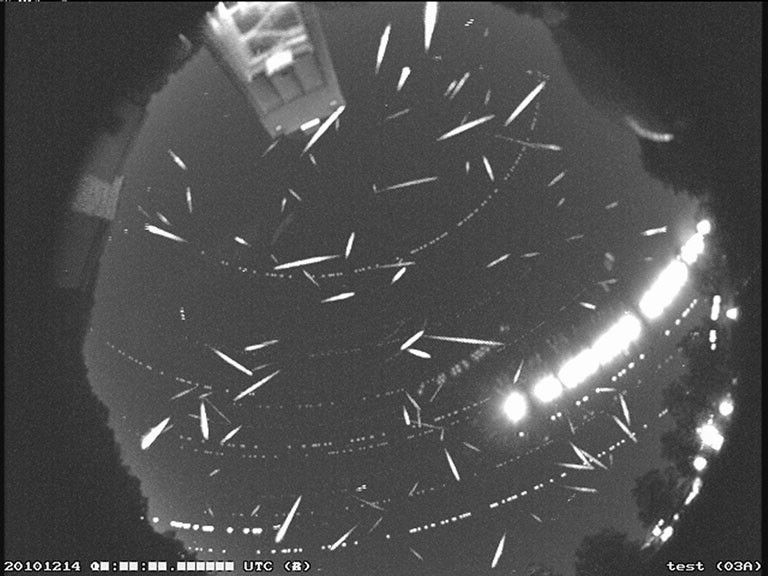
What changes between dinner and two in the morning?
Imagine extending each meteor’s trail backward across the sky. For a Geminid, that line leads toward a patch of the constellation Gemini called the radiant. The grains that make the streaks belong to a stream associated with asteroid 3200 Phaethon. They enter the atmosphere on roughly parallel paths. Perspective makes those paths appear to diverge, much as parallel tracks appear to meet in the distance. A Geminid can streak through a completely different constellation and still trace back to Gemini. [3][4]
As Earth turns, New York faces more directly into that stream. The local sky table for December 13–14 gives the height of the radiant above a level horizon. Each entry is a calculated position, so it holds even if clouds hide the stars. [3]
| New York local time | Height of radiant | What that means outside |
|---|---|---|
| Sunday, 6 p.m. | 3° | Gemini is barely above the northeastern horizon. Even a dark site samples little of the shower. |
| Sunday, 10 p.m. | 44° | A group that wants to be home before midnight has a good observing window if the sky is clear. |
| Monday, 2 a.m. | 82° | Gemini is nearly overhead. Someone who can stay out late gets the most favorable local geometry. |
This is why the figure of 150 meteors per hour needs a unit of its own. Astronomers call it the zenithal hourly rate. It estimates what one observer could count with the radiant overhead and a sky dark enough to reveal faint stars. At a radiant height of 30°, the International Meteor Organization’s observing guide puts the expected count at about half the overhead value, even with equally dark skies. A streetlamp costs the observer still more of the faint streaks. NASA gives 40 to 50 an hour as a dark-sky expectation for the Geminids. Neither figure predicts a tally for a particular park. [1][4][5]
Choosing the hour
For a New York group planning three weeks ahead, ten on Sunday is a reasonable time to reserve. A clear late evening gives people a chance to watch together before the workweek. If the sky stays clear and people can stay longer, the radiant keeps climbing for another four hours. If cloud is forecast to move in at midnight, the earlier session is the better bet. The uncertainty that matters for the invitation is which hours will be clear at the site. [1][3]
- When sending the invitation, choose a spot with a wide view and shelter from direct lights. Outside New York, set the sky table to your own location before copying the start time. At southern latitudes Gemini rises later. [1][3][4]
- On Sunday afternoon, check the hourly cloud forecast. If it shows solid cover all evening, move to a clear hour before dawn if one is available. Cancel the outing if the whole local night is overcast.
- Once outside, give your eyes about half an hour to adapt. Take in the widest dark patch you can see. Gemini tells you how to recognize a trail afterward, while the next streak could appear almost anywhere overhead. [3][4]
Sources
- International Meteor Organization, 2026 Meteor Shower Calendar, Geminid maximum and radiant visibility, pp. 20–21
- American Meteor Society, 2026/2027 Meteor Shower Calendar, Geminid peak night and lunar conditions
- Time and Date, Geminids Meteor Shower, local radiant altitude table and interactive sky map
- NASA Science, Geminids Meteor Shower, observing advice, parent asteroid and archival photographic composite
- International Meteor Organization, Major Showers Observations, hourly rates at different radiant elevations