In Seoul right now, the smartest thing on the table is often not the grand cru.
What makes the city interesting is that the glass program increasingly refuses to behave like a luxury sidecar. At the best rooms, pairing is being used to answer a deeper question: if Korean fine dining is no longer trying to prove that it can imitate French luxury, what should the drink sequence sound like instead? The strongest answers are coming from restaurants that treat fermentation, traditional liquor, and alcohol-free R&D as part of the cuisine’s grammar rather than as backup options for guests who “don’t drink much.”
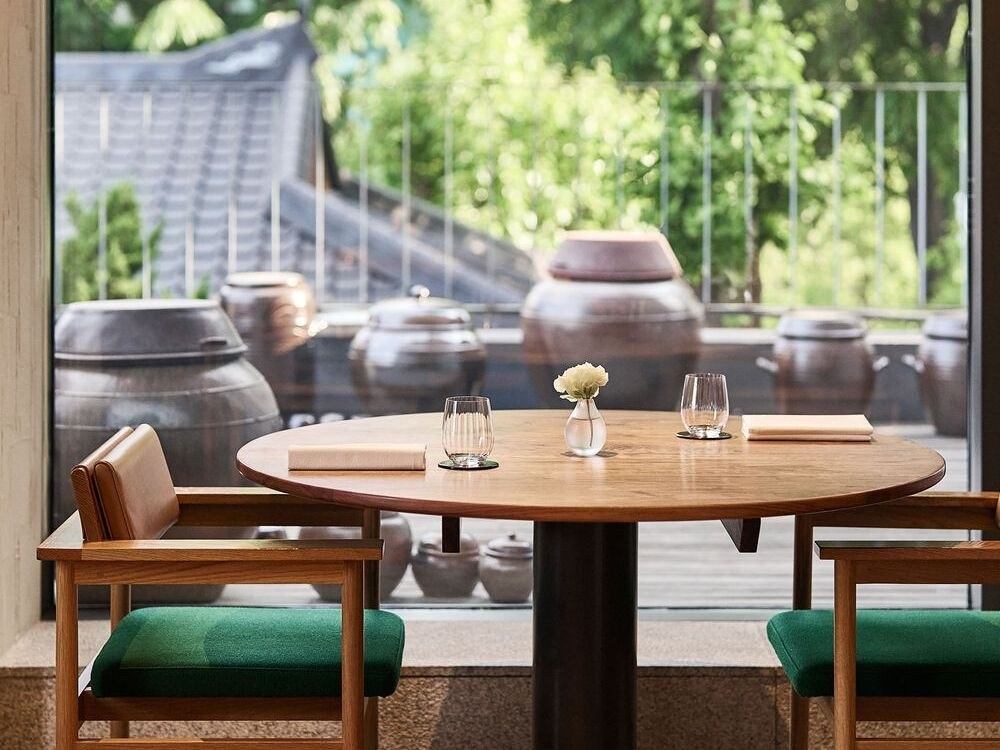
Image context: the cover image shows a Seoul fine-dining room framed by onggi jars. It works as a direct visual anchor for this article’s main argument: in this city, the pairing story often starts with fermentation culture before a bottle is even opened.
That is why Seoul feels different from cities where the food talks local while the beverage program still defaults to imported prestige. Here, the pairings at places like Mingles, Onjium, and EVETT are increasingly saying the quiet part out loud: the meal is not finished when the plate lands. It is finished when the drink explains what kind of modern Korean luxury the room actually believes in.
1) Mingles: the point is not “Korean ingredients plus wine,” but a parallel Korean lane
Mingles still reads, at first glance, like the kind of globally legible luxury room where you might expect classic fine-dining beverage hierarchy to dominate. The setting is calm and polished, Michelin describes the room in warm tones with refined tableware and green views, and chef Mingoo Kang’s tasting menu is technically precise rather than rustic for effect.[1] But the beverage logic matters because the restaurant does not stop at “excellent wine service attached to Korean food.”
A Michelin feature on Gangnam’s starred rooms makes the distinction explicit: at Mingles, wine pairings are available, but so are traditional liquor pairings built around special Korean drinks.[3] That sounds like a small operational detail until you think about what it means. A restaurant is effectively maintaining two different interpretive tracks for the same cuisine.
On one track, the diner reads the meal through familiar global luxury language: structure, acidity, texture lift, bottle prestige, classic sommelier progression. On the other, the diner reads it through Korean fermentation memory: grain softness, savory depth, rice aroma, and a different kind of continuity with the kitchen’s own use of jang and long-built umami.
That is why Mingles matters in this story. Its beverage program is not interesting because it offers “local drinks too.” It is interesting because the local lane is treated as a serious reading of the menu rather than a folkloric appendix.
2) Onjium: when the pairing program starts to feel like research, not restaurant decoration
If Mingles shows how Korean liquor can sit beside the wine track without apology, Onjium pushes the idea further: here the beverage story begins to feel inseparable from historical and culinary research itself.
The restaurant’s identity already leans in that direction. Michelin frames Onjium as a room across from Gyeongbokgung Palace where traditional Korean flavours are reinterpreted through modern technique and long study, while 50 Best notes that the wider project is tied to a Korean cultural centre and shaped by royal-cuisine knowledge, temple-cuisine influence, and in-house ferments such as doenjang, gochujang, and ganjang.[4][6] In other words, this is not a restaurant that borrows heritage as mood lighting. Research is part of the product.
So it matters that Michelin’s feature on chefs brewing their own alcohol uses Onjium as one of the clearest examples. The article describes chef Park Sung-bae treating alcohol-making as a natural extension of fermentation work, with the team producing drinks that can respond more precisely to dishes than off-the-shelf bottles often can.[5] That detail changes how you should think about pairings here.
At Onjium, the beverage program is not simply looking for a “best match.” It is trying to collapse the distance between kitchen, archive, and glassware. The pairing becomes a second course of interpretation. You are not only tasting what modern Korean fine dining serves; you are tasting how the restaurant believes Korean culinary knowledge should be translated into contemporary hospitality.
That makes Onjium one of the few places where a traditional-liquor pairing is not the adventurous side option. It is arguably the clearest path into the restaurant’s thesis.
3) EVETT: the experimental edge comes from treating drinks as active R&D
If Mingles is elegant dual-track luxury and Onjium is scholarship turned into service, EVETT is the restless experimental flank of the same movement.
Michelin’s current EVETT listing already hints at it through the kitchen’s use of hand-made meju, home-brewed sauces, pine-needle oil, and floral medicinal liquor.[7] The beverage point becomes clearer in Michelin’s 2021 interview with chef Joseph Lidgerwood, where he explains that during a period of reduced covers the restaurant cut down to around 18 guests a night and used that space to refine the experience, including the introduction of a non-alcoholic pairing for guests who wanted the same shape of experience as wine.[8]
That is a more consequential move than it sounds. Plenty of restaurants now offer zero-proof pairings because the market expects them. EVETT’s framing is more interesting: the alcohol-free lane is treated as a way to preserve equivalent narrative structure, not as a concession lane for abstainers. That is exactly the logic top beverage programs should aim for.
It also tells you something broader about Seoul. The city’s strongest dining rooms increasingly understand that the pairing sequence is one of the fastest ways to show whether “locality” is real or performative. A menu can talk about Korean ingredients all night. A serious beverage program has to operationalize that talk, course after course, in liquid form.
4) How to choose your lane without turning the night into homework
A practical rule helps.
- Choose the Korean-liquor or house-ferment lane when you want the meal’s internal logic to feel tighter than its global luxury signaling.
- Choose the wine lane when you want contrast, external benchmark clarity, and a more legible classic fine-dining progression.
- Choose the zero-proof or lighter lane when your real priority is sensory precision over ceremony, especially on long menus where alcohol dulls the back half.
A faster room selector also helps. Mingles is the best fit if you want a globally legible luxury room that still takes Korean-liquor pairing seriously; Onjium is the clearest choice if you want the beverage track to feel closest to historical research and fermentation logic; EVETT is the room for diners who care most about experimental sequencing and a zero-proof lane that is treated like first-class hospitality rather than a backup plan.
In Seoul, this decision matters more than in many other cities because the drink track can substantially change what the meal means. The same plate may read as polished cosmopolitan cuisine under one pairing and as deeply local fermentation cuisine under another.
So if you are booking one serious Seoul dinner, do not ask only which room is “best.” Ask which beverage argument you want to spend the night inside.
How to listen to a pairing, not just drink it
Three cues separate a serious pairing program from a luxury add-on:
- Continuity: does the glass extend the dish's fermentation, grain, acid, smoke, or aromatic logic, or does it merely create contrast for effect?
- Reset: does the beverage change the pace at the right moment, especially before the back half of a long menu starts to feel heavy?
- Proof: after the pour, do you understand something more clearly about the restaurant's worldview than you did one course earlier?
That last cue is the useful one. In Seoul's best rooms, the pairing is not there just to sharpen bites. It is there to prove what kind of Korean modernity the restaurant is actually trying to stage.
A one-minute booking script that upgrades the whole night
Before your reservation is locked, three precise questions usually improve the actual pairing experience more than a long pre-read:
- Ask whether the Korean-liquor pairing lane is available on your specific service date, not just in principle.
- Ask whether the non-alcoholic pairing is course-synchronized (same course count and pacing) or a shorter alternative track.
- Ask whether the room allows mid-sequence switching (for example, Korean liquor first half, wine second half) when menu fatigue sets in.
These questions keep the pairing choice in the realm of culinary intent instead of prestige autopilot. In Seoul’s current top tier, that one shift often determines whether the drink program reveals the menu or merely accompanies it.
Why this matters beyond one city
The broader significance is that Seoul is helping define a more convincing version of contemporary Asian fine dining luxury. Not the old script where local ingredients are plated in one register while the beverage program quietly reimports authority from somewhere else; and not the opposite extreme where “tradition” is reduced to token novelty for travelers seeking authenticity theater.
The sharper Seoul model is harder and more interesting. It asks the drink program to carry equal intellectual weight with the kitchen. That means more fermentation fluency, more producer knowledge, more custom development, and more willingness to treat Korean sool or zero-proof design as first-class hospitality rather than backup inventory.
For diners, the takeaway is simple: in this city, the pairing is often where the restaurant stops describing itself and starts revealing itself.
Sources
- MICHELIN Guide — Mingles listing (room, menu character, service atmosphere)
- 50 Best Discovery — Mingles profile (chef background, Korean ingredient search, menu identity)
- MICHELIN Guide Singapore — “12 MICHELIN-Starred Restaurants In Gangnam, Seoul” (Mingles pairing note: wine and traditional liquor lanes)
- MICHELIN Guide — Onjium listing (location, research-forward traditional reinterpretation, curated pairings)
- MICHELIN Guide — “Chefs Start To Brew Their Own Alcohol” (Onjium as house-brewing case)
- 50 Best Discovery — Onjium profile (royal-cuisine training, cultural-centre context, in-house ferments)
- MICHELIN Guide — EVETT listing (meju, pine-needle oil, floral medicinal liquor, pairing fit)
- MICHELIN Guide — interview with Joseph Lidgerwood of EVETT (18-seat refinement and non-alcoholic pairing rationale)