Wells Fargo no longer has a simple cleanup story. The Federal Reserve lifted the asset cap in June 2025, full-year net income reached $21.3 billion, diluted EPS reached $6.26, and return on tangible common equity reached 14.6%.[1][3] At about $85.15 per share on April 13, 2026, roughly 13.6x trailing earnings, the stock does not need proof that the repair work happened. It needs proof that post-cap growth can widen fee mix and lift returns toward management's new 17-18% medium-term ROTCE target without leaning on a big net-interest-income surprise.[1][3][5]
That is the priced-vs-new split. Priced is that Wells Fargo finally cleared the regulatory overhang that defined the stock for years and still carries excess capital, a large deposit base, and room to keep buying back stock. New is that the rerating now has to come from balance-sheet throughput and fee engines rather than from one-time sentiment relief. Full-year 2025 net interest income was $47.5 billion, essentially flat with $47.7 billion in 2024, while noninterest income rose 5% to $36.2 billion.[2][3] If the bank is going to earn a meaningfully higher multiple, that mix shift has to keep deepening.
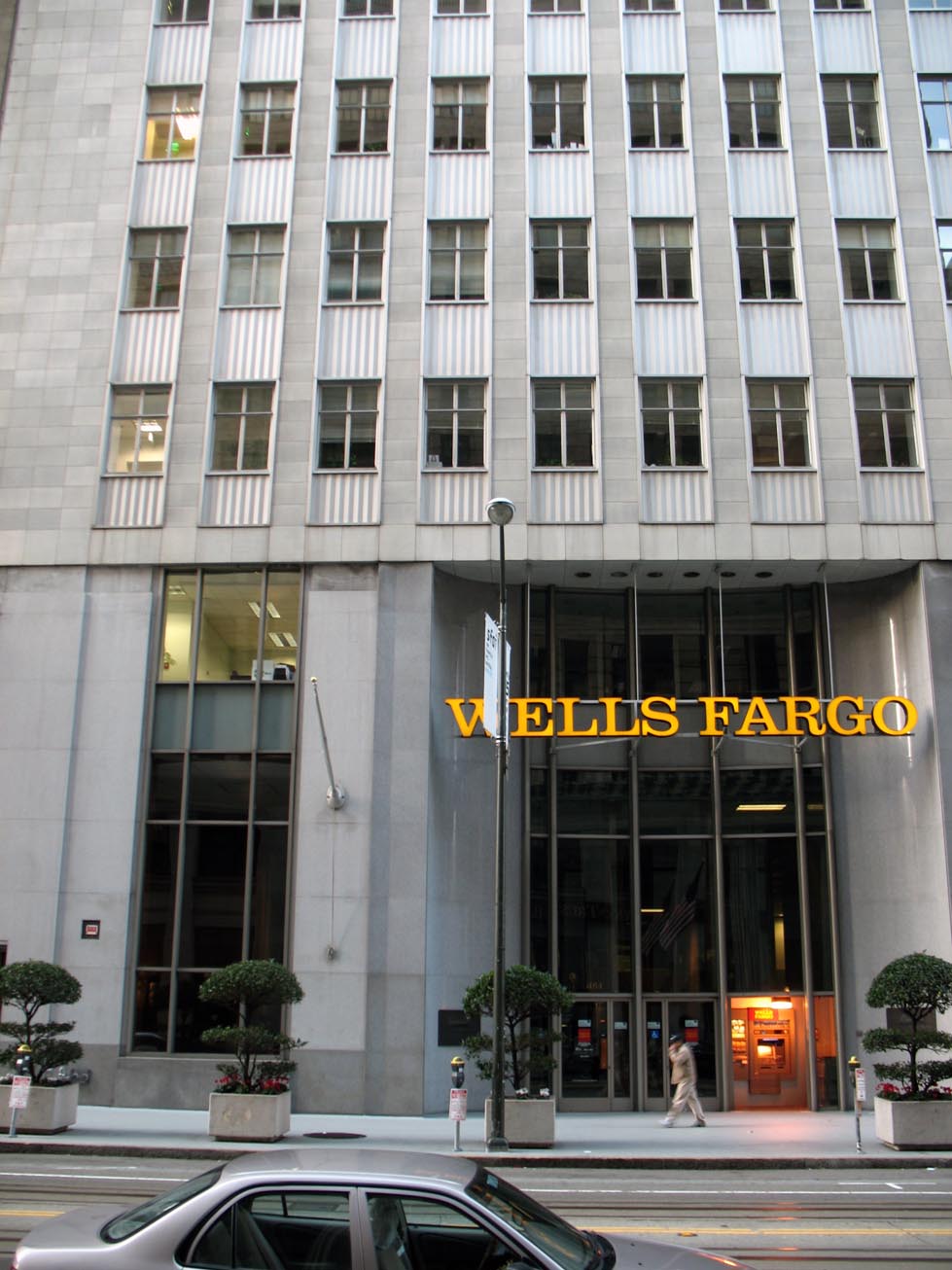
Image context: the cover uses a real photograph of Wells Fargo's San Francisco headquarters rather than a symbolic bank skyline or trading-screen visual. That is the right anchor because this valuation case is about an operating institution using its branch base, lending capacity, advisory platform, and capital return program after years of constraint.[6]
Why the multiple can still move
The bull case starts with the obvious point: Wells Fargo is finally allowed to grow like a normal large bank again. In the fourth quarter of 2025, average loans rose 5% year over year to $955.8 billion, average deposits rose 2% to $1.38 trillion, and period-end total loans reached $986.2 billion, up 8% from a year earlier.[1][2] Those are not theoretical benefits from the asset-cap removal. They are already visible in the balance sheet.
The second support is mix. The 2025 annual report says noninterest income rose 5% to $36.2 billion, helped by higher investment advisory and investment-banking fees as well as increased card and deposit-related fees.[3] In the fourth-quarter results deck, Wells says investment advisory fees and brokerage commissions rose 8% year over year, while investment banking fees rose with better market activity.[2] In Wealth and Investment Management, 2025 revenue reached $16.3 billion, up 6%, and client assets under management surpassed $2.5 trillion.[3] That matters because a better fee mix gives the stock a cleaner rerating path than a bank that depends mainly on spread luck.
Capital return remains part of the case. Wells returned $23 billion to shareholders in 2025, including $18 billion of common-stock repurchases, while raising the common dividend 13%.[1][3] The stock does not need to become a high-growth franchise overnight. It only needs balance-sheet growth, fee income, and buybacks to keep working together.
Where the valuation still needs proof
The harder part is that the next leg of the story is less automatic than the first. The repair trade was easy to understand: remove the cap, close consent orders, and let the stock stop trading like a permanent regulatory problem. The next trade requires operating proof. Full-year 2025 net interest income was basically flat, which means Wells did not yet show that a larger balance sheet automatically converts into a faster earnings engine.[2][3]
That is why fee quality matters more now. Management highlighted 5% growth in fee-based income, 8% growth in advisory fees in Wealth and Investment Management, 14% growth in investment banking fees, and 12% growth in commercial-business loans.[1] Those are the right lines. But they still need repetition. A bank can get one good year of market help, one good quarter of capital-markets activity, or one burst of post-constraint lending. A durable rerating needs readers of the numbers to believe the mix change is structural.
Capital is the second constraint. Wells ended the fourth quarter with a 10.6% CET1 ratio and $137.3 billion of CET1 capital.[2] That is still comfortably above regulatory minimums and supports the buyback case. But the bank cannot indefinitely run all three levers at once at maximum speed: expand the balance sheet, keep repurchasing stock at a double-digit-billion pace, and absorb any macro or credit wobble without investors asking whether the cushion is narrowing. The valuation case therefore depends not only on growth, but on the quality of that growth.
Six numeric anchors
- Current valuation frame: about $85.15 per share on April 13, 2026, or roughly 13.6x trailing $6.26 of 2025 diluted EPS.[3][5]
- 2025 profitability: net income of $21.3 billion, diluted EPS of $6.26, and ROTCE of 14.6%.[2][3]
- Latest quarterly earnings mix: fourth-quarter 2025 revenue of $21.3 billion, including $12.3 billion of net interest income and $9.0 billion of noninterest income; fourth-quarter efficiency ratio of 64%.[1][2]
- Balance-sheet growth: average loans of $955.8 billion and average deposits of $1.38 trillion in the fourth quarter, with period-end total loans reaching $986.2 billion, up 8% year over year.[1][2]
- Capital return and capital cushion: $23 billion returned to shareholders in 2025, including $18 billion of common-stock repurchases; fourth-quarter CET1 ratio of 10.6% and CET1 capital of $137.3 billion.[1][2][3]
- Fee-engine proof points: 2025 noninterest income of $36.2 billion, Wealth and Investment Management revenue of $16.3 billion with client assets above $2.5 trillion, advisory-fee growth of 8%, and investment-banking-fee growth of 14%.[1][2][3]
Those anchors describe a stock that is no longer cheap because it is broken. It is relatively restrained because investors are waiting to see what the first fully post-cap earnings rhythm looks like.
Strongest counterweight
The best pushback is that the market may still be underestimating how much operating leverage the cap removal unlocks. Wells spent years rebuilding controls, exiting lower-priority businesses, and cutting costs while still protecting investment in wealth, cards, commercial banking, and branch refurbishment.[1][3] If the first unconstrained growth cycle now shows up in loans, deposits, advisory fees, and capital-markets share at the same time, then a low-teens earnings multiple may simply be too low for a bank targeting 17-18% medium-term ROTCE.[1]
That counterweight is real. It is why this is not a "Wells is fully priced" argument. The claim is narrower: the easy rerating from regulatory repair has already happened. The next rerating needs operating evidence.
Falsifier
This walkthrough becomes too cautious if the next two quarterly windows show that Wells can grow the balance sheet, hold fee momentum, and keep capital comfortable at the same time. Concretely, if loans and deposits keep expanding, fee-based income keeps outgrowing net interest income, the CET1 ratio stays around the current zone, and reported ROTCE starts moving convincingly toward the 17-18% target, then the present "prove the throughput" framing would be too conservative.[1][2][3][4]
Watchlist
- April 14, 2026: Wells Fargo's Q1 2026 earnings release and webcast are the next direct test of whether post-cap balance-sheet growth is still translating into higher-quality revenue, not just bigger assets.[4]
- July 14, 2026: the projected Q2 2026 earnings date matters because by midyear investors should have a cleaner read on whether loan growth, fee growth, and capital return are repeating rather than reflecting year-end momentum alone.[4]
Takeaway
Wells Fargo's cleanup story is no longer the whole trade. The bank already showed in 2025 that it can earn double-digit returns, grow again after the asset cap lifted, and keep sending large amounts of capital back to shareholders.[1][2][3] The better 2026 valuation question is narrower and harder: can fee mix and balance-sheet throughput do enough work to earn a richer multiple while net interest income stays only steady? That is the gap investors still need the numbers to close.
Sources
- Wells Fargo, "Wells Fargo Reports Fourth Quarter 2025 Net Income of $5.4 billion, or $1.62 per Diluted Share" (January 14, 2026).
- Wells Fargo, "4Q25 Financial Results" (January 14, 2026).
- Wells Fargo, "2025 Annual Report."
- Wells Fargo, "Investor Relations" page, including Q1 2026 webcast and projected 2026 earnings dates, accessed April 13, 2026.
- Google Finance, "Wells Fargo & Co (NYSE: WFC) Stock Price & News," accessed April 13, 2026.
- Wikimedia Commons, "File:Wellsfargohq.jpg."