Priced: Saltchuk closed its purchase of Great Lakes Dredge & Dock at an enterprise value of about $1.5 billion, acquiring a contractor that had ended 2025 with $888.1 million of total backlog and $171.3 million of adjusted EBITDA. New: the durable asset was not the backlog by itself. It was the ability to put a scarce, coastwise-qualified dredge into a funded channel during a permitted work window—and finish a mostly fixed-price job without giving the bid margin back.[1][2]
That distinction turns the transaction into a useful map of dredging economics. Dividing the deal value by 2025 adjusted EBITDA gives a rough 8.8 times multiple, but neither number says how much cash the next contract will produce. Backlog is an estimate of revenue still to be performed. Vessel availability, mobilization, production rate, weather, sediment, fuel, labor, drydock timing, and the original bid decide what survives below it.[1]
Evidence cut-off: September 4, 2026. Great Lakes became a wholly owned Saltchuk subsidiary and stopped trading publicly on April 1, so its 2025 Form 10-K is the last full public operating baseline. The 8.8-times figure is a calculation from the reported transaction value and adjusted EBITDA, not a current market multiple or an investment recommendation.[1][2]
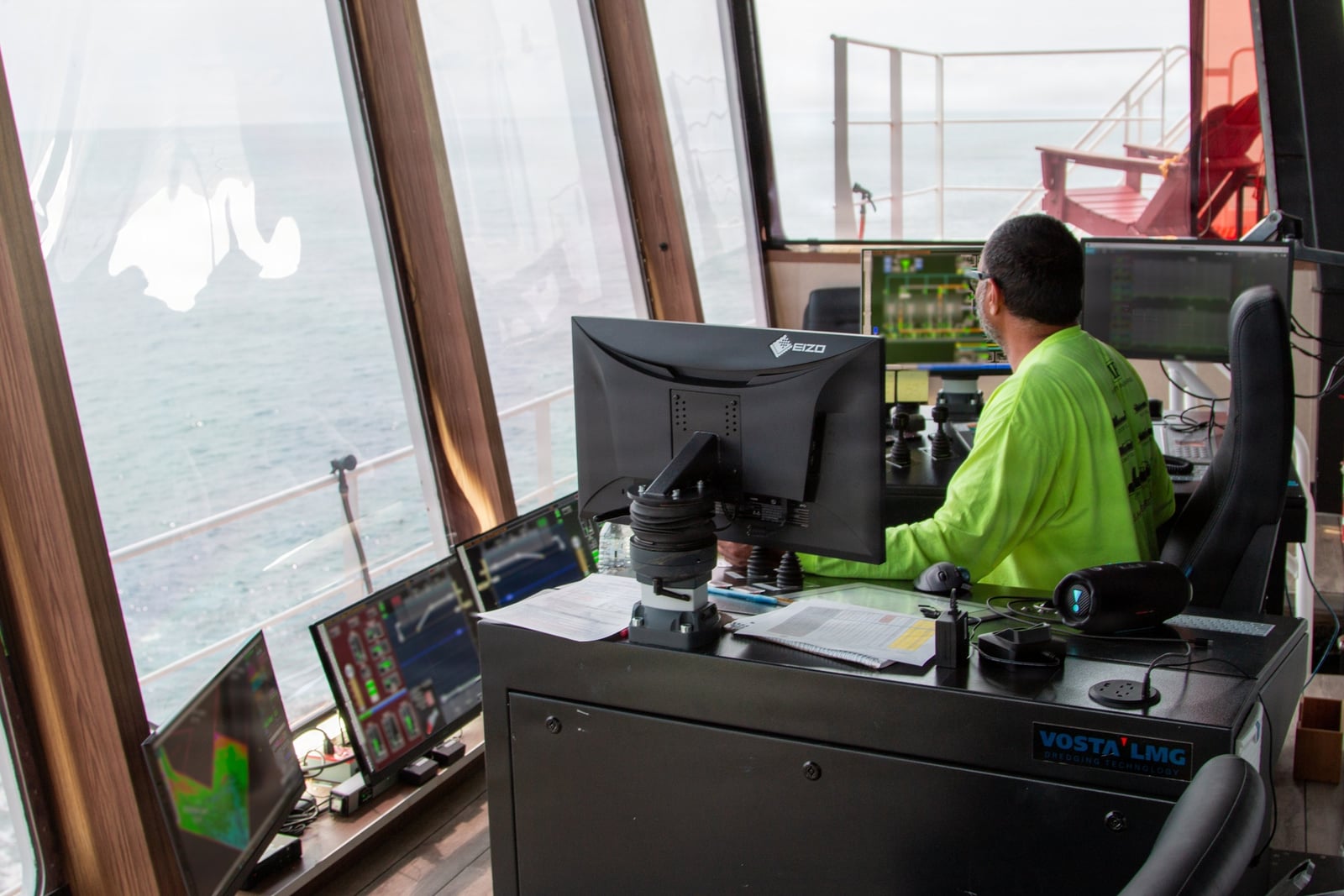
Image context: the cover is a real U.S. Army Corps of Engineers photograph taken aboard the Great Lakes hopper dredge Amelia Island during South Carolina's Grand Strand beach-renourishment project on July 27, 2026. It documents the vessel, human operator, and project setting discussed here; it is not evidence of the acquisition price or fleet-wide utilization.[9]
A contract does not earn until the steel moves
Dredging sounds like one activity—remove material from one place and put it somewhere else—but the fleet has to match several different jobs. Capital work deepens ports and berths. Coastal protection moves sand onto vulnerable shorelines. Maintenance removes the sediment that returns to established channels. Great Lakes said most maintained channels need another pass every one to three years, which gives the market a recurring base without making any individual award automatic.[1]
The operating chain is short:
funding -> award -> mobilization -> work window -> production -> placement -> acceptance
The dollars can pause at every arrow. Great Lakes reported that 45 days to six months may pass between an award and the start of a major activity, depending on project complexity and environmental windows. Mobilization itself consumes crew time and fuel before productive digging begins. A hopper dredge can carry material away; a cutter suction dredge may need a pipeline and a placement area; a mechanical dredge needs barges or scows. A company with backlog but the wrong equipment in the wrong geography can still have an idle asset and a delayed job.[1]
Accounting does not remove that physical constraint. Great Lakes recognized revenue over time by comparing costs incurred with estimated total costs. Substantially all revenue was fixed-price, often at a fixed price per cubic yard. If soil proves harder, weather closes the window, equipment fails, or daily production misses the estimate, the contractor bears much of the difference. Revisions to expected gross profit therefore enter the accounts as circumstances change. The project can add revenue while destroying the margin assumed when it was bid.[1]
“Vessel day” is not a metric Great Lakes reported in its financial statements. It is the useful analytical unit: one suitable dredge, crewed and operating rather than mobilizing, waiting, or sitting in drydock, for one day. Backlog tells an investor what has been sold. Vessel days explain whether it can be delivered economically.
A current Corps example makes that abstraction physical. After routine drydock work, the government-owned Dredge Potter returned to the Mississippi in August 2026 with 52 employees split across three watches so it could operate around the clock. It had removed 4.7 million cubic yards from 36 locations in 2025. Potter is not a Great Lakes asset and its cost structure is not a proxy for the company; it shows why a “day” is really a coordinated package of vessel, maintenance, crew, pipeline, and placement capacity.[8]
The moat is legal, physical, and narrower than it looks
Federal law does not let any available foreign dredge sail in and perform domestic work. Under 46 U.S.C. § 55109, a vessel dredging U.S. navigable waters generally must be owned—and, if applicable, chartered—by U.S. citizens and hold the required coastwise documentation. That does not guarantee attractive bids, but it narrows the equipment pool that can answer one.[4]
Great Lakes entered 2026 with 16 dredges, 13 material-transportation barges, two multi-cats, and a large support fleet. It described that set as the largest and most diverse in the domestic industry. Diversity matters because a deep harbor, a beach fill, and an inland maintenance cut do not call for identical equipment. Mobility matters because the next attractive project may be several coasts away.[1]
Scarcity should not be mistaken for monopoly. The Corps owns dredges, other private contractors compete, and the relevant capacity changes by vessel type and region. A Government Accountability Office review of hopper dredging found that statutory limits on use of the Corps fleet helped retain emergency capacity, but it could not establish a clear effect on private competition. The same review highlighted no-bid and high-bid solicitations as the evidence to track when industry capacity is genuinely short.[5]
That is the right boundary for the investment thesis. Coastwise rules raise the barrier to adding capacity. They do not rescue a poor bid, eliminate competitors, or make every dredge interchangeable.
Backlog is a clock, not a vault
At December 31, 2025, Great Lakes had $763.2 million of dredging backlog, down 36% from a year earlier. Another $200.2 million of low bids and contract options had not yet met the company's definition of signed backlog. Even within the signed figure, 59% related to federal contracts that the government could cancel, while owing committed costs and profit on completed work under the applicable terms.[1]
The decline was a real counterweight to the deal story. Great Lakes won 14% of the domestic bid market it tracked in 2025, versus 33% in 2024, and it won neither of the two domestic capital projects awarded during the year. Management argued that annual awards are lumpy, which is credible in a market where a few large jobs can move the total. It does not make the missing wins irrelevant.[1]
More revealing was the conversion promise: Great Lakes expected about 90% of year-end dredging backlog to become revenue during 2026. That compressed a large part of the order book into one operating calendar. Each scheduling slip could move revenue across a year-end boundary; each bad production assumption could preserve revenue while eroding profit. The backlog total was therefore less a vault of future earnings than a clock attached to a fleet plan.[1]
The Corps' live Dredging Quality Management list shows why aggregation hides the work. As of the evidence cut-off, Great Lakes vessels were attached to active jobs including Jacksonville Harbor maintenance and Great Egg Harbor Inlet beach renourishment, alongside many jobs awarded to other contractors using different dredges. Each entry joins a named vessel, place, contractor, district, and project identifier—the operational objects that a backlog dollar leaves out.[7]
The purchase price included a reinvestment bill
Saltchuk did not buy a static collection of old boats. Great Lakes had been renewing the fleet, and that program pulled cash forward. Purchases of property and equipment reached $147.2 million in 2025—about 86% of that year's adjusted EBITDA by calculation—including $69.1 million for the Acadia subsea rock-installation vessel and $32.3 million for the new hopper dredge Amelia Island. The ratio overstates steady maintenance because those were growth builds, but it makes the core point: EBITDA is not a vessel owner's free cash flow.[1]
The Acadia also shows what a new vessel needs before it becomes an earning asset. Great Lakes took delivery on June 25, 2026, then said it would mobilize to Equinor's Empire Wind 1 project, proceed to Sunrise Wind, and afterward move to European work expected to occupy most of 2027. Delivery ended construction risk; it did not end mobilization, commissioning, project, or utilization risk.[3]
The strongest counterweight is that a capable fleet can turn the same constraints into pricing and duration. Required channel maintenance recurs. Port deepening and coastal repair are physical public works, not software projects that a customer can duplicate overnight. A private parent with a long horizon may also tolerate lumpy awards and newbuild cycles better than a public market focused on the next quarter.
Still, the public baseline warns against treating all cash as recurring. Great Lakes generated $246.7 million of operating cash in 2025, but it explicitly attributed part of the increase to receivables, advance billings, deferred taxes, and other working-capital movements. Those can reverse. Saltchuk paid for the platform that can win and execute work, not a promise that one year's conversion repeats.[1][2]
Falsifier: qualified capacity stops being scarce
The thesis is falsified if qualified U.S. dredging capacity expands enough that Corps solicitations consistently attract ample bids, no-bid and high-bid cases recede, and comparable work clears at economics that no longer reward fleet breadth or availability. In that world, the contract pipeline—not control of vessel days—owns the bargaining power. The Corps' active-job database and public award results provide the outside evidence needed to test that condition even though Great Lakes is now private.[5][7]
One weak year of awards would not prove the opposite, either. It could reflect project timing, a deliberate refusal to chase low-margin work, or fleet commitments elsewhere. The test is a sustained change in bid depth, pricing, and schedule availability—not a single backlog print.
What to watch
- October 1, 2026 — the federal fiscal-year turn: follow the Corps' Civil Works budget and subsequent work-plan releases. A continuing resolution can keep agencies operating while delaying new project starts, separating authorized demand from jobs actually let to bid.[1][6]
- December 31, 2026 — the old conversion deadline: Great Lakes expected roughly 90% of its 2025 dredging backlog to convert during 2026. With quarterly filings gone, project completion notices and the Corps' active-job records become the check on whether that fleet calendar broadly held.[1][7]
- The 2027 offshore campaign: after Empire Wind 1 and Sunrise Wind, Acadia is scheduled for European contracts covering most of 2027. Watch the handoffs and mobilization, because a specialized vessel earns its strategic premium only when sequential contracts leave little unpaid transit or idle time.[3]
- Each new Corps solicitation and award cycle: compare awards with the jobs that become active, bidder depth, and no-bid or high-bid outcomes. The best public signal of scarcity is not a contractor saying its fleet is scarce; it is customers struggling—or not struggling—to secure suitable capacity on acceptable terms.[5][7]
The deal's cleanest lesson is not that backlog is unimportant. It is that backlog is unfinished work. In dredging, the bridge from signed dollars to cash is made of steel, crew time, weather windows, and estimates about the material below the waterline. Saltchuk bought that bridge; vessel days determine how much traffic it can carry.
Sources
- Great Lakes Dredge & Dock, Form 10-K for the year ended December 31, 2025 — contract economics, fleet, backlog, bidding, revenue recognition, cash flow, capital expenditure, and operating risks.
- Great Lakes Dredge & Dock and Saltchuk, “Saltchuk Welcomes Great Lakes Dredge & Dock to its Family of Companies” (April 1, 2026), filed with the SEC — closing, $17 cash price, approximate $1.5 billion enterprise value, and delisting.
- Great Lakes Dredge & Dock, “Takes Delivery of Acadia, a State-of-the-Art Subsea Rock Installation Vessel” (June 25, 2026) — delivery and the planned U.S.-to-Europe project sequence.
- Cornell Legal Information Institute, 46 U.S.C. § 55109, “Dredging” — citizenship and coastwise-documentation requirements for domestic dredging vessels.
- U.S. Government Accountability Office, Army Corps of Engineers: Actions Needed to Further Improve Management of Hopper Dredging, GAO-14-290 (2014) — fleet policy, capacity signals, bid data, and limits of competition evidence.
- U.S. Army Corps of Engineers, “Civil Works Budget” — official fiscal-year budget, justification, and work-plan repository.
- U.S. Army Corps of Engineers, “Dredging Quality Management: Active Jobs” — vessel-, contractor-, district-, and project-level records for current dredging work.
- U.S. Army Corps of Engineers, “Dredge Potter returns for 2026 dredging season” (August 28, 2026) — a current operational example of drydock work, three-shift crewing, and continuous seasonal dredging.
- Dylan Burnell / U.S. Army Corps of Engineers, “A Modern Marvel on the Coast: High-Tech Dredge Amelia Island Restores Surfside Beach” (July 27, 2026) — source page for the documentary cover photograph.