UPS did not report a magical turnaround quarter on April 28, 2026. What it did report was more useful. The priced part of the story is already familiar: strategic actions are shrinking lower-quality volume, especially in U.S. Domestic. The new part is narrower and more demanding. After first-quarter revenue of $21.2 billion and a reaffirmed full-year guide of roughly $89.7 billion revenue with a 9.6% adjusted operating margin, the burden has shifted to one question: can price-and-mix gains outrun the network's cost-per-piece pressure quickly enough to make that guide feel earned rather than merely maintained.[1][2][3]
The headline numbers still look like a transition, not a clean recovery. Consolidated operating profit was $1.27 billion, adjusted operating profit was $1.32 billion, diluted EPS was $1.02, and adjusted diluted EPS was $1.07.[1] Carol Tome's line that UPS expects to return to revenue growth, operating profit growth, and adjusted margin expansion in the second quarter matters precisely because the first quarter did not yet prove that those outcomes are self-executing.[1]
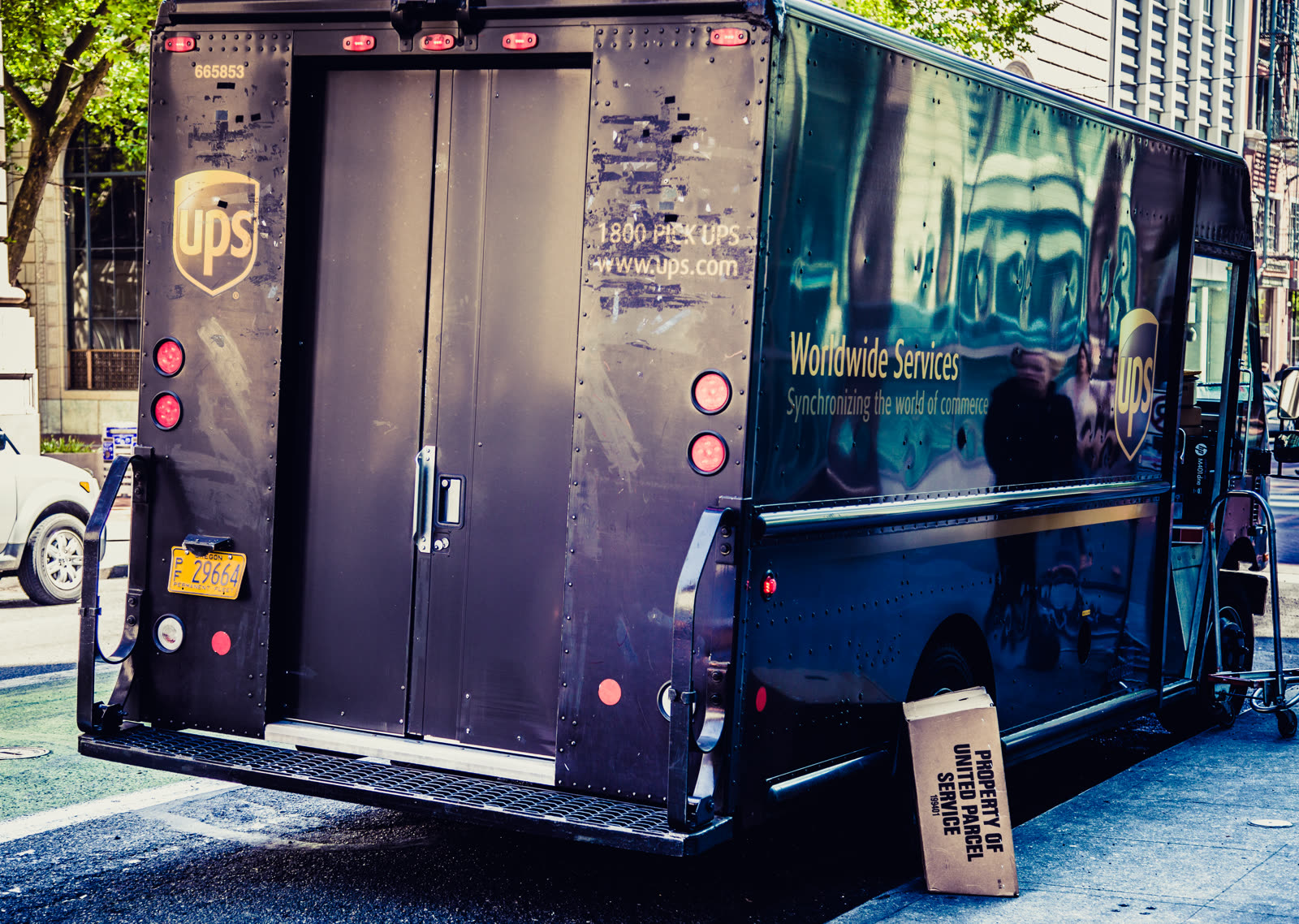
Image context: this UPS truck belongs here because the quarter is about physical-network absorption. Package density, pricing quality, and delivery economics are embedded in a real curbside system like this one, not in symbolic finance visuals.[7]
What the quarter actually proved
The most important evidence sits inside the domestic network. U.S. Domestic revenue fell to $14.125 billion from $14.460 billion, a 2.3% decline, while average daily domestic package volume fell to 16.040 million from 17.443 million.[1][3] UPS did manage to lift domestic revenue per piece by 6.5%, which tells you the mix is moving toward better-yielding packages.[1] But the harder number sits one layer below: U.S. Domestic cost per piece rose to $13.40 from $12.22, a 9.7% increase, and domestic operating margin compressed to 3.6%.[1][3]
That is the whole quarter in miniature. The company is getting paid more per package, but not enough yet to make lower volume comfortable. A network built to move more parcels does not instantly become more profitable when it chooses to move fewer unless stop density, labor deployment, and fixed-cost absorption all reprice fast enough.[1][3]
Why the guide now lives or dies on absorption
UPS's reaffirmed 2026 outlook is still ambitious enough to matter. Management kept its targets for about $89.7 billion in revenue, about $3.0 billion of capital expenditures, about $5.4 billion of dividend payments, and an effective tax rate of about 23.0%.[1] That is not the language of a company cutting the year to meet the quarter. It is the language of a company saying the transition pain should peak before the model improves.
The problem is that the supporting segments were mixed rather than decisively strong. International revenue rose to $4.540 billion from $4.373 billion, helped by a 10.7% increase in revenue per piece, yet International operating profit was $547 million versus $641 million a year earlier, leaving operating margin at 12.0%.[1][3] Supply Chain Solutions revenue fell 6.5% to $2.537 billion, with UPS explicitly pointing to lower volume in Mail Innovations.[1][3] Those figures do not describe a franchise in trouble, but they do describe one where domestic absorption still matters more than any single bright line elsewhere in the portfolio.
So the post-earnings read should stay disciplined. UPS is not being asked to prove that it can cut weaker volume. It has already done that. It is being asked to prove that the remaining network can become more profitable quickly enough that lower volume turns from a transition excuse into a better-quality earnings base.[1][3]
Strongest counterweight
The best argument against that cautious reading is that this quarter may be exactly what a deliberate reset is supposed to look like. Domestic revenue per piece grew 6.5%; International revenue per piece grew 10.7%; management reaffirmed the year and said second-quarter growth and margin expansion should resume.[1] If the company has intentionally walked away from less attractive package flows, then a temporary hit to volume and cost absorption may be the price of a better network rather than the sign of a structurally weaker one.
That is a serious counterweight. It is why the right debate is not "good quarter" versus "bad quarter." The real debate is timing. How fast does the network reabsorb itself after the volume reset?
Falsifier
This cautious absorption-first view breaks if the next quarter shows that the cost problem is already rolling over. Concretely, if UPS delivers the promised second-quarter return to revenue and operating profit growth while domestic cost per piece stops outrunning revenue per piece, then the market should conclude that first-quarter margin pressure was transitional rather than lingering.[1][3]
Watchlist
- May 5, 2026: BEA's release of U.S. International Trade in Goods and Services for March 2026 will give an immediate read on the cross-border goods backdrop feeding UPS's international and trade-sensitive flows.[5]
- May 7, 2026: UPS's 2026 Annual Meeting of Shareowners is the next company-specific checkpoint for how management frames the reset after the quarter.[4]
- May 14, 2026: the Census Bureau's next Advance Monthly Sales for Retail and Food Services release is due, a useful gauge for the U.S. consumer-volume base that still matters to domestic package density.[6]
- May 28, 2026: BEA's Personal Income and Outlays for April 2026 will show whether household spending momentum is staying firm enough to support the second-quarter rebound management is calling for.[5]
Sources
- UPS, "UPS Releases 1Q 2026 Earnings" - consolidated results, segment commentary, management statement, and full-year 2026 guidance.
- SEC, Form 8-K filed by United Parcel Service, Inc. on April 28, 2026 - confirms the earnings release and attached financial statement schedules as Exhibits 99.1 and 99.2.
- SEC, Exhibit 99.2 to UPS's April 28, 2026 8-K - selected first-quarter financial data including domestic volume, cost per piece, and segment revenue tables.
- UPS Investor Relations, "2026 Annual Meeting of Shareowners" - meeting date and time.
- Bureau of Economic Analysis, "Release Schedule" - dates for U.S. International Trade in Goods and Services and Personal Income and Outlays releases.
- U.S. Census Bureau, "Economic Indicators" - current and next release timing for advance retail sales and other demand-sensitive series.
- Wikimedia Commons, "File:UPS Truck Delivering Package (17710458768).jpg" - source page for the article image.