As of 2026-04-17, the easy UnitedHealth bull case is already familiar. Management has thrown a large charge through 2025, reset the operating baseline, changed leaders inside Optum, and told investors that 2026 should reopen the earnings path. Priced is that the worst of the disruption sits in the rearview mirror. New is whether first-quarter 2026 can make medical-cost discipline and Optum execution look ordinary again instead of merely improved from a bad level.[1][3]
That distinction matters because the company is asking investors to underwrite a real repair, not a cosmetic one. UnitedHealth finished 2025 with $447.6 billion of revenue, $16.35 of adjusted EPS, and $19.7 billion of operating cash flow, then set a 2026 outlook for more than $439.0 billion of revenue, more than $24.0 billion of operating earnings, and adjusted EPS above $17.75.[1] Those are not distressed numbers. They are the numbers of a very large company arguing that a bruising year was a reset rather than a structural break.
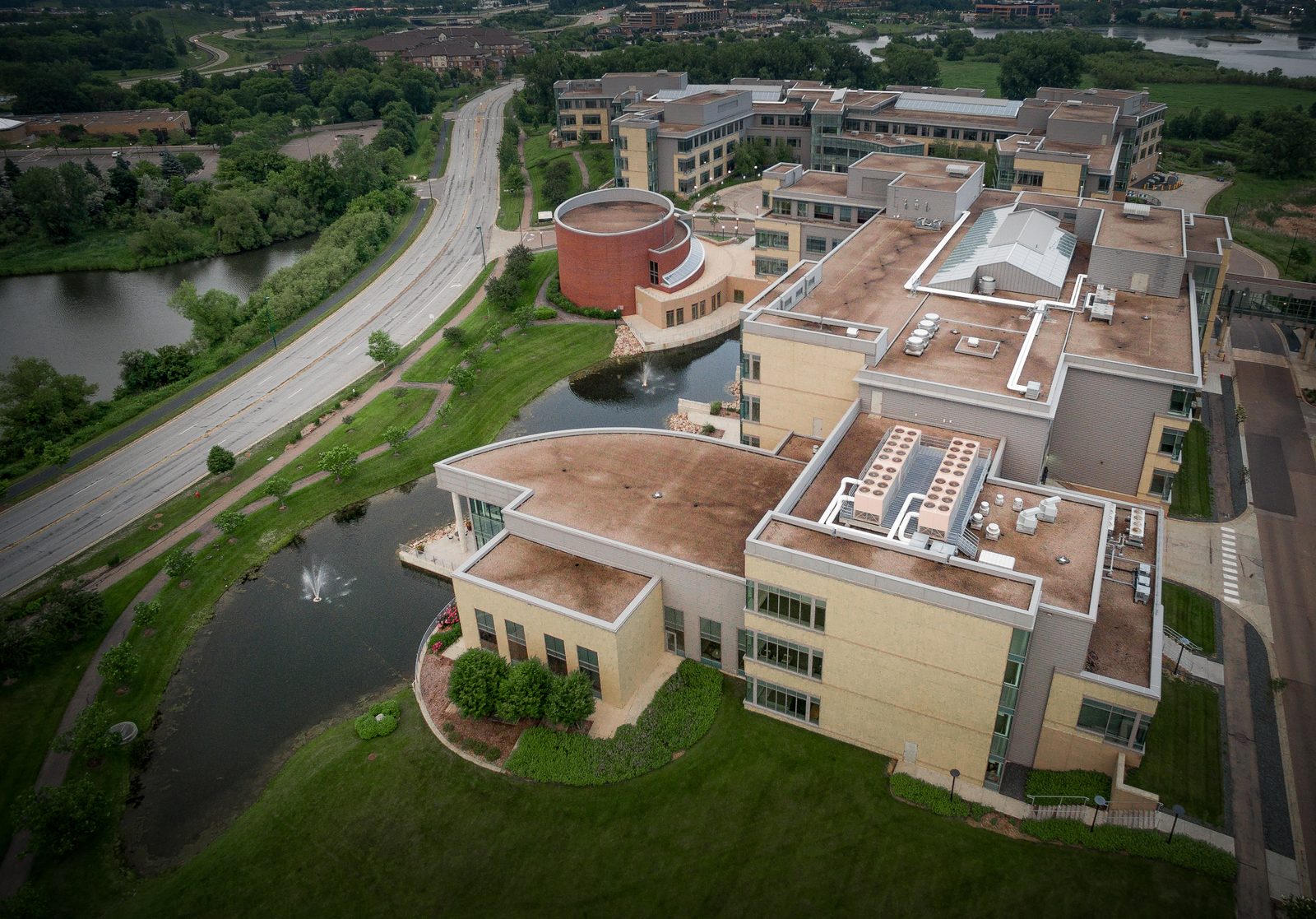
Image context: the cover uses a real photograph of Optum's Eden Prairie headquarters rather than an abstract health-insurance graphic. That is the right anchor because UnitedHealth's current finance question is operational first: whether the Optum side of the platform can absorb tighter discipline and help normalize group economics.[4]
Why the market is already giving the repair thesis some credit
The company has enough scale and enough still-working businesses that investors do not need to imagine a turnaround from scratch. UnitedHealthcare's 2025 revenue rose 16% to $344.9 billion and served 49.8 million consumers.[1] Optum's revenue rose 7% to $270.6 billion and supported more than 123 million consumers across its businesses.[1] The annual report adds another important operating detail: the company kept widening its direct care and services footprint even through the turbulence, with Optum serving care through clinics, surgery centers, and pharmacy infrastructure that give management multiple levers besides premium pricing alone.[2]
That scale is the reason the stock can still support a recovery case after a year that was visibly messy. UnitedHealth says the second half of 2025 included a refocus on key markets, products, and geographies, pricing discipline to reflect higher medical trends and policy changes, and a re-baselining of Optum under new leadership.[1] If those actions are real, then 2026 does not need heroics. It needs a quarter that looks less noisy.
The harder point is that 2025 also gave investors a clean picture of what remains broken. The adjusted medical care ratio was 88.9%, up 340 basis points year over year, reflecting Medicare funding reductions, Inflation Reduction Act effects, and accelerating medical-cost trends.[1] Fourth-quarter reported EPS fell to $0.01 because the company took a $1.6 billion net charge, while adjusted EPS was $2.11.[1] That is why April 21 matters. Management is no longer being asked whether it understands the problem. It is being asked whether the problem is starting to behave like a contained operating issue rather than a repeating earnings surprise.
Three branches for April 21
Base case
The most likely branch is a quarter that keeps the 2026 repair story alive without fully settling it. That means no fresh break in medical-cost trends, no visible loss of control inside Optum, and enough commentary around pricing, utilization, and value-based care that investors can keep underwriting a steadier second half.[1][3] In this branch, management does not need to sound triumphant. It only needs to sound specific and less defensive than it did six months ago.
Bull branch
The better branch needs two things to happen together. First, medical-cost trend language needs to flatten enough that the market stops assuming further negative drift in the ratio. Second, Optum needs to look like a business regaining operating texture rather than one still being reintroduced to basic discipline. If the company can do that while holding the outlook for revenue above $439.0 billion and adjusted EPS above $17.75, then the market can start reading 2025 as a flush year instead of a warning year.[1]
Bear branch
The weak branch is not a collapse scenario. It is a credibility leak. If the first quarter arrives with renewed pressure on care ratios, weak cash conversion, or language implying that Optum still needs another cycle of cleanup before margins can normalize, then the repair timeline stretches again.[1][3] For a company this large, even a modest extension of the repair clock can matter because the stock is no longer trading on raw size alone. It is trading on the idea that execution is becoming boring again.
Six numeric anchors
- 2025 scale: revenue of $447.6 billion, up 12% year over year.[1]
- 2025 earnings base: reported EPS of $13.23 and adjusted EPS of $16.35.[1]
- 2026 hurdle: outlook for more than $439.0 billion of revenue, more than $24.0 billion of operating earnings, and adjusted EPS above $17.75.[1]
- UnitedHealthcare base: $344.9 billion of 2025 revenue, up 16%, serving 49.8 million consumers.[1]
- Optum base: $270.6 billion of 2025 revenue, up 7%, supporting more than 123 million consumers.[1]
- Repair-quality checks: adjusted medical care ratio of 88.9%, adjusted operating cost ratio of 12.9%, operating cash flow of $19.7 billion, and debt-to-capital of 43.9% with a long-term target of 40.0% in 2026.[1]
Those anchors describe a company that is still enormous and still profitable, but also one whose 2026 case depends on turning that scale back into predictable operating discipline.
Strongest counterweight
The strongest pushback is that this framework is still too nervous about a business that already did the hardest part. UnitedHealth has acknowledged the pressure, reset the baseline, taken the charge, and preserved a large earnings and cash-flow base anyway.[1] The annual report also shows that the franchise still has real strategic depth: integrated care delivery, pharmacy services, benefits administration, and value-based arrangements all give management more ways to repair margins than a pure insurer would have.[2] If that is the right frame, then April 21 does not need to prove a full recovery. It only needs to confirm that the company is back inside its own lane.
That counterweight is real. It is why this is not a collapse thesis. The point is narrower: after 2025, investors are likely to demand proof of normality before they pay for acceleration.
Falsifier
This scenario analysis is too cautious if April 21 brings a clean reaffirmation or improvement in the 2026 outlook, no sign of renewed medical-cost deterioration, and commentary showing that Optum's re-baselining is already translating into steadier margins and cash discipline. If those conditions show up together, then the argument here has drawn the repair boundary too tightly.[1][3]
Watchlist
- 2026-04-21 pre-market results: the first question is whether UnitedHealth still holds the 2026 outlook for revenue above $439.0 billion and adjusted EPS above $17.75.[1][3]
- 2026-04-21 at 8:00 a.m. ET: the earnings call matters because management needs to explain medical-cost trend, Optum execution, and whether pricing and care-delivery changes are becoming visible in routine operations.[3]
- 2026-04-21 accompanying materials: investors should watch cash flow, debt-to-capital, and any movement in the medical care ratio more closely than headline revenue alone, because those are the lines most tied to whether the repair is becoming ordinary.[1]
Takeaway
UnitedHealth does not need April 21 to prove that it is big, diversified, or still profitable. It needs April 21 to prove that the 2025 cleanup is starting to behave like a closed chapter. The repair thesis is already partly in the price. The new proof is quieter: ordinary medical-cost discipline, less drama inside Optum, and a first quarter that makes 2026 look like execution again rather than explanation.[1][2][3]
Sources
- UnitedHealth Group, "UnitedHealth Group Reports 2025 Results and Issues 2026 Outlook" (January 27, 2026).
- UnitedHealth Group, 2025 Annual Report (2026).
- UnitedHealth Group, "UnitedHealth Group Announces Earnings Release Date" (March 17, 2026).
- Wikimedia Commons, "File:Optum Headquarters, Eden Prairie, MN (49120017041).jpg."