Uber's first quarter did not reveal a hidden demand story. Investors already know that the company can keep adding trips, that delivery remains larger and more resilient than the old "food app" label suggests, and that management has become much better at translating scale into operating income.[1][2] That part is priced. The more important new question after Q1 2026 is whether Uber can use Uber One, cross-platform consumer behavior, and a capital-light autonomous-vehicle buildout to preserve margin expansion even as the product set gets more infrastructure-heavy.[1][3][6][7]
The headline quarter was strong. Trips reached 3.6 billion, Monthly Active Platform Consumers reached 199 million, Gross Bookings hit $53.7 billion, revenue reached $13.2 billion, and adjusted EBITDA rose to $2.48 billion.[1][2] Delivery, in particular, looked less like a mature side business than a second engine: gross bookings rose to $26.0 billion, revenue to $5.1 billion, and segment operating income to $961 million.[1][5] But the more interesting signal sat above the segment table. Uber said membership surpassed 50 million in April, members now drive roughly half of Mobility and Delivery gross bookings, and AV mobility trips on the platform rose more than 10x year over year.[1][3]
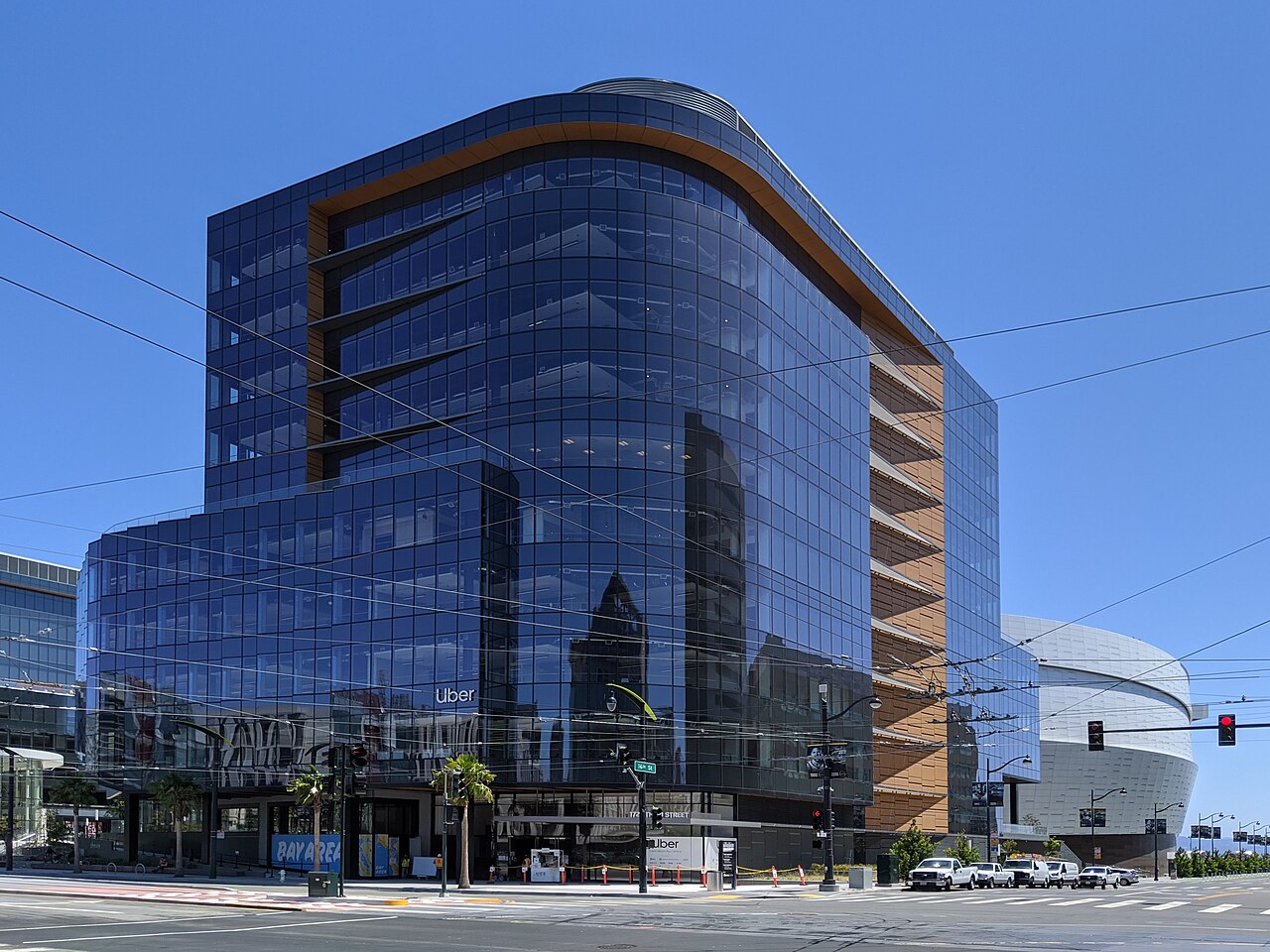
Image context: the cover uses a real Wikimedia Commons photograph of Uber's Mission Bay headquarters rather than a stock chart, smartphone mockup, or synthetic robotaxi rendering.[8] That scale fits the thesis better. This quarter is about whether software density can become physical operating leverage once membership, depots, insurance, and fleet orchestration all start interacting.
Priced vs new
The priced part of the story is straightforward. Uber's marketplace is still compounding. Gross Bookings grew 25% year over year, or 21% in constant currency, while adjusted EBITDA grew 33%.[1] Mobility gross bookings rose to $26.4 billion, Delivery to $26.0 billion, and even Freight returned to top-line growth.[1] Management also guided Q2 Gross Bookings to $56.25 billion-$57.75 billion and adjusted EBITDA to $2.70 billion-$2.80 billion, which says the volume engine has not stalled coming out of March.[1]
What is new is the shape of the operating moat Uber is trying to build on top of that volume. Prepared remarks described Uber One as a loyalty layer that deepens cross-platform behavior rather than merely subsidizing orders: membership exceeded 50 million, roughly 1 in 5 eligible consumers are active across both Mobility and Delivery, and among Uber One members that ratio rises to 2 in 5.[3] Supplemental slides add that cross-platform consumers are Uber's fastest-growing and most-retained audience, growing 1.5x faster than single-business users in eligible markets.[2][3] If that behavior persists, Uber is not just buying transactions. It is making the same consumer produce more rides, more orders, and more retained lifetime value across one account.
The AV layer matters because management is explicitly trying to attach it to that same density engine without owning the whole stack. In the prepared remarks, Uber said AV mobility trips on the platform rose more than 10x year over year, that the company is live in 8 cities, and that it expects to facilitate AV trips in as many as 15 cities globally by the end of 2026.[2][3] The strategic claim is not that Uber will become a manufacturer. It is that the platform can supply demand, software, depots, insurance, financing, and fleet management while leaving a large share of vehicle and autonomy risk with partners.[3][6][7]
Why the quarter can still rerate
The strongest bullish read is that Uber's next increment of profitability may come from density rather than pure cost cutting. The core marketplace is already large enough that small behavioral improvements begin to matter. Q1 MAPCs grew 17% while trips per MAPC grew another 3%, pushing total trips up 20%.[1][2] That is the cleanest sign that usage is getting thicker, not merely broader.
You can see the same logic in the segment details. Delivery revenue rose 34%, faster than Mobility revenue's 5% reported growth, and the 10-Q says Delivery benefited from a $180 million increase in advertising revenue.[5] That matters because advertising, membership, and cross-platform shopping are all higher-quality forms of monetization than simply taking a larger cut of one ride. Uber is gradually trying to make the app behave like a local-commerce operating system rather than a single-mode transportation product.[2][3]
That framing helps explain why AV is now financially relevant even before it becomes numerically large. Uber's February Autonomous Solutions launch described the company's pitch in very plain terms: marketplace demand, mapping, regulatory support, fleet financing, user experience, remote assistance, and insurance as services for autonomy partners.[6] The April Hertz/Oro announcement made the same point operationally, laying out charging, cleaning, repairs, depot staffing, and Bay Area fleet services for Lucid vehicles equipped with Nuro technology later this year.[7] In other words, Uber is trying to own the connective tissue around robotaxis rather than the full capital burden. If that model works, AV can reinforce platform density without forcing Uber back into an asset-heavy identity.
Six numeric anchors
- $53.7 billion: Q1 Gross Bookings, the best high-level proof that Uber's marketplace scale remains intact.[1]
- 199 million and 3.6 billion: MAPCs and trips, showing that both reach and usage frequency kept growing together.[1][2]
- $2.48 billion and 4.6%: adjusted EBITDA and adjusted EBITDA margin as a share of Gross Bookings, which is the clearest signal that scale is still converting into earnings power.[1]
- 50 million and 50%: Uber One membership in April and the share of Mobility plus Delivery bookings driven by members, which is the strongest evidence that loyalty is becoming an operating asset rather than a coupon program.[1][3]
- 1.5x and 2 in 5: cross-platform consumers grew 1.5x faster than single-business users, and 2 in 5 Uber One members are active across both core businesses.[2][3]
- 8 to 15 cities: Uber is live with AV operations in 8 cities and expects up to 15 by year-end 2026, which turns autonomy from a distant option into a live commercialization test.[2][3]
Strongest counterweight
The cleanest pushback is that the quarter still depended on a lot of adjustments, and the AV story is only capital-light if the surrounding ecosystem really scales. GAAP net income fell to $263 million because Uber absorbed a $1.5 billion pre-tax headwind from revaluing equity investments.[1][5] The reported revenue growth line was also distorted by UK business-model changes that cut total revenue growth by 9 percentage points year over year, even while bookings stayed strong.[1][5]
The 10-Q also shows that cost pressure has not vanished. In Mobility, insurance expense rose by $45 million year over year; in Delivery, insurance expense rose another $41 million; and Delivery's good quarter still came with a $631 million increase in courier payments and incentives.[5] On the autonomy side, management was candid on the call that AV financing is harder because residual values are not yet well established, which is why Uber is building out depots, insurance relationships, and financing partners instead of pretending the economics solve themselves.[4][7]
That is the real tension in the stock. Booking growth is no longer rare. The harder test is whether the platform can keep adding new layers without letting complexity eat the margin story.
Falsifier
This thesis breaks if member density and AV commercialization add operational bulk faster than they add incremental profit. Concretely, if Uber One keeps growing, AV cities keep multiplying, and Gross Bookings keep rising, but adjusted EBITDA margin stops expanding because insurance, incentives, depot services, and partner support absorb the upside, then the quarter should be read as a peak-efficiency snapshot rather than a durable new base.[1][4][5][7]
Watchlist
- Q2 2026 results: management guided to $56.25 billion-$57.75 billion in Gross Bookings and $2.70 billion-$2.80 billion in adjusted EBITDA. Hitting that range is the first proof that Q1 was not a one-quarter crest.[1]
- Q3 2026 Zoox launch in Las Vegas: prepared remarks said Zoox plans to deploy purpose-built robotaxis there in the third quarter, which gives investors a concrete checkpoint on whether partner launches keep converting from announcements into rides.[3]
- Bay Area Lucid/Nuro fleet operations later in 2026: the Hertz/Oro partnership is supposed to start supporting charging, maintenance, repairs, and depot staffing in the San Francisco Bay Area later this year. That is a direct test of whether Uber can outsource capital intensity without outsourcing execution.[7]
- Year-end 2026 AV city count and next Uber One disclosures: the platform target remains up to 15 AV cities by year-end, and the next membership and cross-platform updates will show whether density is still compounding fast enough to support that rollout.[2][3]
Takeaway
Uber's quarter did not change the obvious part of the story. The app is large, trips are growing, delivery is not fading, and management can still translate marketplace scale into real operating income.[1][2] The fresh question is narrower and more important. Uber is trying to prove that the next layer of value comes from density: one membership product, one cross-platform consumer graph, and one autonomy stack that stays capital-light by pushing vehicles, depots, financing, and insurance into partner structures.[3][6][7]
If that works, the company can keep widening the moat without rebuilding the balance-sheet risk that earlier transportation businesses carried. If it fails, investors are left with a very good marketplace whose best growth line is already familiar.
Sources
- Uber Technologies, "Uber Q1 26 Earnings Press Release" (May 6, 2026) - headline results, segment tables, Q2 guide, Uber One scale note, and margin metrics.
- Uber Technologies, "Uber Q1 26 Earnings Supplemental Data" (May 6, 2026) - cross-platform growth, AV city target, operating-metric trends, and platform product framing.
- Uber Technologies, "Q1 2026 Prepared Remarks" (May 6, 2026) - Uber One penetration, cross-platform usage, AV trip growth, partner pipeline, and capital-allocation language.
- Uber Technologies, "Uber Q1 26 Earnings Call Transcript" (May 6, 2026) - management discussion of AV financing, ecosystem buildout, and capital-light intent.
- Uber Technologies, "Form 10-Q for the quarter ended March 31, 2026" - reported-growth distortions from UK model changes, segment cost detail, insurance expense, and advertising contribution in Delivery.
- Uber Technologies, "Uber Unveils Uber Autonomous Solutions to Accelerate Autonomous Mobility & Delivery Worldwide" (February 23, 2026) - Uber's infrastructure, financing, insurance, and fleet-services pitch for AV partners.
- Uber Technologies, "Hertz and Uber Partner to Power Autonomous Robotaxi and Driver-Led Fleet Operations" (April 30, 2026) - Bay Area Lucid/Nuro fleet-management timeline and the concrete operating tasks being pushed to partners.
- Wikimedia Commons, "File:Uber offices, Mission Bay (July 2020) -2.jpg" - source page for the article image.