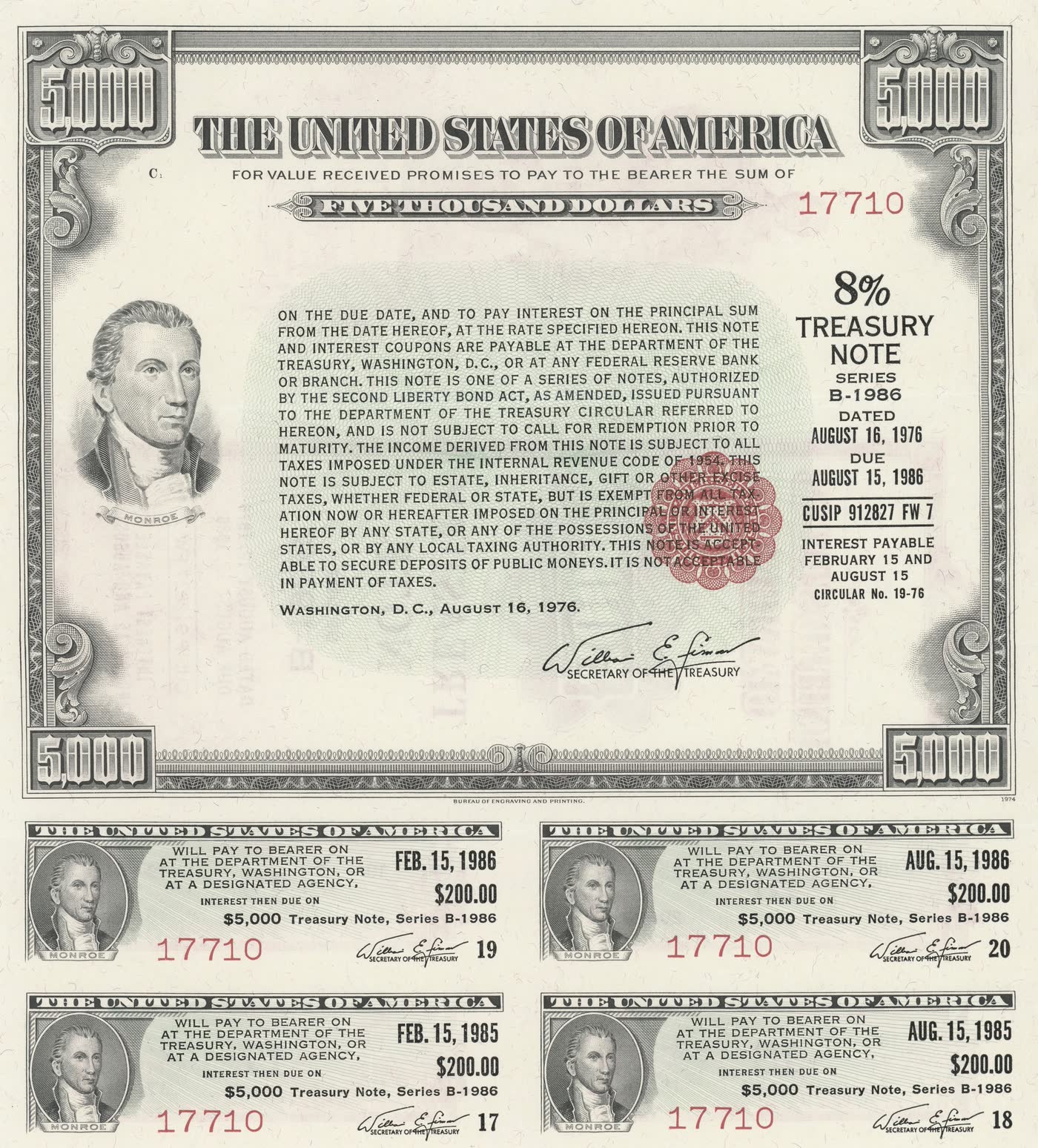
Priced: Treasury's June 11 reopening of a 30-year bond cleared at 99.683378, or $996.83 per $1,000 of face amount—below par. New: the buyer still needed $1,001.05 at settlement because $4.21196 of accrued interest was added, not because of a hidden fee or a premium valuation.[1][2]
That distinction is small in dollars and large in interpretation. The auction yield was slightly above the bond's coupon, so the security itself priced below par. But a reopening gives the new buyer the existing bond's full next coupon. Treasury therefore collects the interest that had already accumulated before the buyer took ownership. Clean price is the accrual-stripped valuation quote; settlement cash adds the earned coupon slice and answers how much money had to be ready on issue day.
This is an explanation of one Treasury auction, not individualized investment, tax, or accounting advice. A broker's confirmation, fees, settlement convention, and secondary-market display can differ from a TreasuryDirect auction record.
One security, three amounts
The worked security is CUSIP 912810UU0, the 5% Treasury bond due May 15, 2056. It was first issued and dated May 15, 2026, then reopened at auction on June 11 for settlement on June 15. The reopened tranche kept the original bond's CUSIP, coupon, maturity, and May/November payment schedule.[1][2][6]
Treasury's result published three numbers that belong in separate ledgers:
- Clean price: 99.683378 per $100 of face amount, so $1,000 of face cost $996.833780 before accrued interest.
- Accrued interest: $4.21196 per $1,000 of face amount.
- Settlement cash: $996.833780 + $4.211960 = $1,001.045740, which rounds to $1,001.05.[1]
The result looks paradoxical only if “below par” is treated as a promise about the bank debit. It is not. Par is the principal Treasury promises at maturity. The auction price is quoted per $100 of that principal. Accrued interest is then added when the security has earned coupon interest before its new issue date.[3][4]
Why the clean price was below par
The bond pays a 5% annual coupon on face amount. The reopening's high yield was 5.020%. Treasury's pricing rule is intuitive: when auction yield exceeds the coupon rate, a fixed-rate note or bond prices below par; when yield is below the coupon, it prices above par.[1][3]
Here the yield-coupon gap was narrow, so the clean discount was narrow too: $1,000 minus $996.833780 equals $3.166220. That is the valuation signal. The market required a little more yield than the 5% coupon supplied, and the clean price fell enough to bridge the difference across the remaining life of the bond.
Accrued interest does not reverse that signal. It answers a different question: how much of the next coupon had the bond already earned before June 15?
The $4.21196 line, reconstructed
The annual 5% coupon produces a $25 semiannual payment on $1,000 of face amount. The relevant half-year runs from May 15 to November 15, a period of 184 calendar days. At the June 15 settlement, 31 of those days had elapsed.
accrued interest = $25 × 31 / 184 = $4.2119565… → $4.21196
That matches Treasury's published amount. The auction regulations use actual calendar days for this calculation and round accrued interest to five decimal places per $1,000 of par.[1][5]
The arithmetic also explains why the cash debit crossed par. The $4.21196 accrual was larger than the $3.16622 clean-price discount. Add the two ledgers and the settlement amount lands $1.04574 above $1,000, even though the bond itself was auctioned at a discount.
Accrued interest is prepaid coupon, not extra yield
TreasuryDirect says a reopening sells more of an existing security with the same CUSIP, maturity, and payment dates but a new issue date and usually a new price. When accrued interest is due, the buyer pays it in the purchase price and receives it back as part of the first regular coupon.[4][6]
For this bond, the next full coupon is $25 per $1,000 of face amount on the scheduled November 15 payment date. Economically, $4.21196 of that payment returns the interest prepaid at settlement; the remaining $20.78804 corresponds to the post-settlement portion of the coupon period. Calling the whole $25 “new income earned after purchase” would count the prepaid slice twice.
That does not make accrued interest irrelevant. The cash has to be funded on settlement day, and the buyer does not receive it back until the coupon payment. It is a real liquidity line. It is simply not evidence that the bond was valued above par.
The strongest counterweight: coupon plumbing is not the main risk
It would be a mistake to turn this $4.21 reconciliation into the investment thesis for a bond maturing in 2056. Accrued interest is mechanical and recoverable through the coupon schedule. The clean price remains exposed to market yields for almost three decades. A meaningful move in long rates can change market value by far more than the settlement accrual.
The right comparison depends on the question. To rank bonds by valuation, use clean price, yield, maturity, and cash-flow structure so that different positions inside a coupon period do not masquerade as relative value. To make sure an account is funded, use the total settlement amount. One lens is analytical; the other is operational.
The separation also prevents a common performance error. If a statement shows a large first coupon, subtract the accrued interest paid at purchase before treating the cash as holding-period income. Conversely, do not subtract that accrual from the clean price and call the bond cheaper. It sits outside that quote for a reason.
Falsifier
The “accrued interest, not premium” diagnosis fails if the official clean price itself is above 100. In that case the buyer is paying a genuine premium before accrued interest is added. It also fails operationally if the actual debit cannot be reconciled as face amount × (clean quote / 100) plus accrued interest scaled to that face amount; a remaining difference calls for a check of quantity, fees, settlement date, and the broker's convention rather than another bond-valuation story.
The June reopening did not break par arithmetic. It exposed two different meanings of price. The clean quote was $996.83, while the buyer owed $1,001.05 because a piece of the next coupon already belonged to the period before settlement. Read both lines and the apparent premium disappears.
Watchlist: the next three reconciliation points
- August 13, 2026 — new 30-year auction: Treasury will auction $25 billion of a new bond due August 15, 2056. Compare its yield with the coupon set at auction; that relationship will determine whether the clean price begins above or below par.[3][7]
- August 17, 2026 — issue and settlement: the bond is dated August 15 but issued two days later because the dated date falls on a weekend. Treasury's announcement says accrued interest for those two days will be determined at auction, a useful reminder that this line can appear even on an original issue rather than a reopening.[4][7]
- November 15 scheduled date / November 16, 2026 payment — first coupon for the worked bond: because November 15 is Sunday, Treasury's next-business-day rule moves payment to Monday without extra interest. Reconcile the full $25 coupon against the $4.21196 prepaid on June 15. The cash receipt is whole; the holding-period economics are not.[2][4][8]
Sources
- U.S. Department of the Treasury, “Treasury Auction Results: 29-Year 11-Month Bond” (June 11, 2026) — CUSIP, coupon, high yield, clean price, accrued interest, issue date, and maturity.
- U.S. Department of the Treasury, “Treasury Offering Announcement: 29-Year 11-Month 5% Bond Reopening” (June 4, 2026) — dated date, settlement date, coupon schedule, and reopening terms.
- TreasuryDirect, “Understanding Pricing and Interest Rates” — the relationship among note/bond coupon, auction yield, par, and price.
- TreasuryDirect, “Buying a Treasury Marketable Security” — auction payment, reopening mechanics, and the treatment of accrued interest in purchase price and the next coupon.
- U.S. Government Publishing Office, 31 CFR Part 356, Appendix B — official day-count, accrued-interest, rounding, and fixed-principal price formulas.
- TreasuryDirect, “Schedule of Auction Reopenings” — which Treasury securities reopen and which contract terms remain fixed across tranches.
- U.S. Department of the Treasury, “Treasury Offering Announcement: 30-Year Bond” (August 5, 2026) — August 13 auction, August 15 dated date, August 17 issue date, offering size, and pending accrued interest.
- Electronic Code of Federal Regulations, “31 CFR § 356.30 — When does the Treasury pay principal and interest on securities?” — next-business-day payment rule when a scheduled date is not a business day.
- Wikimedia Commons, “1976 $5000 8% Treasury Note” — archival photograph from the Joe I. Herbstman Memorial Collection of American Finance.