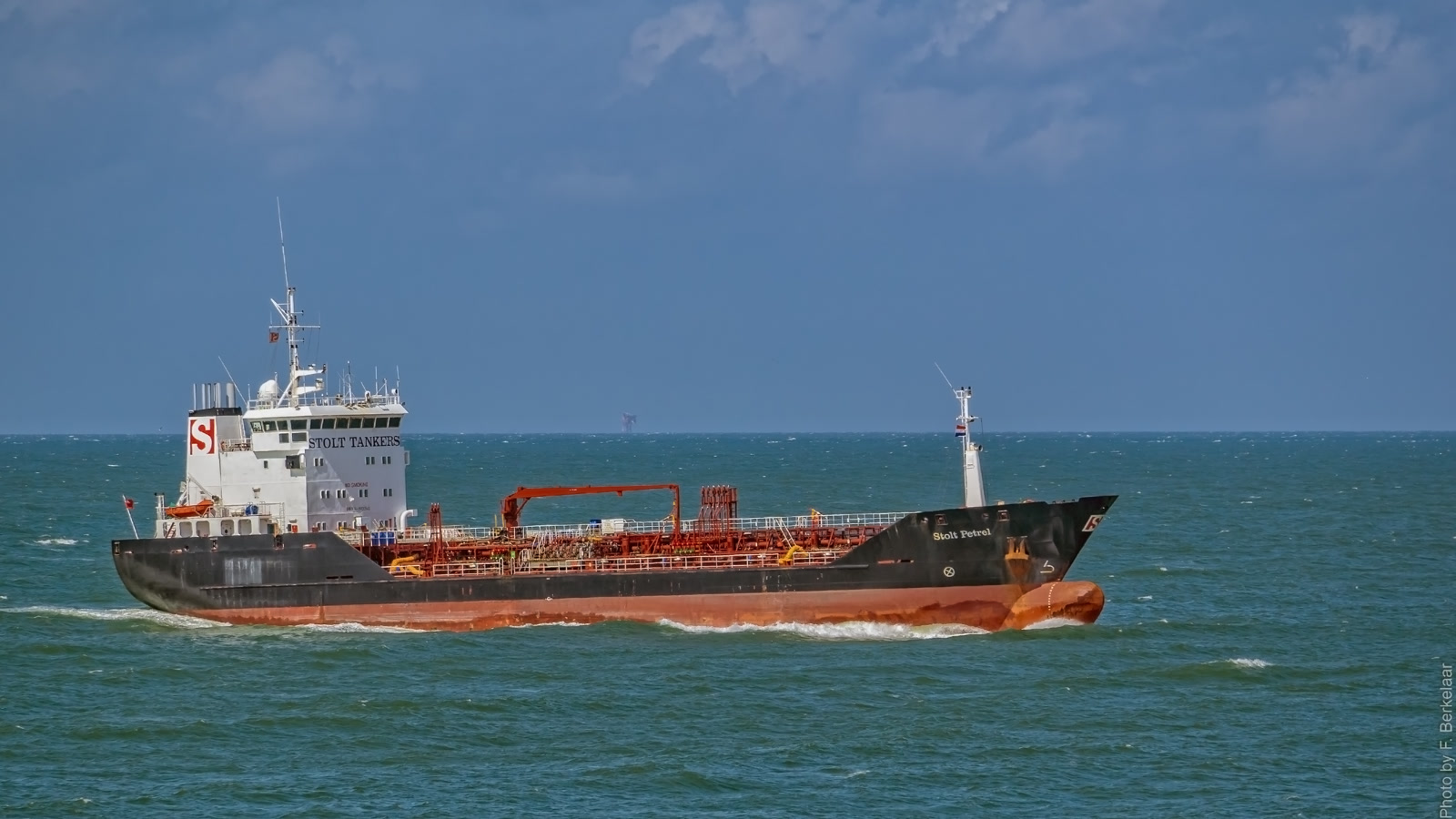
Stolt-Nielsen already gets credit for owning several links in the bulk-liquid chain rather than making a single bet on chemical-tanker freight. The new information in its second quarter is less comfortable: more activity reached the network, but the price and profit attached to that activity moved in three different directions.
Revenue rose to $750.3 million from $712.9 million a year earlier, yet adjusted EBITDA fell to $177.3 million from $210.1 million. Tanker yields weakened, terminal utilization reached a record-profit setting, and an acquisition made tank-container shipments look much stronger than the underlying business. This is not a broken diversification story. It is a quarter that shows exactly where diversification stops helping.[1]
One Top Line, Three Earnings Curves
The cleanest comparison is the quarter, not the first half. Stolt-Nielsen's first-half 2025 net profit included $75.2 million of one-off gains after additional share purchases in Avenir LNG and Hassel Shipping 4 triggered consolidation accounting, which makes the headline year-over-year profit decline look harsher than the operating change. On a Q2-to-Q2 basis, the picture is still soft enough: operating profit fell to $93.8 million from $113.7 million, and net profit fell to $51.7 million from $75.2 million.[1]
Sequentially, the group did produce more revenue than in Q1, but EBITDA slipped from $180.8 million to $177.3 million.[1][2] That combination matters. It says the problem was not a lack of things moving through ships, tanks, terminals, and depots. It was the earnings quality of the movement.
The three operating divisions make the bridge visible:
- Stolt Tankers carried more deep-sea volume but earned less per operating day.
- Stolthaven Terminals filled more capacity and nudged operating profit to a record.
- Stolt Tank Containers added Suttons shipments, but its underlying volumes and per-shipment margin remained weak.[1]
Tankers: More Cargo, Less Yield
Stolt Tankers is still the largest operating-profit contributor, so its rate cycle sets the group's center of gravity. Deep-sea volume increased 5.9% year over year in Q2, driven mainly by contract cargo. Deep-sea revenue nevertheless fell 4.5% because lower contract rates outweighed that extra volume. Average time-charter-equivalent revenue declined 10.9% to $23,372 per operating day, while the average bunker price consumed rose to $597 from $526 per tonne.[1]
That is the quarter's shortest causal chain: more cargo multiplied by a lower yield, followed by a higher voyage-cost input. Tanker operating profit fell to $52.5 million from $70.5 million even after $4.0 million of gains on three vessel disposals provided a cushion.[1]
There is an early counter-signal inside the weakness. The Q2 average TCE remained slightly below Q1's $23,627 per day, but management said monthly TCE improved through the quarter and expects stronger tanker rates in Q3.[1][2] Peer Odfjell had also described Middle East disruption as increasing tonne-miles and supporting rates in its May update, although absolute TCE figures are not directly comparable across the two fleets.[5] The rate turn may have begun; the reported quarter did not yet contain enough of it.
Terminals: The Quiet Hedge
Stolthaven supplied the cleanest earnings line. Average utilization at wholly owned terminals rose to 93.4% from 92.1%, revenue increased to $81.6 million from $79.1 million, and operating profit reached a record $29.1 million.[1] Storage rates, new business, and favorable currency movements all helped.
The physical model helps explain the stability. A terminal combines tanks, docks, pipes, rail links, handling systems, and compliance processes rather than offering a patch of empty ground. Stolthaven Houston, for example, lists 189 tanks, marine and rail connections, transloading, cleaning, and direct transfer capability; it also says another 460,000 barrels of capacity is due from mid-2026.[4] The quarter supports a bounded inference: revenue attached to those storage contracts reset less directly than voyage rates, because terminal rates and utilization rose while tanker TCE fell.[1][4]
But “record” should not be mistaken for high incremental conversion. Terminal operating profit increased by only $0.2 million year over year. Higher administrative and general expenses absorbed much of the revenue gain, while weaker Antwerp results and start-up costs at the new Taiwan joint venture reduced equity income.[1] The terminal hedge worked—it just could not offset the $18.0 million decline in tanker operating profit by itself.
Tank Containers: Acquisition Volume Is Not Organic Volume
Tank Containers produced the quarter's most important reconciliation. Revenue rose to $202.2 million from $164.7 million and shipments increased 21%, predominantly because Stolt-Nielsen bought Suttons in November 2025. That transaction added more than 11,000 ISO tank containers to the network.[1][3]
Strip out Suttons, however, and underlying shipment volume declined about 0.9%. The division reported a $0.3 million operating loss; excluding $4.0 million of Suttons integration costs, operating profit was $3.7 million, still far below $12.2 million a year earlier. Gross margin per shipment remained lower because competition was intense and demurrage and other ancillary revenue were weaker.[1]
There is real sequential progress. Q1's reported operating loss was $5.2 million, including $5.1 million of integration costs; by Q2 those figures had narrowed to $0.3 million and $4.0 million.[1][2] In Q2, cleaning and tank-rental expense rose with the larger fleet, repositioning costs were flat, and administrative expense increased as operations scaled.[1] The acquisition case will be proved by margin per shipment and network efficiency, not by the acquired shipment count.
The Best Case for Calling This a Transition Quarter
The strongest counterweight is that diversification did what it was supposed to do. Stable terminals, improving tank-container results, and stronger profit from the smaller businesses absorbed part of the tanker decline. Net debt was broadly unchanged at about $2.36 billion from the end of Q1 even after the final $1-per-share dividend and continued investment, and the company still had $399 million of undrawn committed revolving credit at quarter-end.[1]
The outlook also offers a plausible sequence for improvement. Management expects stronger tanker rates and an improving tank-container margin trend in Q3, while storage markets remain resilient. A safe reopening of the Strait of Hormuz could normalize trade flows and trigger inventory restocking; the preceding disruption may also encourage customers to diversify supply routes and storage locations.[1]
The bearish answer is that those benefits arrive on different clocks. Restocking may help tanker voyages and terminal throughput, but additional chemical-tanker capacity is due later in 2026 and through 2027. Suttons can add density, yet integration savings must outrun competitive pricing and the cost of a larger fleet. Terminals can stay nearly full while administrative and start-up costs consume the last turn of operating leverage.[1]
What Would Prove This Reading Too Cautious
The falsifier is a synchronized Q3 conversion rather than another quarter of offsets: tanker TCE rises materially above the Q2 average, Tank Containers closes most of its prior-year adjusted-profit gap as integration costs fall, and Terminals holds utilization near its current level without another step-up in overhead. If all three occur together, Q2 will look like a transition trough and the portfolio will again be compounding earnings, not merely cushioning declines.
The opposite combination would break the earnings-recovery case: monthly tanker rates lose their late-quarter momentum, underlying tank-container volumes stay negative after the acquisition effect is removed, and terminal revenue again fails to carry through to operating profit.
Two Dates That Matter
August 20 — Odfjell's first-half report. The closest listed peer will provide an external read on chemical-tanker rate direction, contract renewals, and the effect of Middle East disruption before Stolt-Nielsen reports again.[5][7]
October 1 — Stolt-Nielsen's Q3 report. Three lines deserve priority: TCE per operating day, Tank Containers' profit excluding Suttons integration costs, and Stolthaven utilization plus overhead. Also watch for evidence that the Houston capacity addition has begun contributing and whether Alex Ng's August 1 transition into the CFO role changes the capital-allocation framing.[1][4][6]
The quarter is neither a clean diversification win nor a collapse. Stolt-Nielsen moved more revenue through a broader system, but only the terminal business translated that activity into a record—and even there, cost growth kept the increment small. By October, improvement needs to arrive as rate and margin, not simply as another busy network.
Sources
- Stolt-Nielsen via Euronext, Second Quarter and First Half 2026 Earnings Release (July 9, 2026, with official report attachments) — group results, divisional bridges, balance-sheet liquidity, outlook, and CFO transition.
- Stolt-Nielsen via Euronext, First Quarter 2026 Earnings Release (April 9, 2026, with official report attachments) — sequential TCE, terminal profit, tank-container loss, and Suttons integration-cost baseline.
- Stolt-Nielsen via Euronext, "Stolt-Nielsen Limited Announces Completion of the Acquisition of Suttons International Holdings Limited" (November 5, 2025) — acquisition date, ownership, and the addition of more than 11,000 ISO tank containers.
- Stolthaven Terminals, "Stolthaven Houston" — tank count, terminal connections and services, operating characteristics, and the mid-2026 capacity addition.
- Odfjell, "Odfjell SE 1Q26 Results: Solid Operational Performance amid Market Uncertainty" (May 6, 2026) — peer commentary on tanker rates, tonne-mile disruption, and near-term expectations.
- Euronext, "Financial Events: Stolt-Nielsen" — financial calendar listing October 1, 2026 for third-quarter results.
- Odfjell, "Investors" — official financial calendar listing August 20, 2026 for the second-quarter and first-half report.
- Frans Berkelaar, "Chemical/Oil Products Tanker 'Stolt Petrel' — North Sea — Netherlands" — Wikimedia Commons source page for the real 2016 photograph; resized to 1600×900 for this article; CC BY 2.0.