Starbucks finally produced the number the market had been waiting for: traffic came back. In fiscal Q2 2026, global comparable store sales rose 6.2%, driven by a 3.8% increase in comparable transactions, while consolidated net revenue rose 9% to $9.5 billion and non-GAAP EPS reached $0.50.[1] That is enough to let management say the turnaround has crossed from promise into evidence.
The cleaner finance question sits one layer below that headline. Priced is that Starbucks can revive customer traffic through staffing, service, rewards, and menu work. New is whether the margin story is as strong as the EPS headline makes it look once investors separate North America's labor-heavy rebuild from the accounting boost created by the China handoff.[1][2][3]
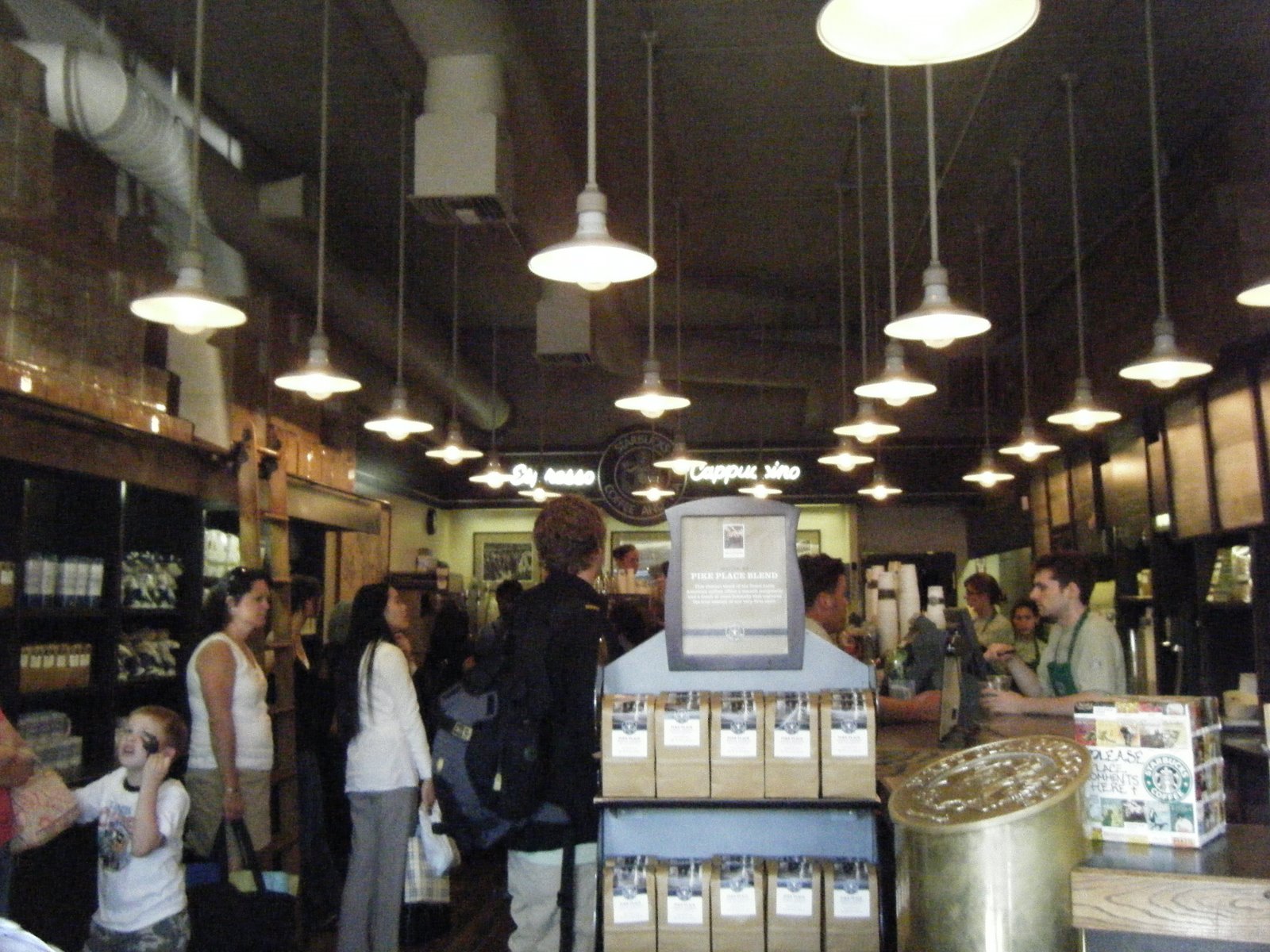
Image context: the cover uses a real interior photograph from Starbucks' Pike Place Market flagship in Seattle. That choice fits the article because the quarter's signal ran through coffeehouse throughput, partner stability, and counter-level service rather than through an abstract consumer-brand narrative.[5]
Priced vs new
The priced part is straightforward. Starbucks now has proof that the customer-facing pieces of "Back to Starbucks" are doing real work. Global comparable sales rose 6.2%. North America comparable sales rose 7.1%, with transactions up 4.4%. China also stayed positive on transactions, with comparable transactions up 2.1%, even though ticket fell 1.6%.[1] For a company whose core debate had drifted toward whether the coffeehouse model had lost its rhythm, that is a real turn.
The new part is that quality of earnings still needs sorting. North America generated $6.9 billion of revenue, up 7%, but operating income fell 9% and operating margin contracted 170 basis points to 9.9% because labor investments, product mix, tariffs, and elevated coffee costs absorbed much of the traffic benefit.[1] At the same time, International operating margin expanded 780 basis points to 19.4%, helped not only by sales leverage but also by lower operating and depreciation expense after Starbucks classified its China retail assets as held for sale.[1][2] That is why this quarter reads as an operating improvement and an accounting-transition quarter at the same time.
Why the traffic turn matters
It would be too easy to dismiss the sales recovery as a temporary promo bounce. The company's own operating details point to a deeper service reset. Starbucks said it has invested more than $500 million in partners, improved staffing and scheduling, and lifted labor stability enough that nearly 95% of partners are getting their preferred schedules while 98% of available shifts are filled.[4] The same update says turnover is now nearly half the industry average, roughly 80% of the highest-performing coffeehouses have a leader who has been in role for more than a year, and about 80% of U.S. company-operated coffeehouses are delivering cafe orders in four minutes or less.[4]
That matters because Starbucks is a throughput business before it is a slogan business. When order handoff becomes more reliable, transactions come back first. Ticket usually follows more slowly. That pattern is exactly what the quarter showed. Globally, comparable transactions rose faster than ticket. In China, transactions rose while ticket still declined. In North America, transactions and ticket both improved, but transactions still did the heavier lifting.[1] The shape of the recovery looks operational, not cosmetic.
Why the margin read is less clean than headline EPS
The margin picture is where investors still need discipline. Consolidated GAAP operating margin expanded 180 basis points to 8.7%, and management raised full-year non-GAAP EPS guidance to $2.25 to $2.45 while keeping global and U.S. comparable-sales growth at 5% or greater.[1] On the surface, that sounds like a clean turn from traffic to earnings.
Underneath, the segments do not tell the same story. North America, still the economic center of the company, showed that sales recovery alone is not yet enough to protect margin. The segment's revenue rose, but operating income fell from $748.3 million to $679.9 million and margin dropped from 11.6% to 9.9%.[1] Management explicitly tied that pressure to labor investments supporting "Back to Starbucks," product-mix changes, tariffs, and elevated coffee pricing.[1] That is not a broken result. It is a reminder that Starbucks is still paying for its recovery.
International looked much stronger, but some of that strength belongs to the reporting transition in China. Starbucks said the retail operations in China were classified as held for sale, which reduced store operating and depreciation expense and helped lift International margin.[1][2] The company also closed its transaction with Boyu Capital in April, leaving Boyu-managed funds with 60% of Starbucks China retail operations and Starbucks with 40%, with the new structure beginning to affect reported results in the third quarter.[1][3] So the next quarter matters more than this one for judging whether International margin strength is operationally durable or partly a one-time accounting bridge.
Six numeric anchors
- Traffic returned at scale: global comparable sales rose 6.2%, with transactions up 3.8% and ticket up 2.3%.[1]
- North America proved demand but not yet margin durability: revenue rose to $6.89 billion, but operating margin fell to 9.9% from 11.6%.[1]
- International margin jumped, but not all of it is clean run-rate economics: revenue rose to $2.05 billion and operating margin rose to 19.4% from 11.6%.[1]
- China remained a transaction story, not a pricing story: comparable sales rose 0.5%, transactions rose 2.1%, and ticket fell 1.6%.[1]
- The company still has scale to absorb experimentation: Starbucks ended the quarter with 41,129 stores globally, including 16,944 in the U.S. and 7,991 in China.[1]
- The labor rebuild is expensive but measurable: Starbucks says it has invested more than $500 million in partners, with nearly 95% preferred-schedule satisfaction and 98% of shifts filled.[4]
Those anchors point to a narrower conclusion than the headline might suggest. Starbucks did enough to prove that the turnaround has operating traction. It has not yet proved that all of the earnings improvement is recurring at the same quality.
Strongest counterweight
The strongest pushback is that this caution may over-discount real operating leverage that is only beginning to show up. Management argues the company has now reached the phase where top-line improvement can start translating into earnings growth.[1][3] The loyalty relaunch, the new store-level incentive structure, and partner retention data all point in the same direction: Starbucks may simply be in the early innings of a cleaner comp-and-margin recovery.[1][4]
That counterweight deserves respect. If service metrics keep improving while partner turnover stays contained, then the current North America margin drag may look like a deliberate investment hump rather than a persistent ceiling. The article's view is narrower. This quarter proved Starbucks can bring customers back. The next quarter has to prove that the most important segment can keep more of that benefit while China shifts into a new reporting structure.
Falsifier
This cautious read is wrong if the third quarter shows North America holding positive transaction growth while operating margin stabilizes or improves, and if the first quarter under the new China joint-venture structure does not create a material quality drop in International earnings or guidance.[1][2][3] If that happens, then this quarter will deserve to be read as the start of a cleaner earnings cycle rather than as a mixed quarter flattered by transition accounting.
Watchlist
- Q3 FY2026 results: this will be the first quarter in which the closed Boyu Capital transaction begins to affect reported results for Starbucks China retail operations.[1][3]
- North America operating margin: the core test is whether traffic gains can offset continued labor investment, tariffs, and elevated coffee costs after the initial turnaround push.[1][2]
- China transactions versus ticket: Q2 showed transactions ahead of ticket; the next read will show whether traffic can keep improving without leaning on discounting.[1]
- Full-year guidance integrity: Starbucks now guides to 5% or greater global and U.S. comparable-sales growth and $2.25 to $2.45 in non-GAAP EPS, so the next update will show whether the current quarter's margin bridge really carries forward.[1]
Takeaway
Starbucks delivered a better quarter than skeptics needed to see. Traffic came back, sales grew, and EPS improved. That is real progress.
The harder finance call now is about quality. North America still has to convert better traffic into sturdier margin, and International still has to prove that China-transition optics are not doing too much of the work. Until that happens, the stock's next rerating belongs less to the fact that customers returned and more to whether Starbucks can keep more of the economics once they do.
Sources
- Starbucks Investor Relations, "Starbucks Reports Q2 Fiscal Year 2026 Results" (April 28, 2026), including comparable-sales, segment-margin, guidance, store-count, and China-joint-venture disclosures.
- Starbucks Corporation, Form 10-Q for the quarter ended March 29, 2026, including discussion of held-for-sale accounting, restructuring, margin drivers, and transaction-related China costs.
- About Starbucks, "Starbucks Reports Q2 Fiscal Year 2026 Results" (April 28, 2026), including Brian Niccol's remarks on transaction-led growth and the Boyu Capital close.
- Mike Grams, "Starbucks investments in coffeehouse partners are paying off" (About Starbucks, April 29, 2026), including labor-investment, schedule-fill, retention, and speed-of-service metrics.
- Wikimedia Commons, "File:FirstStarbucks.jpg" - interior photograph of Starbucks' Pike Place Market flagship location in Seattle, uploaded by Liz525.