Planet Fitness closed at $54.20 on August 21, 52.6 percent below its 52-week high.[1] What is observably repriced: the equity itself after a reset 2026 outlook. What the drawdown does not resolve: whether the people who supply most of the system's physical capital can still earn enough to keep supplying it when the franchisor discloses estimated costs, but not realized franchisee cash returns or payback periods.[2][9]
The listed company looks asset-light because independent operators run roughly 90 percent of its clubs. Yet Planet Fitness also sells those operators equipment, specifies when it must be replaced, and depends on them to finance most new locations. The parent collects the recurring royalty; the franchisee funds the harder capital cycle.[2][3]
Evidence cutoff: August 23, 2026. Market values use the August 21 close; operating data run through June 30.
One brand, two capital cycles
At June 30, Planet Fitness reported approximately 21.5 million members and 2,930 clubs: 2,636 franchised and 294 corporate-owned.[2][3] That scale makes two economic loops easy to confuse.
The first is the parent-company loop. Membership dues flow to club operators. Franchisees then pay royalties and other fees to Planet Fitness, while the parent supplies brand marketing, systems and equipment. More clubs and more members enlarge the royalty base without requiring the parent to build most locations itself.
The second is the operator loop. Franchisees must find sites, build clubs, fund working capital, refresh facilities and buy specified equipment. Corporate revenue can therefore keep growing while the return on the capital underneath that revenue deteriorates. The royalty model transfers much of the construction risk; it does not abolish it.
The June quarter shows why the distinction matters. Same-club sales grew 1.7 percent, while membership was reported at approximately 21.5 million in both the March and June quarter-end releases. Management now expects roughly 1 percent same-club growth for 2026, down from its previous 4–5 percent range.[2][5] Franchise-segment revenue rose 13.5 percent, but $10.1 million of that increase came from a higher national advertising-fund contribution that was matched by advertising expense. Segment adjusted EBITDA rose a less dramatic 6.1 percent.[2] The headline revenue growth was real accounting revenue, but not equivalent economic lift.
The equipment floor is a second tollbooth
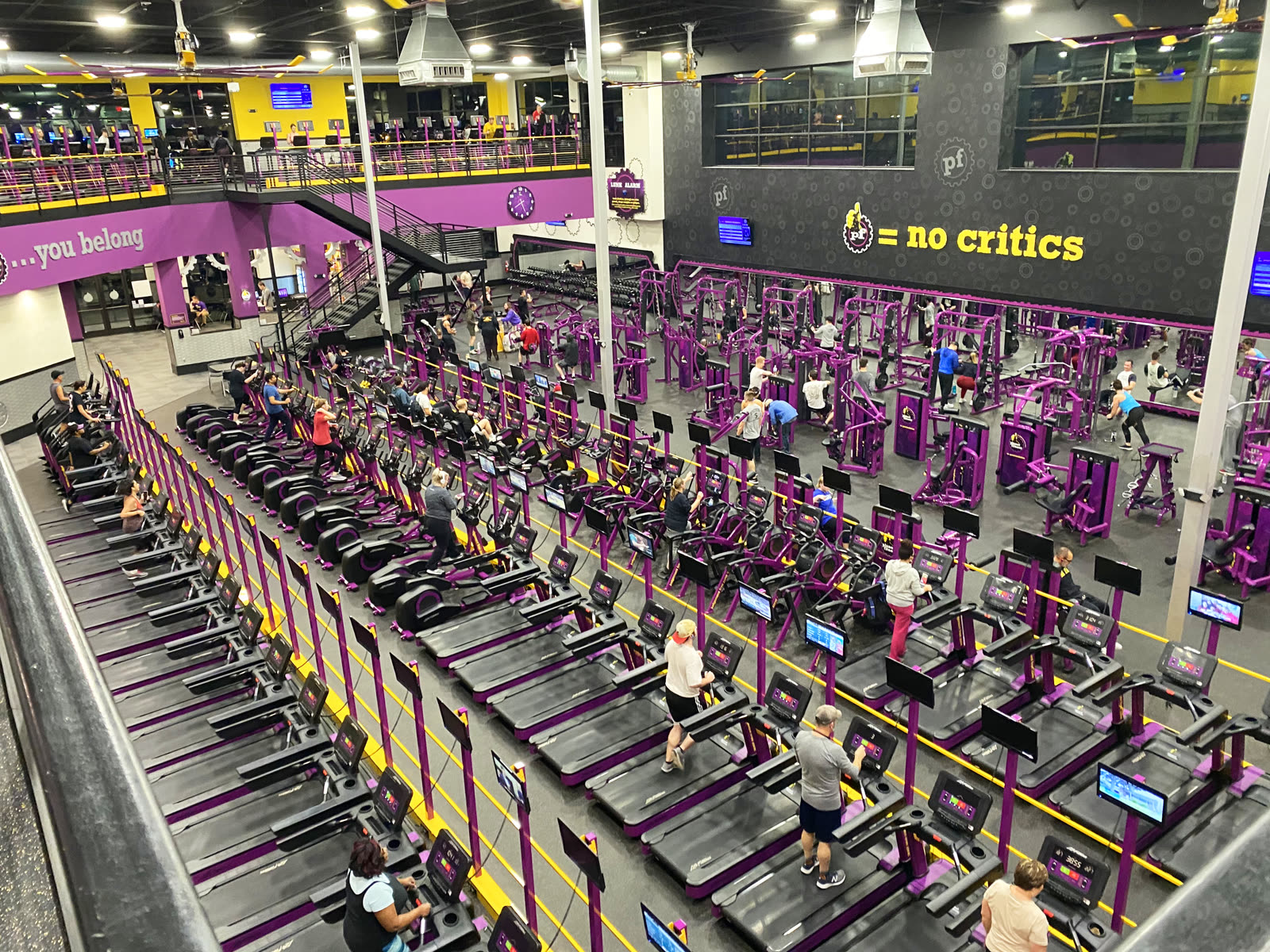
The standardized rows of machines are not only part of the customer proposition; they are a second transaction between Planet Fitness and its operators. Franchise agreements generally require equipment replacement every five to nine years, and equipment represented 23.4 percent of the parent's 2025 revenue.[4] That creates a recurring installed-base opportunity alongside royalties.
The FDD turns that cadence into a cash claim. It estimates $333,000–$995,000 to re-equip a club every five to nine years and $250,000–$1.2 million for a remodel every 12 years, although actual costs can vary.[9] The equipment component feeds the parent and its affiliate; both refresh obligations sit with the operator.
Replacement demand has recently done more work than new-club demand. In 2025, sales to existing franchise clubs supplied $47.4 million—about 88 percent—of the equipment segment's $54.0 million revenue increase.[4] During the first half of 2026, equipment revenue rose 34.2 percent to $147.7 million, again led by existing clubs.[3] But timing and economics are not interchangeable: second-quarter equipment revenue grew 4.1 percent while segment adjusted EBITDA fell 8.0 percent because discounts tied to replacement timing compressed profit.[2]
Management still expects 150–160 equipment placements and 180–190 new club openings this year.[2] Those targets are the operational bridge between the installed base and the parent company's growth algorithm. Because most clubs and almost all recent openings are franchised, they are predominantly a claim on franchisee balance sheets.[2][3]
Planet Fitness's own franchise inquiry form makes that capital intensity visible: an applicant proposing up to ten locations must show at least $33 million of non-borrowed liquid assets.[7] The May 2026 franchise disclosure document is more specific. It estimates $1.28–$3.77 million to open one club when equipment is financed and $2.39–$5.39 million when it is purchased. Those ranges include an initial lease deposit and typical leasehold improvements, but exclude most real-estate purchase or lease costs; the financed case also excludes interest, finance charges and debt service.[9]
That supplies a capital bracket, not a realized return. Item 19 reports 2025 electronic-funds-transfer revenue for 2,291 franchised clubs in the United States, including Puerto Rico, that operated all year; the middle third's median was $1.86 million.[9] But Planet Fitness says it does not receive complete franchisee expense information, so its full cost-and-profit table uses corporate clubs instead. That proxy shows roughly $2.0 million in average unit volume, a 42.7 percent four-wall adjusted EBITDA margin and a 35.3 percent margin after a royalty adjustment.[4][9] It excludes debt service, initial investment and reserves for future capital expenditure. An estimated build cost and a corporate margin still do not produce a franchisee cash-on-cash return or payback period.
The parent has a capital cycle too
The lower share price makes the parent easier to value, though not automatically cheap. Applying the August 21 close to the roughly 75.5 million economic shares represented by Class A stock and exchangeable holdings units at June 30 gives an equity value of about $4.1 billion. Add roughly $2.58 billion of face-value debt and subtract $471 million of unrestricted cash and securities, and a simplified enterprise value is about $6.2 billion.[1][3]
Planet Fitness earned $551.6 million of adjusted EBITDA and $3.07 of adjusted EPS in 2025.[4] Its 2026 guidance calls for both measures to grow about 6 percent.[2] On those guided figures, the shares screen at roughly 10.6 times enterprise value to adjusted EBITDA and 16.7 times adjusted EPS. These are author calculations, and the enterprise value deliberately excludes lease liabilities and other contractual claims; it is a comparison tool, not a liquidation value.
The EPS bridge deserves more scrutiny than the multiple. Management expects adjusted net income to fall about 3 percent even while adjusted EPS rises about 6 percent.[2] Most of that nine-percentage-point gap must come from a smaller share denominator. Planet Fitness repurchased $250 million of stock under its current program in the first half, and the 10-Q says proceeds from a $75 million variable-funding-note draw partially funded second-quarter repurchases.[3] That link matters because financial engineering is carrying part of per-share growth while operating expectations are falling.
Interest is already a meaningful fixed claim. Management guides to about $115 million of 2026 net interest expense, nearly 20 percent of guided adjusted EBITDA by the same author calculation.[2][4] And $923.4 million of securitized principal is scheduled for anticipated repayment in 2029, well before the notes' legal final maturities.[3][4] An asset-light income statement can coexist with a leveraged parent balance sheet.
What the reset does—and does not—buy
There is a credible counterweight to the caution. The valuation evidence is observable: a share price more than 50 percent below its high and a mid-teens guided earnings multiple.[1][2][4] The operating evidence is not only contractual. Franchisees opened 21 clubs in the June quarter; at quarter-end, the system had commitments for approximately 800 more. And at the end of 2025, roughly 98 percent of franchised clubs belonged to groups operating at least three locations.[2][3][4] None proves future returns, but it shows that capital is still being deployed through a largely multi-unit operator base. Buybacks at a depressed price can add value if operating cash flows recover before refinancing becomes the central issue.
Nor has the long-term ambition disappeared. At its 2025 investor day, Planet Fitness targeted mid-single-digit same-club sales growth, 6–7 percent annual unit growth and mid-teens adjusted EBITDA growth for 2026–2028.[6] The current-year guide—about 1 percent same-club sales and 6 percent adjusted EBITDA growth—shows how far the near-term starting point has slipped.[2]
That leaves a narrower thesis than “the stock has fallen enough.” The royalty-and-equipment model works if franchisees can finance growth and earn attractive returns after rent, labor, equipment, royalties and remodels. The FDD brackets the capital required; contractual club commitments show intent, while the liquidity screen shows the entry bar for new applicants. None proves current funding capacity or realized return.[3][7][9] Until Planet Fitness supplies franchisee-level profit, financing and maintenance-capex evidence, openings, placement volume and the corporate-club proxy are the best available signals.
Falsifier and dated watchlist
Falsifier: the franchise-capital thesis fails if full-year 2026 openings fall below 180 and equipment placements fall below 150 while same-club sales remain near 1 percent, and management attributes the shortfalls to franchisee financing, return hurdles or delayed operator spending. That combination would directly connect a broken growth loop to the external capital on which it depends.
- Quarter ending September 30, 2026: compare reported membership, same-club sales, openings and equipment profit—not only equipment revenue—when third-quarter results arrive.[2][3]
- Year ending December 31, 2026: test the 180–190 opening and 150–160 placement ranges alongside the roughly 1 percent same-club-sales and 6 percent adjusted-EBITDA outlook.[2]
- 2027–2028: look for an evidence-backed path back toward the investor-day unit and EBITDA growth ranges rather than treating those targets as a base case.[6]
- 2029: monitor the anticipated repayment and refinancing plan for $923.4 million of principal before it becomes a near-term constraint on buybacks or operating flexibility.[3][4]
Planet Fitness has already had a valuation reset. The next rerating depends less on how inexpensive the parent appears than on whether franchisees keep making the investments from which the parent earns its lightest returns.
Sources
- Planet Fitness investor relations, stock information — August 21, 2026 close and 52-week trading range.
- Planet Fitness, “Planet Fitness, Inc. Announces Second Quarter 2026 Results,” August 6, 2026 — members, clubs, segment results, capital returns and current guidance.
- Planet Fitness, Form 10-Q for the quarter ended June 30, 2026 — club mix, debt, liquidity, equipment sales, repurchases and anticipated repayment schedule.
- Planet Fitness, Form 10-K for the year ended December 31, 2025 — segment economics, equipment replacement cycle, debt and mature-club performance proxy.
- Planet Fitness, “Planet Fitness, Inc. Announces First Quarter 2026 Results,” May 7, 2026 — original and revised 2026 outlook.
- Planet Fitness, 2025 Investor Day release, November 13, 2025 — 2026–2028 growth targets.
- Planet Fitness official franchise inquiry form — current non-borrowed liquid-asset qualification for candidates proposing up to ten clubs.
- EEJCC, “Planet Fitness Cincinnati,” Wikimedia Commons — January 2020 documentary photograph used for the lead image.
- Planet Fitness Franchising LLC, Franchise Disclosure Document issued May 22, 2026 — Items 6–7 opening, re-equipment and remodel costs plus Item 19 franchise-revenue and corporate-cost disclosures; public filing mirror.